3 kW vs 5 kW Solar System
Introduction
Choosing between a 3 kW and a 5 kW solar system depends on household electricity consumption, available rooftop space, installation budget and the number of electrical appliances used daily. Both systems can reduce dependence on grid electricity by generating power from sunlight. However, their electricity generation capacities are different. A 3 kW solar system is generally suitable for households with moderate electricity consumption, while a 5 kW solar system is better suited to homes with higher electricity requirements, multiple air conditioners and several other electrical appliances.
A 3 kW solar system can be sufficient for many families using lights, fans, refrigerators, televisions and other everyday appliances. A 5 kW system provides greater generation capacity and can support higher electricity consumption when properly designed. However, selecting a larger solar system does not automatically guarantee greater savings. Homeowners should consider their monthly electricity bills, daytime power consumption, inverter capacity, battery requirements and local electricity connection rules before making a decision.
Quick Comparison Table
| Feature | 3 kW Solar System | 5 kW Solar System |
|---|---|---|
| System Capacity | 3,000 watts | 5,000 watts |
| Daily Generation | Approximately 9–15 units | Approximately 15–25 units |
| Monthly Generation | Approximately 270–450 units | Approximately 450–750 units |
| Rooftop Space | Around 180–240 sq. ft. | Around 300–400 sq. ft. |
| Solar Panels | Fewer panels | More panels |
| Initial Investment | Lower | Higher |
| Electricity Bill Savings | Moderate to high | Higher potential savings |
| Household Usage | Moderate consumption | Higher consumption |
| AC Support | Limited to moderate | Better suited to multiple loads |
| Battery Requirements | Smaller backup requirements | Greater backup potential |
| Installation | Comparatively simpler | Requires more panels and equipment |
| Best For | Medium-sized households | Larger households |
These are indicative estimates. Actual generation and space requirements depend on panel wattage, location, weather, shading, installation layout and system losses.
1. Solar System Capacity
3 kW Solar System
A 3 kW solar system has an installed solar panel capacity of 3,000 watts. It is commonly suitable for households with moderate electricity consumption.
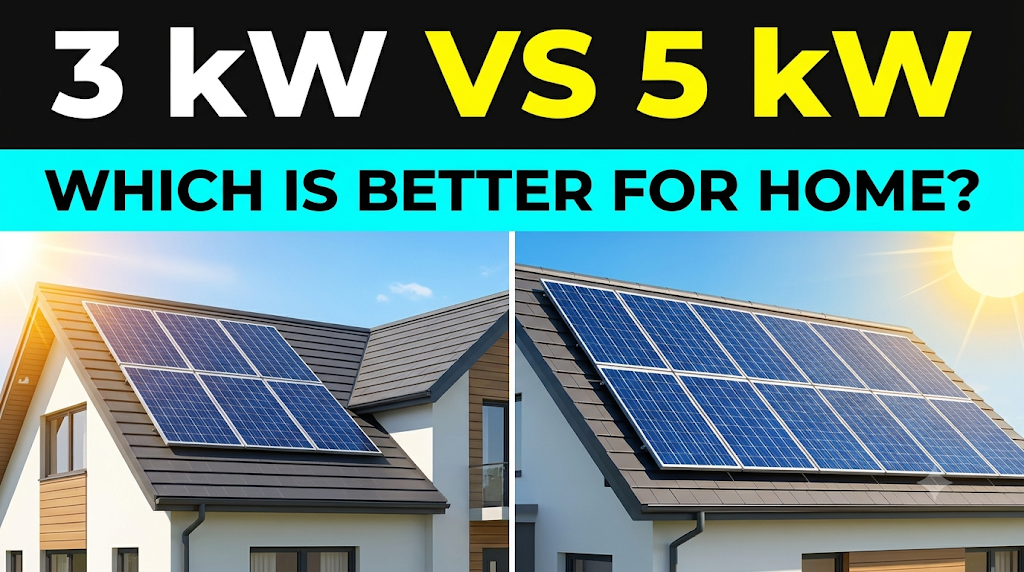
Depending on the panel wattage, it may require approximately six 500-watt solar panels.
This system can be a practical option for families looking to reduce electricity bills without investing in a larger installation.
5 kW Solar System
A 5 kW solar system has an installed capacity of 5,000 watts. It provides considerably more solar generation potential than a 3 kW installation.
Using 500-watt panels, it would require approximately ten solar panels.
It is generally more suitable for larger homes, families with higher electricity consumption and properties using several electrical appliances.
Winner: 5 kW Solar System for households requiring greater electricity generation capacity.
2. Daily Electricity Generation
Daily electricity generation is one of the biggest differences between these systems.
A 3 kW solar system may generate approximately 9–15 units per day under favourable conditions.
A 5 kW solar system may generate approximately 15–25 units per day under comparable conditions.
Actual output depends on sunlight availability, panel orientation, shading, temperature, inverter efficiency and seasonal weather.
Winner: 5 kW Solar System because it has a higher installed capacity and greater electricity generation potential.
3. Monthly Electricity Generation
A 3 kW solar system may generate approximately 270–450 units per month, depending on the installation location and weather conditions.
A 5 kW solar system may generate approximately 450–750 units per month under comparable conditions.
For example, a household consuming around 500 units per month may find a 5 kW installation more suitable, depending on its daytime electricity usage and grid-export arrangements.
Winner: 5 kW Solar System for households with higher monthly electricity consumption.
4. Rooftop Space Requirement
A 3 kW solar system generally requires approximately 180–240 square feet of usable rooftop space.
A 5 kW solar system may require approximately 300–400 square feet, depending on the panel dimensions and mounting arrangement.
Additional space may be necessary for panel spacing, maintenance access and avoiding shadows from nearby buildings or trees.
Winner: 3 kW Solar System for homes with limited rooftop space.
5. Number of Solar Panels
The number of panels depends on the wattage of the selected solar modules.
For example, if each panel has a capacity of 500 watts:
- 3 kW system: Approximately 6 panels.
- 5 kW system: Approximately 10 panels.
If lower-wattage panels are used, the number of panels will increase.
The final panel count should also be compatible with the inverter’s voltage, current and string configuration requirements.
Winner: 3 kW Solar System for installations requiring fewer panels and less mounting equipment.
6. Initial Installation Cost
A 3 kW solar system generally has a lower initial installation cost because it requires fewer panels, a smaller inverter and less mounting material.
A 5 kW solar system costs more because its installed capacity is higher and it requires additional equipment and installation work.
However, larger systems can sometimes have a lower cost per installed kilowatt because some installation expenses are shared.
The total price depends on panel technology, inverter type, mounting structure, batteries, installation charges and applicable government subsidies.
Winner: 3 kW Solar System for buyers with a smaller initial budget.
7. Electricity Bill Savings
A 3 kW solar system can significantly reduce electricity bills for households with moderate consumption, especially when solar generation is used directly during daylight hours.
A 5 kW system can provide greater potential savings for households that consume more electricity.
For example, a home using 450–600 units per month may benefit from a 5 kW system if its generation, consumption pattern and electricity export arrangements are suitable.
However, savings depend on electricity tariffs, self-consumption, fixed charges, net metering rules and actual solar production.
Winner: 5 kW Solar System for households with higher electricity consumption and sufficient solar utilisation.
8. Running Air Conditioners and Other Appliances
3 kW Solar System
A 3 kW solar system can support a combination of household appliances such as:
- LED lights
- Ceiling fans
- Refrigerator
- Television
- Washing machine
- Computers
- Certain air conditioners, depending on their power consumption
However, running multiple heavy appliances simultaneously may exceed the inverter’s available output.
5 kW Solar System
A 5 kW solar system provides greater power-generation capacity and can support a larger combination of appliances, such as:
- Multiple air conditioners
- Refrigerators
- Washing machines
- Ceiling fans
- LED lights
- Televisions
- Computers
- Other compatible household appliances
The actual number of appliances that can operate simultaneously depends on the inverter’s rated output, starting current, solar availability and grid or battery configuration.
Winner: 5 kW Solar System for homes with several electrical appliances.
9. Battery Backup and Off-Grid Applications
A 3 kW solar system can be configured with a compatible hybrid or off-grid inverter and battery bank to provide backup for household appliances.
A 5 kW solar system can support a larger backup arrangement when paired with an appropriately rated inverter and sufficient battery capacity.
However, solar panel capacity and battery storage capacity are two different things. A larger solar system does not automatically provide longer backup.
Backup duration depends on battery capacity, usable battery energy, inverter efficiency and the connected electrical load.
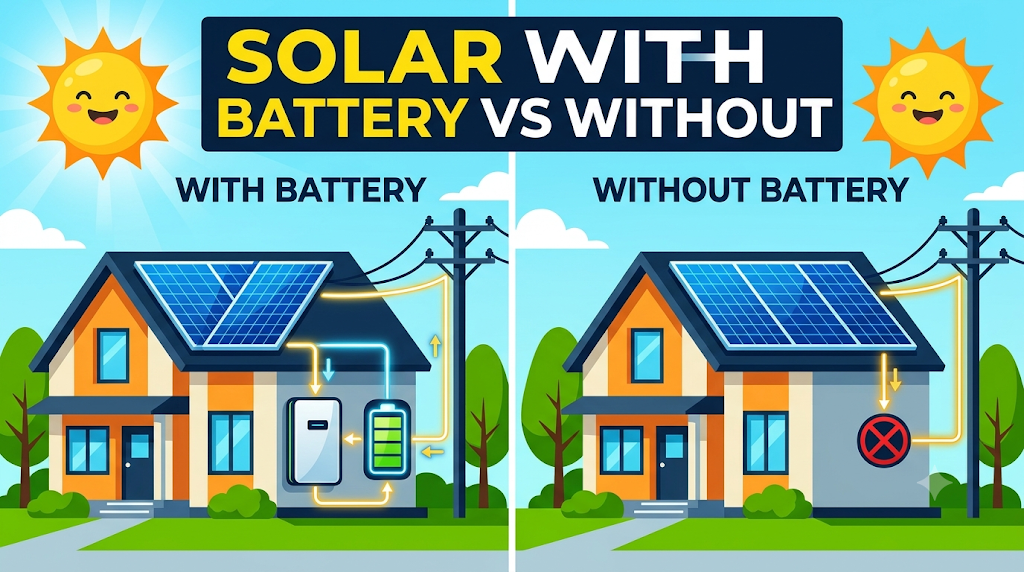
Grid-connected solar systems without suitable backup functionality generally do not provide electricity during a grid outage.
Winner: 5 kW Solar System for greater generation capacity and the potential to support larger battery arrangements.
10. Which Solar System Is Better for Home Use?
A 3 kW solar system is generally suitable for families with moderate electricity consumption and a smaller installation budget.
A 5 kW solar system is more suitable for larger households with higher monthly electricity consumption, multiple air conditioners and other heavy electrical appliances.
For example:
- A home consuming approximately 250–350 units per month may consider a 3 kW system.
- A home consuming approximately 450–600 units per month may consider a 5 kW system.
These figures are indicative starting points rather than fixed recommendations. Actual system sizing should account for seasonal consumption, daytime usage and electricity export arrangements.
Homeowners should also check whether their existing electricity connection supports the proposed solar capacity. In some locations, a three-phase connection or an approved load enhancement may be necessary.
Advantages and Disadvantages
3 kW Solar System
Advantages
- Lower initial installation cost.
- Requires less rooftop space.
- Needs fewer solar panels.
- Suitable for many medium-sized households.
- Can reduce electricity bills considerably.
- Smaller inverter capacity may be sufficient for moderate loads.
Disadvantages
- Lower electricity generation capacity.
- Less suitable for homes with high electricity consumption.
- Limited capacity for running several heavy appliances simultaneously.
- Lower potential solar savings for high-consumption households.
- May require an upgrade if electricity requirements increase.
5 kW Solar System
Advantages
- Higher electricity generation capacity.
- Greater potential electricity bill savings.
- Suitable for larger households.
- Better suited to homes using multiple appliances and air conditioners.
- More flexibility for future electricity requirements.
- Can support larger battery arrangements with compatible equipment.
Disadvantages
- Higher initial installation cost.
- Requires more rooftop space.
- Needs additional solar panels.
- Requires a suitably rated inverter and electrical connection.
- May generate excess electricity if household consumption is low.
Frequently Asked Questions (FAQs)
1. How many units does a 3 kW solar system generate per day?
A 3 kW solar system may generate approximately 9–15 units per day under favourable conditions. Actual production varies by location, season and installation quality.
2. How many units does a 5 kW solar system generate per day?
A 5 kW solar system may generate approximately 15–25 units per day under favourable conditions.
3. How much rooftop space is required for a 5 kW solar system?
A 5 kW system may require approximately 300–400 square feet of usable rooftop space, depending on the solar panel dimensions and installation arrangement.
4. Can a 3 kW solar system run two air conditioners?
It may support two efficient air conditioners under suitable operating conditions, but the combined electrical consumption and inverter capacity must be checked. Running both alongside other heavy appliances may exceed its capacity.
5. Can a 5 kW solar system run three air conditioners?
It may support three compatible air conditioners under suitable conditions, but this depends on their individual power consumption, inverter output, starting current and other connected loads.
6. Is a 5 kW solar system enough for a large house?
It can be sufficient for many large homes with moderate or relatively high electricity consumption. Homes with several air conditioners, geysers and other heavy appliances may require a larger system.
7. Is a 5 kW solar system more economical than a 3 kW system?
A 5 kW system costs more initially but can provide a lower cost per installed kilowatt in some installations. Its overall economic value depends on electricity savings, subsidies, self-consumption and installation costs.
8. Can I upgrade a 3 kW solar system to 5 kW later?
Yes, in some cases. However, the existing inverter, panel configuration, wiring, mounting structure and electricity connection must support the additional capacity. An inverter replacement or other upgrades may be required.
Conclusion
A 3 kW solar system is a practical choice for households with moderate electricity consumption, limited rooftop space and a smaller installation budget. A 5 kW solar system is generally better for larger homes with higher electricity requirements, multiple air conditioners and greater daytime energy consumption. Although the 5 kW option costs more initially, it offers higher generation capacity and greater potential electricity bill savings. Before purchasing, compare your actual monthly electricity consumption, available rooftop space, inverter requirements and local electricity connection rules.
Disclaimer
Solar panel prices, installation costs, electricity generation, government subsidy eligibility and net metering regulations may change over time and vary by location. Daily and monthly electricity generation figures are estimates and are not guaranteed. Always verify current technical specifications and applicable electricity distribution company requirements before purchasing or installing a solar system.