Fiber Internet vs Broadband
Introduction
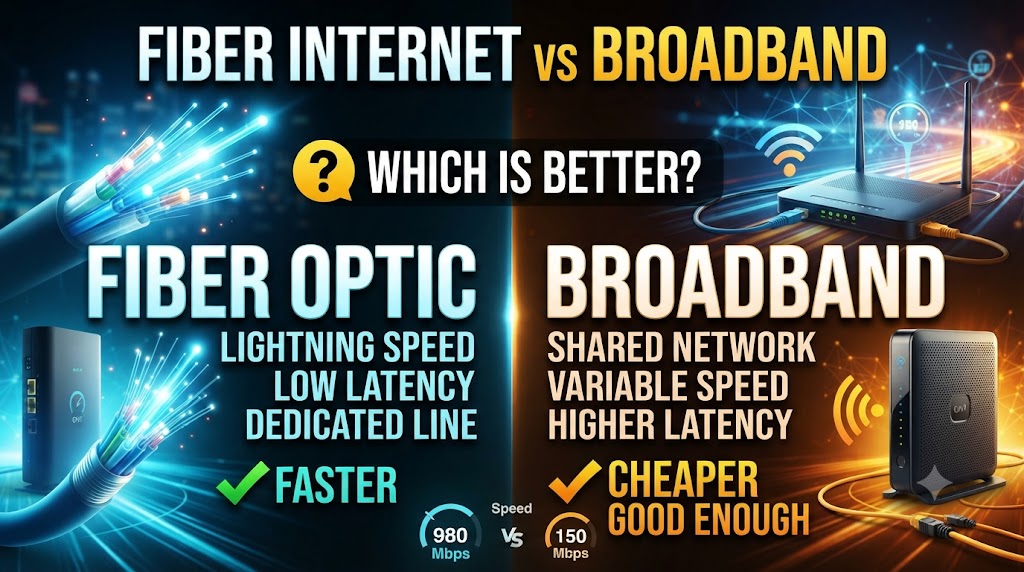
Fiber Internet and Broadband are both used to provide internet access, but the terms do not describe exactly the same thing. Fiber Internet uses fiber-optic cables to transmit data using light, while “broadband” is a broader term for high-speed internet access that can be delivered through different technologies, including cable, DSL, fiber, fixed wireless, and other connections. This makes the comparison slightly different from comparing two completely separate technologies.
For many users, the important differences are connection technology, speed, latency, reliability, upload performance, and availability. Fiber Internet can provide high speeds and strong upload performance, but its availability depends on local infrastructure. Other broadband technologies may be easier to access in areas where fiber has not yet been deployed. The right choice therefore depends on what technology is actually available at your location and how you use the internet.
Quick Comparison Table
| Feature | Fiber Internet | Other Broadband Connections |
|---|---|---|
| Technology | Fiber-optic cable | DSL, cable, fixed wireless, and other technologies |
| Data Transmission | Light through optical fiber | Depends on the technology |
| Download Speed | Can be very high | Varies widely |
| Upload Speed | Often high | Varies widely |
| Latency | Generally low | Varies by technology and network |
| Reliability | Generally strong | Depends on connection type and infrastructure |
| Interference | Low susceptibility to electromagnetic interference | Depends on technology |
| Availability | Depends on fiber deployment | Often varies by technology |
| Best Use | High-speed internet, streaming, uploads, gaming, heavy usage | General internet access where available |
What Is Fiber Internet?
Fiber Internet uses fiber-optic cables to transmit data as pulses of light. Fiber cables can carry large amounts of data over long distances with relatively low signal loss.
Fiber connections can use different network architectures, such as:
- FTTH (Fiber to the Home)
- FTTP (Fiber to the Premises)
- Other fiber-based access networks
The exact equipment and connection design can vary between internet providers.
How Does Fiber Internet Work?
A simplified connection looks like this:
ISP network → Fiber-optic cable → ONT/ONU → Router → Your devices
The optical network terminal or optical network unit converts the optical signal into a form that the local network equipment can use.
What Is Broadband?
Broadband is a general term for high-speed internet access rather than one specific cable technology.
Broadband services can use technologies such as:
- Fiber
- Cable
- DSL
- Fixed wireless
- Other access technologies
This means fiber internet itself can be considered a type of broadband internet.
Why Is This Important?
When someone compares Fiber Internet vs Broadband, they are often actually comparing fiber internet with another type of broadband connection, such as DSL, cable, or fixed wireless.
Therefore, the actual performance depends on which broadband technology is being compared with fiber.
Fiber Internet vs Broadband: Main Differences
1. Connection Technology
Fiber Internet uses optical fiber to transmit data.
Other broadband technologies can use copper telephone lines, coaxial cable, wireless links, or other infrastructure.
Practical meaning: The physical technology behind the connection can have a major effect on speed, latency, reliability, and upload performance.
2. Download Speed
Fiber networks can support very high download speeds, depending on the provider’s network and service plan.
Other broadband connections can also offer high download speeds, but their capabilities vary significantly.
Practical meaning: You should compare the actual speed plan rather than assuming that every broadband connection is slow.
3. Upload Speed
Fiber connections can provide strong upload performance, and some fiber services offer similar download and upload speeds.
Other broadband technologies may have lower upload speeds than their download speeds, although this varies by technology and provider.
Practical meaning: Fiber can be particularly useful for users who frequently upload large files, create video content, use cloud services, or participate in video conferencing.
4. Latency
Fiber connections generally offer low latency, although actual latency depends on the ISP’s network, routing, congestion, and destination server.
Other broadband technologies can also provide good latency, but performance varies considerably.
Practical meaning: For online gaming, video calls, and other interactive applications, actual latency and consistency can matter more than maximum download speed alone.
5. Reliability
Fiber-optic cables are not affected by electromagnetic interference in the same way as copper cables.
However, overall internet reliability depends on the entire network, including the ISP, power supply, local equipment, fiber infrastructure, and maintenance.
Practical meaning: Fiber has technical advantages, but no internet connection is completely immune to outages.
6. Availability
Fiber requires dedicated fiber infrastructure to reach the location.
In areas where fiber has not been deployed, another broadband technology may be the only practical option.
Practical meaning: Availability can be more important than theoretical performance when choosing an internet connection.
Fiber Internet vs Broadband: Which Is Better?
There is no universal answer because fiber is itself a type of broadband.
If the comparison is between fiber and a slower or more limited broadband technology, fiber may provide advantages in areas such as:
- Upload performance
- Maximum speed
- Latency
- Capacity for multiple connected devices
However, another broadband technology may be more suitable when fiber is unavailable or when the available service already meets your requirements.
Fiber Internet May Be More Suitable If You:
- Upload large files frequently
- Stream high-resolution video
- Work from home
- Use cloud applications heavily
- Have many connected devices
- Play online games
- Need high upload performance
Other Broadband May Be Suitable If You:
- Have no fiber coverage
- Mainly browse websites and use social media
- Use moderate amounts of data
- Already receive sufficient speed and reliability
- Want to use existing local infrastructure
Fiber Internet vs Broadband for Gaming
For gaming, the maximum download speed is not the only important factor.
Latency, connection stability, packet loss, and routing can have a greater impact on the gaming experience.
Fiber can offer low latency and strong capacity, but the actual gaming experience also depends on the ISP and the game server.
Practical meaning: Don’t choose an internet connection based only on its advertised download speed.
Fiber Internet vs Broadband for Streaming
For streaming video, both fiber and other broadband technologies can work well when they provide enough bandwidth for the desired video quality.
Fiber can offer substantial capacity, which can be useful when several people are streaming simultaneously.
However, the required speed depends on the number of users, streaming quality, and other network activity.
Fiber Internet vs Broadband for Work From Home
Fiber can be useful for work-from-home users who regularly attend video meetings, upload files, access cloud services, and use remote systems.
However, a good cable, DSL, or wireless broadband connection can also support remote work if it provides adequate speed, latency, and reliability.
Practical meaning: For work from home, look at both download and upload performance rather than focusing only on the advertised download speed.
Fiber Internet vs Broadband: Key Takeaway
The most important point is that fiber internet is a type of broadband.
So, instead of thinking:
Fiber vs Broadband
it is often more useful to think:
Fiber vs Cable Broadband
Fiber vs DSL Broadband
Fiber vs Fixed Wireless Broadband
This makes the comparison more precise because each technology has different characteristics.
Conclusion
Fiber Internet uses fiber-optic cables to transmit data and can provide high speeds, strong upload performance, and low latency. Broadband, on the other hand, is a broader category that includes multiple internet-access technologies, including fiber.
If fiber is available and you need high performance for activities such as heavy uploads, cloud work, gaming, streaming, or multiple connected devices, its capabilities can make it an attractive option. However, another broadband technology may be completely adequate for lighter usage or may be the practical choice where fiber is unavailable.
Ultimately, compare the actual technology, speed, upload performance, latency, reliability, price, and availability of the plans offered at your location.
Disclaimer
Internet performance varies by ISP, technology, service plan, network congestion, infrastructure, and location. Advertised speeds may differ from real-world performance. Fiber availability and broadband technologies also vary by area, so check the specific plans and network conditions available at your location before choosing a connection.