Smart Thermostat vs Normal Thermostat
Introduction
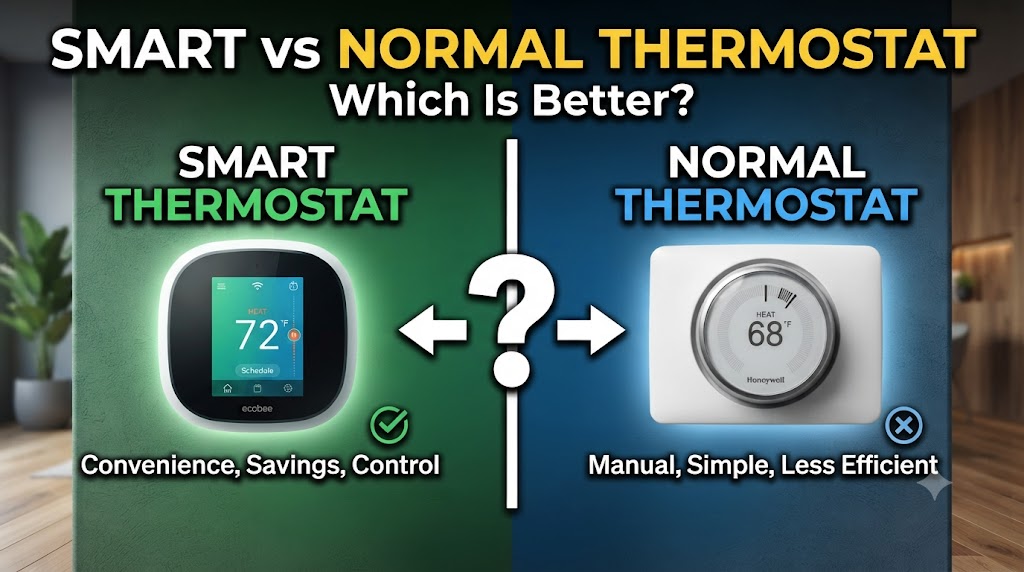
A thermostat controls the temperature of a heating or cooling system, but different thermostat technologies provide different levels of control. A normal thermostat generally allows users to set a desired temperature manually, while a smart thermostat can add features such as scheduling, smartphone control, learning functions, remote monitoring, and integration with compatible smart-home systems. The exact features vary between models and heating or cooling systems.
Choosing between a smart thermostat and a normal thermostat depends on your comfort preferences, HVAC compatibility, installation requirements, and how much automation you want. A normal thermostat can provide straightforward temperature control without requiring an internet connection, while a smart thermostat can offer more flexible control and automation. Let’s compare both options in detail.
Quick Comparison Table
| Feature | Smart Thermostat | Normal Thermostat |
|---|---|---|
| Temperature Control | Yes | Yes |
| Programmable Schedule | Usually available | Available on programmable models |
| Smartphone Control | Available on connected models | No |
| Remote Monitoring | Available on connected models | No |
| Automatic Learning | Available on some models | Usually no |
| Smart-Home Integration | Available on compatible models | Usually no |
| Wi-Fi Requirement | Often required for smart features | No |
| Installation | Can be more complex | Usually simpler |
| Power Requirement | Depends on model and system | Depends on model |
| Maintenance | Software and hardware maintenance | Generally simpler |
| Automation | More advanced | Basic to moderate |
| Best For | Connected control and automation | Simple temperature control |
Smart Thermostat vs Normal Thermostat: How Do They Work?
Smart Thermostat
A smart thermostat controls the connected heating or cooling system while adding digital and connected features.
Depending on the model, it may connect to Wi-Fi and communicate with a smartphone app. Users may be able to change the temperature remotely, create schedules, receive information about the system, or integrate the thermostat with other compatible smart-home devices.
Some smart thermostats can also use sensors or learning features to adjust operation according to programmed settings or detected patterns.
Normal Thermostat
A normal thermostat provides basic temperature control. Depending on the type, the user may adjust the temperature manually or use a simple programmed schedule.
Traditional thermostats generally do not require internet connectivity or a smartphone application.
Smart Thermostat vs Normal Thermostat: Temperature Control
Tie for basic temperature control.
Both types can control the temperature of a compatible heating or cooling system.
The difference is mainly in how much control and automation they provide. A normal thermostat can be sufficient when you simply want to set and maintain a temperature.
A smart thermostat can provide additional ways to control the system, including smartphone apps and automated schedules on supported models.
Smart Thermostat vs Normal Thermostat: Smartphone Control
Smart Thermostat wins.
Many smart thermostats can connect to a smartphone app, allowing users to adjust settings without physically standing at the thermostat.
This can be useful if you want to change the temperature while you are in another room or away from home.
A normal thermostat generally requires manual adjustment at the thermostat itself.
Smart Thermostat vs Normal Thermostat: Scheduling
Depends on the normal thermostat.
Smart thermostats commonly support programmable schedules. Some models can provide more advanced scheduling options or automation.
Normal thermostats can also be programmable. However, basic models may only provide manual temperature adjustment.
Therefore, the difference depends on the specific normal thermostat being compared.
Smart Thermostat vs Normal Thermostat: Remote Access
Smart Thermostat wins.
A connected smart thermostat can allow remote temperature adjustments through a compatible app.
For example, you may be able to change the temperature before returning home or check the thermostat’s status while away.
A normal thermostat does not normally provide internet-based remote access.
Smart Thermostat vs Normal Thermostat: Automation
Smart Thermostat wins.
Smart thermostats can provide more automation than basic thermostats. Depending on the model, automation may include programmed schedules, sensor-based adjustments, geofencing, or integration with other smart-home devices.
Normal thermostats generally focus on manual control or basic programmed schedules.
The level of automation varies considerably between smart thermostat models.
Smart Thermostat vs Normal Thermostat: Internet Requirement
Normal Thermostat wins for independence.
Many smart thermostats use Wi-Fi for smartphone control, remote access, cloud services, and other connected features.
Some smart functions may not be available when internet connectivity is lost.
A normal thermostat generally does not need an internet connection to perform its basic temperature-control function.
Smart Thermostat vs Normal Thermostat: Installation
Normal Thermostat is generally simpler.
A normal thermostat may have relatively straightforward installation when it is compatible with the existing heating or cooling system.
Smart thermostats can require additional compatibility checks. Some systems may also require specific wiring or a compatible power arrangement.
Before replacing a thermostat, it is important to check whether the new model is compatible with the HVAC system.
Smart Thermostat vs Normal Thermostat: Compatibility
Depends on the HVAC system.
Not every thermostat works with every heating and cooling system.
Smart thermostats may have specific wiring, power, system-type, or equipment requirements. Some models may require a common wire or another power solution.
Normal thermostats also have compatibility requirements, but their simpler designs may work with a wider range of conventional systems.
Always check the manufacturer’s compatibility information before installation.
Smart Thermostat vs Normal Thermostat: Energy Management
Depends on usage and features.
A smart thermostat can provide scheduling and automation features that may help users manage heating and cooling more efficiently.
However, simply installing a smart thermostat does not automatically guarantee energy savings. Actual results depend on the HVAC system, temperature settings, schedule, home insulation, climate, and how the thermostat is used.
A programmable normal thermostat can also help manage heating and cooling according to a schedule.
Smart Thermostat vs Normal Thermostat: Maintenance
Normal Thermostat is generally simpler.
A normal thermostat usually has fewer connected features and does not require app management or software-related maintenance.
A smart thermostat may require firmware updates, app updates, Wi-Fi troubleshooting, or other maintenance depending on the model.
Both types should still be kept clean and properly maintained according to the manufacturer’s instructions.
Smart Thermostat vs Normal Thermostat: Smart-Home Integration
Smart Thermostat wins.
Compatible smart thermostats can integrate with certain smart-home platforms and devices.
Depending on the ecosystem, users may be able to control the thermostat using a smartphone, voice assistant, automation routine, or other connected devices.
A normal thermostat generally does not offer this type of integration.
Smart Thermostat vs Normal Thermostat: Ease of Use
Depends on the user.
A normal thermostat can be easier for someone who wants straightforward manual temperature control.
A smart thermostat can provide more features, but those features may require initial setup, app configuration, Wi-Fi connectivity, and familiarity with smart-home controls.
Therefore, simplicity and functionality can lead to different preferences.
Smart Thermostat vs Normal Thermostat: Reliability
Depends on the system and model.
A normal thermostat has fewer connected components and does not normally depend on Wi-Fi or cloud services for basic operation.
A smart thermostat contains additional electronics and connected features. Network or software problems may affect some functions, although basic thermostat operation may continue depending on the model.
The reliability of either type ultimately depends on the specific thermostat, HVAC system, installation, and operating conditions.
Which Is Better for Your Home?
A smart thermostat may be suitable if you want:
- Smartphone temperature control
- Remote access
- Advanced scheduling
- Smart-home integration
- Automation features
- Additional connected controls
A normal thermostat may be suitable if you want:
- Simple temperature control
- No internet dependence
- Straightforward operation
- Fewer connected features
- Simpler maintenance
Smart Thermostat vs Normal Thermostat: Which Should You Choose?
| If You Want… | Better Fit |
|---|---|
| Basic temperature control | Normal Thermostat |
| Smartphone control | Smart Thermostat |
| Remote temperature adjustment | Smart Thermostat |
| Smart-home integration | Smart Thermostat |
| Advanced automation | Smart Thermostat |
| No internet dependence | Normal Thermostat |
| Simple operation | Normal Thermostat |
| Basic scheduled control | Either, depending on model |
| Minimal connected features | Normal Thermostat |
| Connected home control | Smart Thermostat |
Conclusion
Smart thermostats and normal thermostats can both control the temperature of a compatible heating or cooling system, but smart thermostats offer more connected features. Smartphone control, remote access, automation, scheduling, and smart-home integration can make a smart thermostat more flexible, while a normal thermostat can provide straightforward temperature control without relying on internet-connected features.
If you want simple and independent temperature control, a normal thermostat may be sufficient. If you want remote access, automation, and smart-home integration, a smart thermostat offers more functionality. Before choosing either option, check HVAC compatibility, wiring requirements, power requirements, and the features you actually need.
Disclaimer
This comparison is for general informational purposes. Thermostat features, compatibility, wiring requirements, power arrangements, smart-home support, and installation procedures vary by model and HVAC system. Energy savings also depend on system settings, usage, climate, and other conditions. Always check the manufacturer’s compatibility information and installation requirements before replacing or installing a thermostat.