Fiber Internet vs 5G Internet
Introduction
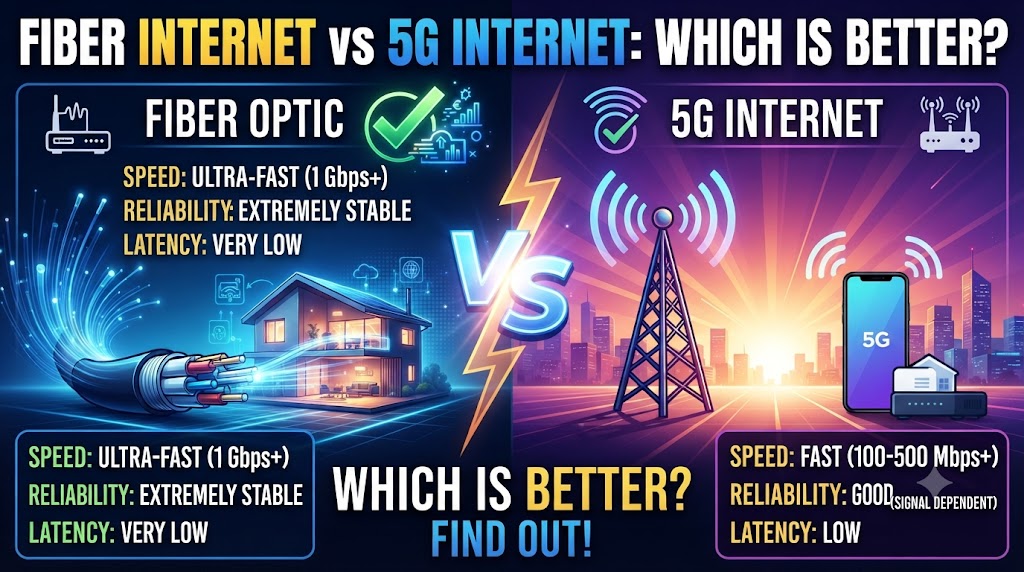
Fiber Internet and 5G Internet are two modern ways to access high-speed internet, but they use very different technologies. Fiber Internet sends data through fiber-optic cables, while 5G Internet uses fifth-generation cellular wireless networks. Both can provide fast internet, but their real-world performance depends on the service provider, network infrastructure, location, congestion, and the equipment being used.
The biggest difference is the connection between your home and the service provider. Fiber uses a physical cable, while 5G Internet connects wirelessly to a nearby 5G cellular network. Fiber can offer strong consistency, low latency, and high upload performance, while 5G can be easier to deploy in locations where wired infrastructure is limited. The better option depends on availability and how you use your internet connection.
Quick Comparison Table
| Feature | Fiber Internet | 5G Internet |
|---|---|---|
| Connection Type | Wired | Wireless |
| Main Technology | Fiber-optic cable | 5G cellular network |
| Download Speed | Very high, depending on plan | High, but varies by network |
| Upload Speed | Often high | Varies by provider and network |
| Latency | Generally low | Generally low, but can vary |
| Reliability | Generally consistent | Can vary with signal and congestion |
| Weather/Obstructions | Fiber itself is not affected like wireless signals | Physical obstacles and radio conditions can affect performance |
| Installation | Requires fiber infrastructure | Usually simpler where 5G coverage exists |
| Mobility | Fixed connection | Wireless access |
| Best For | High-performance fixed home internet | Wireless home internet and locations with suitable 5G coverage |
What Is Fiber Internet?
Fiber Internet uses fiber-optic cables to transmit data as pulses of light.
A typical home fiber connection may work like this:
ISP network → Fiber cable → ONT/ONU → Router → Devices
Fiber networks can provide very high bandwidth and low latency. The actual service depends on the ISP, network architecture, plan, and equipment.
Advantages of Fiber Internet
Fiber can provide:
- High download speeds
- Strong upload performance
- Low latency
- Consistent wired connectivity
- High capacity for multiple devices
- Good performance for large downloads and uploads
Fiber does require physical infrastructure to reach the property, which means availability can be limited in some locations.
What Is 5G Internet?
5G Internet uses a 5G cellular network to provide internet connectivity.
For home broadband, a 5G router or gateway receives the wireless signal from a nearby 5G network and provides internet access to devices inside the home.
A simplified setup looks like:
5G cellular network → 5G router/gateway → Wi-Fi/Ethernet → Devices
5G Internet does not necessarily mean using a smartphone hotspot. Dedicated 5G home internet services can use specialized indoor or outdoor equipment.
Advantages of 5G Internet
5G can provide:
- High download speeds
- Wireless connectivity
- Quick installation in supported areas
- Useful performance where fiber is unavailable
- Flexible deployment without a new physical cable to every property
However, performance depends heavily on signal quality, network capacity, spectrum, distance from the cell site, and local conditions.
Fiber Internet vs 5G Internet: Main Differences
1. Wired vs Wireless Connection
Fiber Internet uses a physical fiber-optic connection to the premises.
5G Internet uses radio communication between the 5G network and the receiving equipment.
Practical meaning: Fiber generally provides a dedicated physical access path, while 5G performance can change according to wireless network conditions.
2. Download Speed
Fiber can provide very high download speeds, depending on the service plan.
5G can also deliver high download speeds, but actual performance can vary considerably based on signal strength, network congestion, spectrum, and the service provider.
Practical meaning: Don’t compare only the advertised maximum speed. Check typical performance at your location.
3. Upload Speed
Fiber services often provide strong upload speeds and may offer similar download and upload rates.
5G upload performance varies by network configuration and local conditions and may not match the download speed.
Practical meaning: If you frequently upload large files, back up data to the cloud, or create and upload videos, upload performance deserves particular attention.
4. Latency
Both technologies can provide relatively low latency.
Fiber generally provides consistent latency because the connection is wired. 5G can also provide low latency, but wireless conditions and network congestion can cause variations.
Practical meaning: For gaming and video calls, consistency can be as important as the lowest possible latency.
5. Reliability
Fiber connections can provide consistent performance when the physical network and equipment are functioning normally.
5G performance can be affected by factors such as:
- Signal strength
- Network congestion
- Distance from the cell site
- Building materials
- Network configuration
- Radio conditions
Practical meaning: A 5G connection that performs well at one location may perform differently at another location.
6. Installation
Fiber installation requires fiber infrastructure to reach the premises and may require professional installation.
5G home internet can be simpler to deploy because the connection to the cellular network is wireless.
Practical meaning: 5G can be particularly useful when installing a wired connection is difficult or fiber infrastructure is not available.
7. Availability
Fiber availability depends on whether an ISP has deployed fiber infrastructure in your area.
5G home internet requires suitable 5G coverage and a compatible service.
Neither technology is universally available everywhere.
Fiber Internet vs 5G Internet: Which Is Better?
There is no single choice that is better for every user.
Fiber Internet may be more suitable if you:
- Want a highly consistent fixed connection
- Upload large files frequently
- Work heavily with cloud services
- Need strong upload performance
- Have multiple users and devices
- Play latency-sensitive online games
- Have reliable fiber service available
5G Internet may be more suitable if you:
- Have strong 5G coverage
- Do not have fiber available
- Want wireless home internet
- Prefer easier installation
- Live in an area where wired broadband options are limited
Fiber Internet vs 5G Internet for Gaming
Gaming depends on more than download speed.
Important factors include:
- Latency
- Jitter
- Packet loss
- Connection stability
- Routing to the game server
Fiber can provide a consistent connection with low latency. 5G can also perform well for gaming, but wireless network conditions can cause latency or performance changes.
Practical meaning: If gaming consistency is important, test the actual connection rather than relying only on the advertised speed.
Fiber Internet vs 5G Internet for Streaming
Both Fiber and 5G can support video streaming when sufficient bandwidth is available.
Fiber can be particularly useful when several people are streaming simultaneously because of its high capacity.
5G can also support multiple streaming devices when the local wireless network provides sufficient and consistent bandwidth.
Fiber Internet vs 5G Internet for Work From Home
Fiber can be useful for remote workers who regularly use:
- Video conferencing
- Cloud applications
- Remote desktops
- Large file uploads
- Online collaboration tools
5G can also support these activities when the signal and network performance are strong.
For work from home, upload speed, latency, stability, and reliability should be considered along with download speed.
Fiber Internet vs 5G Internet: Key Takeaway
The simplest difference is:
Fiber Internet = wired connection through fiber-optic cable
5G Internet = wireless connection through a 5G cellular network
Fiber generally offers a more consistent fixed connection, while 5G offers greater wireless flexibility and can be easier to deploy where suitable coverage exists.
Conclusion
Fiber Internet and 5G Internet can both provide fast internet access, but they use fundamentally different technologies. Fiber uses physical optical cables and can provide high speeds, strong upload performance, and consistent low-latency connectivity. 5G uses a cellular wireless network and can provide high speeds without requiring a physical fiber connection to the home.
For users who have good fiber availability and need consistent performance, high upload capacity, or heavy home internet usage, fiber can be a strong fit. 5G can be useful where fiber is unavailable, difficult to install, or where a wireless home internet service better fits the user’s needs.
Before choosing, compare the actual speed, upload performance, latency, reliability, data limits, installation requirements, price, and coverage available at your location.
Disclaimer
Internet performance varies according to the ISP, service plan, network congestion, location, equipment, signal conditions, and infrastructure. Advertised speeds may differ from real-world results. 5G coverage and fiber availability also vary by location, so check the specific service available at your address before choosing an internet connection.