Off-Grid vs Hybrid Solar System
Introduction
Solar energy systems are becoming an important option for homes, farms and businesses looking to reduce their dependence on conventional electricity. However, choosing the right solar system is just as important as selecting good solar panels. Two popular options are off-grid and hybrid solar systems. Both can provide electricity using solar panels and battery storage, but they differ in their connection to the electricity grid, energy management, backup options and installation requirements.
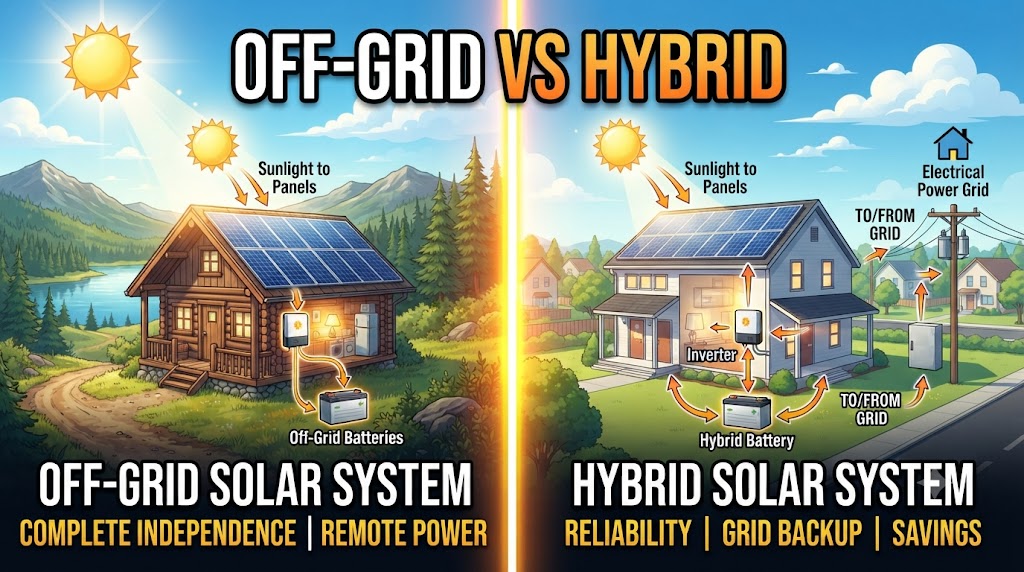
An off-grid solar system operates independently without depending on the electricity grid, while a hybrid solar system combines solar panels, battery storage and a grid connection. An off-grid setup is useful in locations where grid electricity is unavailable or unreliable. A hybrid system is more suitable for users who want to use solar energy, store excess electricity and retain access to grid power when needed. Understanding these differences can help you choose a system that matches your electricity requirements and budget.
Quick Comparison Table
| Feature | Off-Grid Solar System | Hybrid Solar System |
|---|---|---|
| Grid Connection | Not connected | Connected |
| Battery Storage | Required for normal household use | Required for backup operation |
| Main Power Sources | Solar and batteries | Solar, batteries and grid |
| Electricity During Power Cuts | Yes, if sufficient energy is available | Yes, through backup circuits and batteries |
| Excess Solar Electricity | Stored or curtailed | Stored or potentially exported to the grid |
| Net Metering | Not available | Possible, subject to local regulations and approval |
| Energy Independence | Higher independence from the grid | Partial dependence on the grid |
| Initial Cost | Depends on battery and system size | Depends on inverter and battery configuration |
| Battery Requirement | Often larger for extended autonomy | Can be sized around backup requirements |
| Grid Dependency | None | Available as an additional power source |
| Best For | Remote homes, farms and areas without grid supply | Homes and businesses needing solar savings and backup |
1. What Is an Off-Grid Solar System?
An off-grid solar system is a standalone electricity generation system that operates without a connection to the utility electricity grid. Solar panels generate electricity during daylight hours, and a charge controller or integrated inverter manages the charging of batteries. The stored electricity is then converted into usable AC power through an inverter to operate household appliances.
This system is particularly useful in remote locations, farms, rural properties and areas where grid electricity is unavailable or unreliable. Since there is no utility grid to provide backup, the battery bank and solar panel capacity must be carefully planned according to daily electricity consumption and expected periods of low sunlight.
Advantages of an Off-Grid Solar System
- No Grid Connection Required: It can supply electricity in locations where conventional electricity connections are unavailable.
- Greater Energy Independence: Users can generate and store their own electricity without depending on the utility grid.
- Backup During Power Cuts: The system can continue supplying electricity during grid outages because it operates independently.
- Suitable for Remote Locations: It is useful for farms, cottages, rural homes and isolated properties.
- Control Over Energy Consumption: Users can manage their electricity usage according to available solar generation and battery storage.
Disadvantages of an Off-Grid Solar System
- Higher Battery Dependence: Batteries are essential for supplying electricity at night and during periods of insufficient sunlight.
- Careful System Sizing Required: Solar panels and batteries must be designed to meet electricity demand even during low-generation periods.
- No Net Metering: Excess electricity generally cannot be exported to the utility grid.
- Battery Replacement Costs: Batteries have a limited service life and may need replacement.
- Limited Energy During Extended Cloudy Weather: If solar generation remains low and batteries become depleted, electricity availability can be affected.
2. What Is a Hybrid Solar System?
A hybrid solar system combines solar panels, battery storage and a connection to the utility electricity grid. It uses solar electricity to operate appliances, charges batteries with available excess energy and can draw electricity from the grid when solar generation and stored energy are insufficient.
One of its main advantages is flexibility. During a power cut, a properly configured hybrid inverter can disconnect from the grid and supply selected household circuits using solar panels and battery storage. When grid electricity is available, the system can also use it to support household demand or charge batteries, depending on its configuration.
Advantages of a Hybrid Solar System
- Grid and Battery Support: It combines solar energy, battery storage and utility electricity.
- Backup During Power Cuts: It can supply selected appliances through its backup output when the grid fails.
- Flexible Energy Management: Users can configure how solar, battery and grid electricity are used.
- Potential Net Metering Benefits: Eligible systems may export surplus electricity to the grid, subject to local regulations and utility approval.
- Flexible Battery Sizing: Battery capacity can be selected according to the required backup duration and electricity demand.
- Suitable for Regular Homes: It works well for properties that have grid electricity but also need backup during power cuts.
Disadvantages of a Hybrid Solar System
- Higher Equipment Cost: Hybrid inverters and battery storage can increase the initial investment.
- Grid Connection Required: Its grid-connected operation depends on an available utility connection.
- Battery Maintenance and Replacement: Batteries require proper management and eventually need replacement.
- More Complex Installation: The system requires appropriate inverter configuration, protection devices and electrical connections.
- Limited Backup Capacity: Not every appliance can necessarily operate during a power cut. Backup depends on inverter capacity, battery size and the selected circuits.
3. Off-Grid vs Hybrid Solar System: Key Differences
A. Grid Connection
An off-grid solar system operates independently and does not require a utility electricity connection. This makes it suitable for locations where extending conventional electricity infrastructure is difficult or expensive.
A hybrid solar system connects to the electricity grid and uses it as an additional energy source. It can switch between available energy sources according to system configuration and household requirements.
Winner: Off-grid for complete independence from the utility grid; hybrid for homes that want both solar and grid electricity.
B. Battery Storage
Battery storage is a central part of a typical household off-grid solar system. It must store enough electricity to operate appliances at night and provide energy during periods of poor sunlight.
A hybrid system also uses batteries for backup and energy management. However, the required capacity can be based on selected backup appliances and the expected duration of power cuts rather than complete independence from the grid.
Winner: Depends on requirements. Off-grid is designed around independent battery storage, while hybrid offers more flexibility in battery sizing.
C. Electricity During Power Cuts
An off-grid solar system is not affected by utility grid outages because it does not depend on the grid. It can continue supplying electricity as long as sufficient solar generation or stored battery energy is available.
A hybrid system can also provide electricity during power cuts, provided its inverter supports backup operation and the battery has sufficient charge. However, only the circuits connected to its backup output may receive electricity.
Winner: Tie for suitable backup operation. Both can provide electricity during power cuts when properly designed.
D. Initial Installation Cost
An off-grid system requires solar panels, batteries, an inverter and suitable protection equipment. Its cost depends heavily on how much electricity must be stored to maintain operation without grid support.
A hybrid system requires a hybrid inverter, batteries and grid-compatible electrical equipment. Its total cost also depends on battery capacity, backup requirements and installation complexity.
Neither system is automatically cheaper in every situation. A large off-grid battery bank can be expensive, while a hybrid installation with substantial storage can also require a significant investment.
Winner: Depends on system size, battery capacity and installation requirements.
E. Electricity Bill Savings
An off-grid system can reduce or eliminate regular dependence on purchased grid electricity because it generates and stores its own power. However, users must account for battery replacement, maintenance and any additional generator or backup arrangements.
A hybrid system can reduce grid electricity consumption by using solar generation and stored battery energy. Where net metering is permitted, surplus electricity may also be exported to the grid according to applicable rules.
Winner: Depends on electricity tariffs, grid availability, battery costs and local net metering arrangements.
F. Performance During Cloudy Weather
An off-grid system depends on its solar panels and stored battery energy. During extended cloudy or rainy weather, lower solar generation can reduce battery charging and limit the electricity available to appliances.
A hybrid system has an additional advantage because it can draw electricity from the utility grid when solar generation and battery reserves are insufficient.
Winner: Hybrid for locations with frequent cloudy weather and an available grid connection.
G. Maintenance Requirements
An off-grid system requires regular attention to battery condition, inverter operation, electrical connections and solar panel cleanliness. Proper battery sizing and management are important for reliable performance.
A hybrid system also requires battery care, inverter monitoring, electrical inspections and panel maintenance. Its additional grid connection and energy management equipment may require more complex installation and troubleshooting.
Winner: Depends on equipment quality and system configuration. Neither system is maintenance-free.
H. Energy Independence
An off-grid system provides greater independence because it does not rely on utility electricity. However, this independence depends on having enough solar generation and battery storage to meet electricity requirements throughout the year.
A hybrid system provides a combination of solar power, battery backup and grid support. It offers flexibility but does not provide the same level of independence because it retains a utility connection.
Winner: Off-grid solar system.
4. Which Solar System Is Better for Different Users?
| User Requirement | Better Choice | Reason |
|---|---|---|
| Remote farmhouse without grid electricity | Off-Grid | Does not require a utility connection |
| Rural home with frequent power cuts | Hybrid, if grid is available | Combines battery backup with grid support |
| Home requiring greater energy independence | Off-Grid | Operates independently of the utility grid |
| Home wanting solar savings and backup | Hybrid | Combines solar generation, batteries and grid support |
| Small property with limited backup needs | Depends | Battery and inverter sizing determine suitability |
| Business requiring selected backup circuits | Hybrid | Can support critical electrical loads during outages |
| Location where grid connection is unavailable | Off-Grid | Designed for independent operation |
5. Which One Should You Choose?
Choose an off-grid solar system if your property does not have a reliable electricity connection or you want to operate independently of the utility grid. It is particularly suitable for farms, remote homes and locations where grid electricity is difficult to access. However, make sure the solar panels and batteries are sufficiently sized to handle your electricity requirements during low-sunlight periods.
Choose a hybrid solar system if your home or business already has an electricity connection and you want to combine solar power, battery backup and grid electricity. It is a practical option for properties that experience regular power cuts but still want access to utility electricity when solar generation or battery storage is insufficient.
6. Final Verdict: Off-Grid vs Hybrid Solar System
Both off-grid and hybrid solar systems offer useful benefits, but they are designed for different electricity requirements. An off-grid system is better for properties that need independence from the utility grid, while a hybrid system is better for users who want solar power, battery backup and the flexibility of grid electricity.
Overall Winner: Hybrid Solar System for most grid-connected homes.
It offers a practical combination of solar energy, battery storage and utility support. However, if your property has no reliable grid connection or you specifically want independent electricity generation, an off-grid solar system is the better choice.
The right decision should be based on electricity consumption, battery requirements, local grid conditions, installation cost and the backup duration you need.
Frequently Asked Questions (FAQs)
1. Which is better, off-grid or hybrid solar?
A hybrid solar system is generally more suitable for grid-connected homes that need electricity bill savings and backup during power cuts. An off-grid system is better for properties without a reliable grid connection.
2. Does an off-grid solar system need batteries?
For a typical household system that needs electricity at night, batteries are essential. Some specialised solar setups can operate certain loads directly during sunlight hours without batteries.
3. Can a hybrid solar system work during a power cut?
Yes. A properly configured hybrid inverter can supply selected appliances through its backup output using solar panels and battery storage. Its backup capacity depends on the inverter and battery specifications.
4. Can an off-grid solar system send electricity to the grid?
A conventional off-grid system is not connected to the utility grid, so it cannot export surplus electricity through net metering.
5. Is a hybrid solar system more expensive than an off-grid system?
Not always. The total cost depends on inverter specifications, battery capacity, solar panel size and installation requirements. A large off-grid battery bank can cost more than a smaller hybrid setup.
6. Which solar system is better for a farmhouse?
An off-grid system is suitable when a farmhouse has no reliable grid connection. If grid electricity is available but power cuts are frequent, a hybrid system may be more practical.
7. Can a hybrid solar system charge batteries from the grid?
Many hybrid inverters support grid-based battery charging. However, this feature depends on the inverter model, settings and local electrical requirements.
8. Do off-grid solar systems work at night?
Yes. They use electricity stored in batteries during daylight hours to supply appliances at night, provided sufficient stored energy is available.
9. Which system is better during rainy weather?
A hybrid system has an advantage when grid electricity is available because it can use the grid if solar generation and battery reserves become insufficient. An off-grid system must rely on its stored energy or another independent backup source.
10. Can I convert an off-grid solar system into a hybrid system?
It may be possible, but it depends on the existing inverter, batteries, wiring and system configuration. Some installations require replacing the inverter and modifying the electrical setup.
Disclaimer
The information in this comparison is intended for general educational purposes. Actual solar system performance, installation costs, battery requirements, backup capacity and electricity savings depend on equipment specifications, location, weather conditions, electricity consumption and installation quality. Grid export, net metering and applicable approvals vary by local electricity regulations. Consult a qualified solar installer before selecting or installing a solar system.