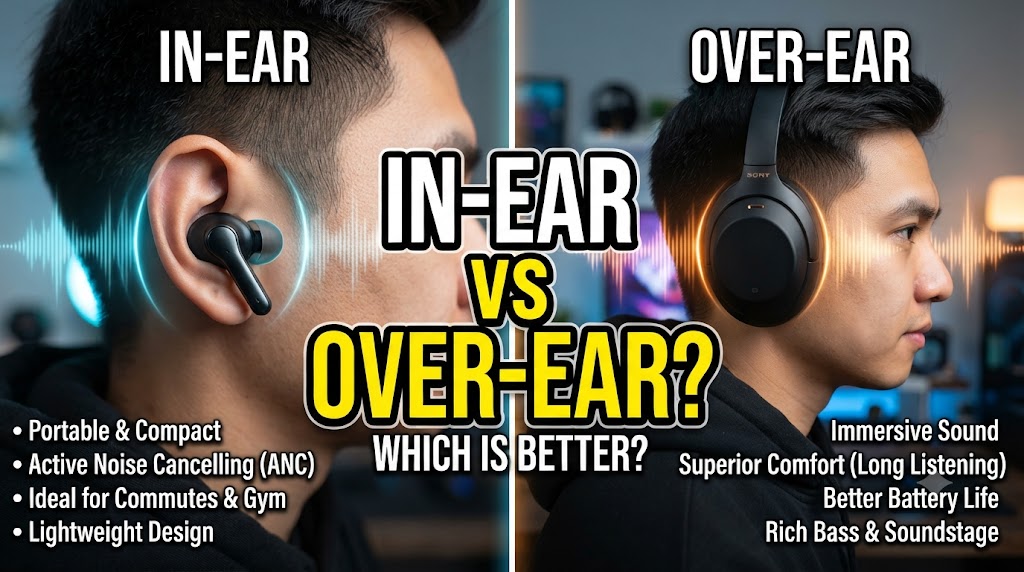
In-Ear vs Over-Ear Headphones
In-ear and over-ear headphones offer two very different ways to listen to music, watch videos, make calls, and enjoy other audio content. In-ear headphones sit inside or at the entrance of the ear canal, making them small and easy to carry. Over-ear headphones use larger ear cups that surround the ears and are usually designed for a more immersive listening experience.
The better choice depends on how and where you plan to use them. In-ear headphones are convenient for travel, exercise, and everyday use, while over-ear headphones can be more suitable for longer listening sessions and situations where comfort, sound isolation, or a larger audio presentation is important.
Quick Comparison Table
| Feature | In-Ear Headphones | Over-Ear Headphones |
|---|---|---|
| Design | Fits inside or around the ear canal | Ear cups surround the ears |
| Portability | Very high | Lower |
| Size | Compact | Large |
| Comfort | Depends on ear fit | Often comfortable for longer sessions, but varies |
| Sound Isolation | Usually good with a proper seal | Usually good, depending on design |
| Active Noise Cancellation | Available on many models | Available on many models |
| Exercise | Generally convenient | Usually less convenient |
| Travel | Easy to carry | Takes more space |
| Battery Life | Varies by model | Often longer on some wireless models |
| Sound Experience | Direct and compact | Often more spacious |
| Best For | Portability and everyday use | Longer listening and immersive audio |
What Are In-Ear Headphones?
In-ear headphones are compact audio devices that fit inside or close to the ear canal. Wireless earbuds are one of the most common examples.
Their small size makes them convenient to carry in a pocket or charging case. Many models also use silicone ear tips that create a seal, which can improve passive noise isolation and help maintain bass response.
Advantages of In-Ear Headphones
- Small and lightweight
- Easy to carry
- Convenient for commuting
- Suitable for workouts
- Many wireless options
- Charging cases make them easy to store
Limitations of In-Ear Headphones
The fit can vary significantly between users. Some people may find in-ear designs comfortable for hours, while others may prefer headphones that do not sit inside the ear canal.
The small size can also limit the physical controls and battery capacity compared with larger headphones, although modern models can still offer many advanced features.
What Are Over-Ear Headphones?
Over-ear headphones have large ear cups that completely surround the ears. The speakers sit outside the ears rather than inside the ear canal.
Their larger design provides more space for drivers, padding, microphones, and batteries. However, this also makes them considerably larger than most in-ear headphones.
Advantages of Over-Ear Headphones
- Large ear cushions
- Can be comfortable for long listening sessions
- Often provide strong passive isolation
- Larger physical design
- Suitable for home and office listening
- Can provide an immersive listening experience
Limitations of Over-Ear Headphones
Over-ear headphones are less convenient to carry than earbuds. They can also feel warm around the ears during extended use, particularly in hot weather.
Their larger size may also make them less practical for exercise or situations where you need maximum portability.
In-Ear vs Over-Ear: Portability
In-ear headphones have a clear advantage in portability because they are much smaller and lighter.
Most wireless earbuds can be placed inside a compact charging case and carried easily in a pocket. Over-ear headphones generally require more space in a bag.
Practical meaning: If you travel frequently or want headphones that are easy to carry everywhere, in-ear headphones are more convenient.
In-Ear vs Over-Ear: Comfort
Comfort depends heavily on personal preference.
In-ear headphones can feel very comfortable when the ear tips fit correctly, but some users may dislike having something inside the ear canal. Over-ear headphones avoid this by surrounding the ears with cushions.
However, over-ear models can create pressure around the head or become warm during long sessions.
Practical meaning: Neither design is automatically more comfortable for everyone. Ear shape, head size, ear-pad material, and personal preference all matter.
In-Ear vs Over-Ear: Sound Quality
Both designs can provide high-quality audio. Sound quality depends on the specific model, driver design, tuning, software processing, and fit rather than simply whether a headphone is in-ear or over-ear.
Over-ear headphones have more physical space for larger drivers and acoustic designs. In-ear headphones can also produce detailed and powerful sound when properly designed and fitted.
Practical meaning: Do not choose only by headphone type if sound quality is your main priority. The individual model matters more.
In-Ear vs Over-Ear: Noise Isolation
Both types can reduce outside noise.
In-ear headphones can create a physical seal inside the ear, while over-ear headphones use ear cups around the ears. Both designs can also include Active Noise Cancellation (ANC).
The actual level of isolation depends on the fit and design.
In-Ear vs Over-Ear: Exercise
In-ear headphones are generally more practical for exercise because they are smaller and lighter.
Many sports-focused earbuds are designed to stay securely in place during movement. Over-ear headphones are larger and can become uncomfortable during intense exercise or sweating.
Practical meaning: For running, gym workouts, and outdoor exercise, in-ear headphones are usually more convenient.
In-Ear vs Over-Ear: Battery Life
Battery life varies greatly by model.
Wireless in-ear headphones often provide several hours of playback from the earbuds and additional charging through their case. Over-ear wireless headphones have larger batteries in many models and can offer long playback between charges.
The actual battery life depends on factors such as ANC use, volume, wireless features, and the individual product.
In-Ear vs Over-Ear: Calls and Meetings
Both can work well for calls, but microphone performance depends more on the individual device than its physical design.
Modern in-ear earbuds often use multiple microphones and software processing to improve voice pickup. Over-ear headphones can also use multiple microphones and advanced voice-processing systems.
Practical meaning: Check the microphone performance of the specific model if calls and online meetings are important to you.
Which One Should You Choose?
Choose in-ear headphones if you prioritize:
- Portability
- Exercise and workouts
- Easy everyday carrying
- Compact design
- Commuting and travel
Choose over-ear headphones if you prioritize:
- Larger ear cushions
- Longer listening sessions
- An immersive listening experience
- Home or office use
- Strong physical isolation
Overall Verdict
In-ear and over-ear headphones are designed around different priorities. In-ear headphones focus on compactness, portability, and convenience, while over-ear headphones provide a larger design that can be well suited to extended listening and immersive audio.
For everyday portability and active use, in-ear headphones can be more practical. For home, office, or longer listening sessions, over-ear headphones can be a better fit. The right choice ultimately depends on your comfort preferences and how you plan to use them.
Disclaimer
Headphone comfort, sound quality, battery life, noise isolation, and microphone performance vary by model, fit, and manufacturer. Specifications and features can also change over time, so check the current product specifications before purchasing.