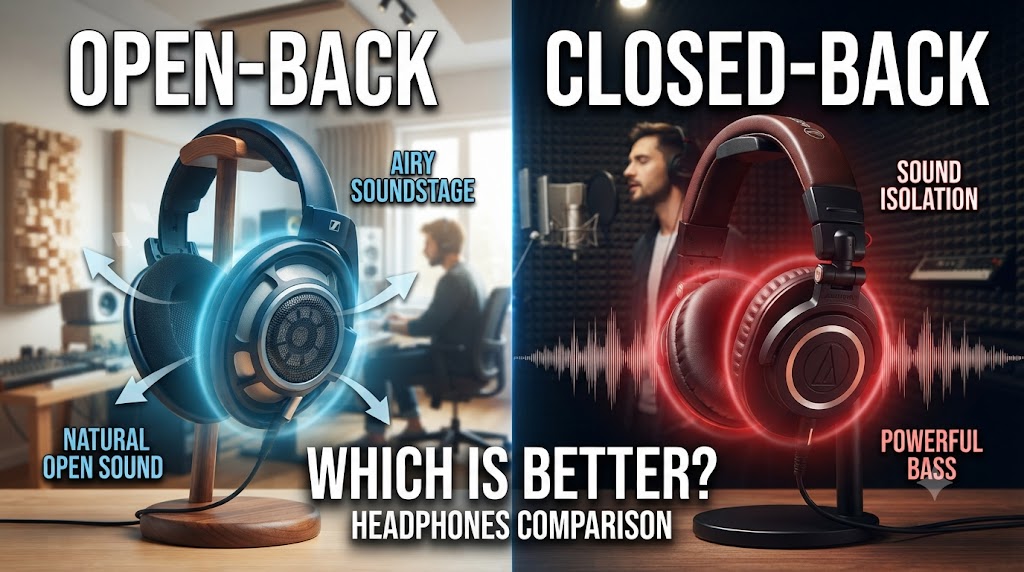
Open-Back vs Closed-Back Headphones
Open-back and closed-back headphones use different ear-cup designs that affect how sound interacts with your ears and the surrounding environment. Open-back headphones have vents or openings on the back of their ear cups, allowing some air and sound to pass through. Closed-back headphones have sealed ear cups that block much of the sound from entering or leaving.
The better choice depends on where and how you listen. Open-back headphones can provide a more natural and spacious listening experience in quiet environments, while closed-back headphones are generally more practical when you need better isolation from outside noise or want to avoid disturbing people nearby.
Quick Comparison Table
| Feature | Open-Back Headphones | Closed-Back Headphones |
|---|---|---|
| Ear Cup Design | Vented/open | Sealed/closed |
| Sound Leakage | High | Low |
| Outside Noise Isolation | Low | Generally higher |
| Soundstage | Often more spacious | Often more enclosed |
| Best Environment | Quiet rooms | Noisy or shared spaces |
| Privacy | Low | Better |
| Heat Around Ears | Can be lower | Can be higher |
| Bass Presentation | Depends on model | Often stronger in the low end |
| Gaming | Useful for spacious audio | Useful for isolation |
| Recording | Can be problematic due to leakage | Better suited to many recording situations |
What Are Open-Back Headphones?
Open-back headphones have ear cups that allow air and some sound to pass through the back of the headphones.
Instead of creating a sealed space around the ear, the open construction lets the listener interact more naturally with the surrounding acoustic environment.
This design is commonly found in headphones intended for home listening, critical listening, music production, and other quiet environments.
Advantages of Open-Back Headphones
- Spacious listening presentation
- Natural-feeling sound for many listeners
- Airflow around the ears
- Can reduce the closed-in feeling of sealed headphones
- Useful for quiet-room listening
Limitations of Open-Back Headphones
The main limitation is sound leakage. People nearby can often hear what you are listening to, while outside sounds can also reach your ears.
For this reason, open-back headphones are generally not ideal for public transport, busy offices, or other environments where isolation is important.
What Are Closed-Back Headphones?
Closed-back headphones have sealed ear cups designed to reduce the amount of sound passing between the headphones and the outside environment.
This makes them more suitable for situations where you want to keep outside noise away from your listening experience or prevent your audio from disturbing others.
Advantages of Closed-Back Headphones
- Better passive isolation
- Less sound leakage
- Suitable for travel and offices
- More practical for shared environments
- Can provide a strong low-frequency presentation
Limitations of Closed-Back Headphones
The sealed design can make the ears feel warmer during long listening sessions. Some listeners may also perceive the sound as more enclosed compared with an open-back design.
However, sound characteristics vary significantly between individual models.
Open-Back vs Closed-Back: Soundstage
Soundstage refers to the perceived space and positioning of sounds.
Open-back headphones often create a more spacious and airy presentation because their construction allows sound to interact more naturally with the surrounding environment.
Closed-back headphones can also have a wide soundstage, but their sealed design often produces a more enclosed presentation.
Practical meaning: If you enjoy a spacious presentation for music or gaming in a quiet room, open-back headphones may suit you well.
Open-Back vs Closed-Back: Noise Isolation
Closed-back headphones generally provide better passive isolation because their ear cups are sealed.
Open-back headphones intentionally allow outside sound to enter, so they provide limited passive isolation.
Practical meaning: Closed-back headphones are generally more practical for commuting, travel, offices, and other noisy environments.
Open-Back vs Closed-Back: Sound Leakage
Sound leakage is one of the biggest differences between these designs.
Open-back headphones allow sound to escape through the ear cups. At moderate or higher volume, people nearby may hear your audio.
Closed-back headphones keep more of the sound inside the ear cups.
Practical meaning: If you are sitting beside other people, closed-back headphones are usually more appropriate.
Open-Back vs Closed-Back: Bass
Closed-back headphones often provide a stronger sense of low-frequency impact because the sealed ear cup can support the bass response.
Open-back headphones can still produce excellent bass, but their design does not create the same sealed acoustic environment.
However, actual bass performance depends heavily on the specific headphone’s drivers and tuning.
Open-Back vs Closed-Back: Comfort
Open-back headphones can allow more airflow around the ears, which may be useful during longer listening sessions.
Closed-back headphones can retain more heat because the ear cups create a sealed space around the ears.
Comfort still depends on factors such as ear-pad material, clamping force, weight, and headphone design.
Open-Back vs Closed-Back for Gaming
Both designs can work well for gaming.
Open-back headphones can provide a spacious presentation that may make positional audio feel more natural in a quiet gaming room.
Closed-back headphones can be useful when outside noise is distracting or when you do not want game audio to leak into the surrounding environment.
Practical meaning: Choose based on your gaming environment rather than assuming one design is universally better.
Open-Back vs Closed-Back for Music
Open-back headphones are often preferred by listeners who want a spacious and natural-feeling presentation.
Closed-back headphones are more practical when you listen in shared spaces or need stronger isolation.
The actual sound quality depends on the headphone model, so the design type alone does not determine whether one headphone sounds better than another.
Open-Back vs Closed-Back for Recording
Closed-back headphones are commonly more practical for recording because they reduce sound leakage from the headphones into a microphone.
Open-back headphones can allow playback audio to escape from the ear cups and potentially be picked up by a nearby microphone.
Practical meaning: For many recording situations, closed-back headphones make monitoring easier.
Which One Should You Choose?
Choose open-back headphones if you prioritize:
- Spacious sound
- Quiet-room listening
- Airflow around the ears
- Music listening at home
- A more open presentation
Choose closed-back headphones if you prioritize:
- Noise isolation
- Privacy
- Travel
- Office use
- Less sound leakage
- Recording and monitoring
Overall Verdict
Open-back and closed-back headphones are designed for different listening environments. Open-back headphones emphasize an open and spacious presentation, while closed-back headphones provide better isolation and less sound leakage.
For quiet home listening, open-back headphones can be a useful choice. For travel, shared spaces, recording, or situations where isolation matters, closed-back headphones are generally more practical.
Disclaimer
Headphone sound, comfort, isolation, and sound leakage vary between models. The comparison describes general characteristics of open-back and closed-back designs, not the performance of every individual headphone. Always check the current specifications and design of the specific model before purchasing.