Smart Doorbell vs Traditional Doorbell
Introduction
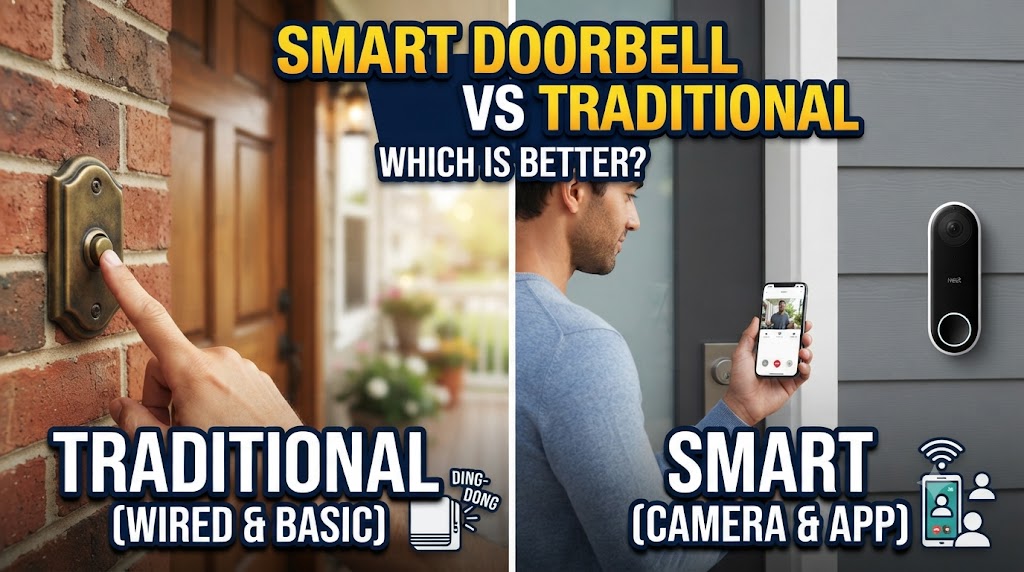
A doorbell is a simple way for visitors to let people inside the home know they have arrived. A traditional doorbell usually provides a basic audible chime when its button is pressed, while a smart doorbell can add features such as smartphone notifications, video, two-way communication, motion detection, and remote monitoring. The difference is mainly between a simple alert system and a connected device with additional functions.
The better choice depends on what you expect from your doorbell. A traditional doorbell can be suitable when you only need a straightforward chime, while a smart doorbell can be useful if you want to see who is outside, receive alerts when you are away, or communicate with visitors remotely. Let’s compare both options based on features, convenience, installation, power, connectivity, privacy, maintenance, and cost considerations.
Quick Comparison Table
| Feature | Smart Doorbell | Traditional Doorbell |
|---|---|---|
| Basic Doorbell Function | Yes | Yes |
| Video | Available on many models | No |
| Smartphone Notifications | Yes, on connected models | No |
| Two-Way Audio | Available on many models | No |
| Motion Detection | Common | No |
| Remote Monitoring | Available | No |
| Internet Requirement | Often required for smart features | No |
| Power Requirement | Battery or wired, depending on model | Wired or battery, depending on model |
| Installation | Can be more involved | Usually simpler |
| Maintenance | More components to maintain | Generally low |
| Privacy Considerations | Higher due to camera/audio | Minimal |
| Best For | Connected monitoring and visitor interaction | Simple visitor alerts |
Smart Doorbell vs Traditional Doorbell: How Do They Work?
Smart Doorbell
A smart doorbell combines the basic doorbell function with electronic and connected features. Depending on the model, it may include a camera, microphone, speaker, motion sensor, night vision, and smartphone connectivity.
When someone presses the button, the homeowner can receive a notification on a compatible smartphone or other connected device. Some models can also detect movement even when the visitor does not press the button.
Traditional Doorbell
A traditional doorbell is designed primarily to produce an audible alert when the button is pressed.
It generally consists of an outdoor button and an indoor chime or bell mechanism. It does not normally include a camera, internet connection, smartphone app, or remote communication.
Smart Doorbell vs Traditional Doorbell: Basic Doorbell Function
Tie.
Both options perform the basic job of alerting people inside when someone presses the doorbell.
The major difference is what happens after the alert. A traditional doorbell usually stops at the audible chime, while a smart doorbell can provide additional information and communication features.
Smart Doorbell vs Traditional Doorbell: Video Monitoring
Smart Doorbell wins.
Many smart doorbells include an integrated camera that allows you to see the person standing at the entrance.
This can be useful when you want to identify visitors before opening the door. Some models also provide night vision or other low-light capabilities.
A traditional doorbell does not normally provide video.
Smart Doorbell vs Traditional Doorbell: Smartphone Notifications
Smart Doorbell wins.
A connected smart doorbell can send a notification to a smartphone when someone presses the button or when motion is detected, depending on the model and settings.
This can be useful when you are in another room or away from home.
A traditional doorbell generally relies on the sound of its indoor chime and does not provide smartphone notifications.
Smart Doorbell vs Traditional Doorbell: Two-Way Communication
Smart Doorbell wins.
Many smart doorbells include a microphone and speaker. This allows homeowners to communicate with visitors through the doorbell.
For example, you may be able to tell a delivery person where to leave a package without opening the door.
A traditional doorbell does not normally provide this function.
Smart Doorbell vs Traditional Doorbell: Motion Detection
Smart Doorbell wins.
Many smart doorbells include motion detection. The device can notify you when movement is detected near the entrance, even if nobody presses the doorbell button.
Traditional doorbells generally do not have this capability.
The accuracy of motion detection depends on the model, placement, sensitivity settings, and detection technology.
Smart Doorbell vs Traditional Doorbell: Remote Monitoring
Smart Doorbell wins.
A smart doorbell with network connectivity can allow you to check the entrance remotely through a compatible app.
This can be useful if you want to know what is happening at the front door while you are away.
A traditional doorbell cannot provide remote monitoring because it is not designed as a connected device.
Smart Doorbell vs Traditional Doorbell: Internet Dependence
Traditional Doorbell wins for simplicity.
Smart doorbells often rely on Wi-Fi or another network connection for features such as remote notifications, live video, and cloud services.
Some functions may continue to work locally when connectivity is unavailable, depending on the model.
A traditional doorbell does not normally need an internet connection.
Smart Doorbell vs Traditional Doorbell: Power Requirements
Depends on the installation.
Smart doorbells may be battery-powered or wired, depending on the model.
Battery-powered models avoid some wiring work but require periodic charging or battery replacement. Wired models can provide continuous power but may require compatible wiring.
Traditional doorbells can also be wired or battery-powered depending on the design.
Therefore, neither option is universally better in this category.
Smart Doorbell vs Traditional Doorbell: Installation
Traditional Doorbell is generally simpler.
A traditional doorbell has fewer components and usually has simpler installation requirements.
Smart doorbells can involve additional considerations such as Wi-Fi coverage, power requirements, mounting position, app setup, and compatibility with existing doorbell wiring.
Battery-powered smart doorbells can simplify installation, but they still require configuration of their connected features.
Smart Doorbell vs Traditional Doorbell: Maintenance
Traditional Doorbell generally requires less maintenance.
A traditional doorbell has relatively few components and normally only needs basic cleaning or replacement of a battery or faulty component when necessary.
A smart doorbell has additional electronic components. Depending on the model, you may need to charge or replace batteries, maintain the app, manage settings, or troubleshoot connectivity.
Smart Doorbell vs Traditional Doorbell: Privacy
Traditional Doorbell has fewer privacy considerations.
Smart doorbells may include cameras and microphones that capture video or audio around the entrance.
This provides useful functionality but also creates additional privacy considerations. The camera should be positioned carefully, and recording or data-storage settings should be reviewed.
A traditional doorbell normally does not record video or audio.
Smart Doorbell vs Traditional Doorbell: Storage
Traditional Doorbell wins for simplicity.
A traditional doorbell does not record anything, so it does not require video storage.
Smart doorbells that include cameras may offer local storage, cloud storage, or both, depending on the model. Some cloud-based services may require a subscription for certain recording features.
Storage requirements should therefore be checked before purchasing a smart doorbell.
Smart Doorbell vs Traditional Doorbell: Home Security
Depends on your security needs.
A traditional doorbell provides an alert when somebody presses the button, but it does not normally provide information about who is outside.
A smart doorbell can add video, motion alerts, two-way communication, and remote monitoring. These features can provide additional information about activity around the entrance.
However, a smart doorbell should be considered one part of a broader home-security setup rather than a complete security system by itself.
Which Is Better for Your Home?
A smart doorbell may be suitable if you want:
- Video of visitors
- Smartphone notifications
- Two-way communication
- Motion alerts
- Remote monitoring
- Additional connected-home features
A traditional doorbell may be suitable if you want:
- A simple doorbell
- Basic visitor alerts
- No internet dependence
- Minimal maintenance
- A simpler installation
- No camera or audio recording
Smart Doorbell vs Traditional Doorbell: Which Should You Choose?
| If You Want… | Better Fit |
|---|---|
| Basic doorbell chime | Traditional Doorbell |
| Video of visitors | Smart Doorbell |
| Smartphone notifications | Smart Doorbell |
| Two-way communication | Smart Doorbell |
| Motion alerts | Smart Doorbell |
| Remote monitoring | Smart Doorbell |
| No internet dependence | Traditional Doorbell |
| Simple installation | Traditional Doorbell |
| Minimal connected features | Traditional Doorbell |
| Fewer privacy concerns | Traditional Doorbell |
Conclusion
Smart doorbells and traditional doorbells perform the same basic function but offer very different levels of functionality. A traditional doorbell is focused on providing a simple alert when somebody presses the button. A smart doorbell can add video, smartphone notifications, two-way communication, motion detection, and remote monitoring.
If you want simple and straightforward operation, a traditional doorbell is a practical choice. If you want connected features and additional information about visitors, a smart doorbell provides more functionality. The choice should also consider power availability, Wi-Fi connectivity, privacy, maintenance, and any ongoing storage or subscription requirements.
Disclaimer
This comparison is for general informational purposes. Smart-doorbell features, storage options, subscription requirements, power methods, connectivity, and compatibility vary by model and manufacturer. Privacy and recording requirements may also vary by location. Check the manufacturer’s specifications and applicable local requirements before installation.