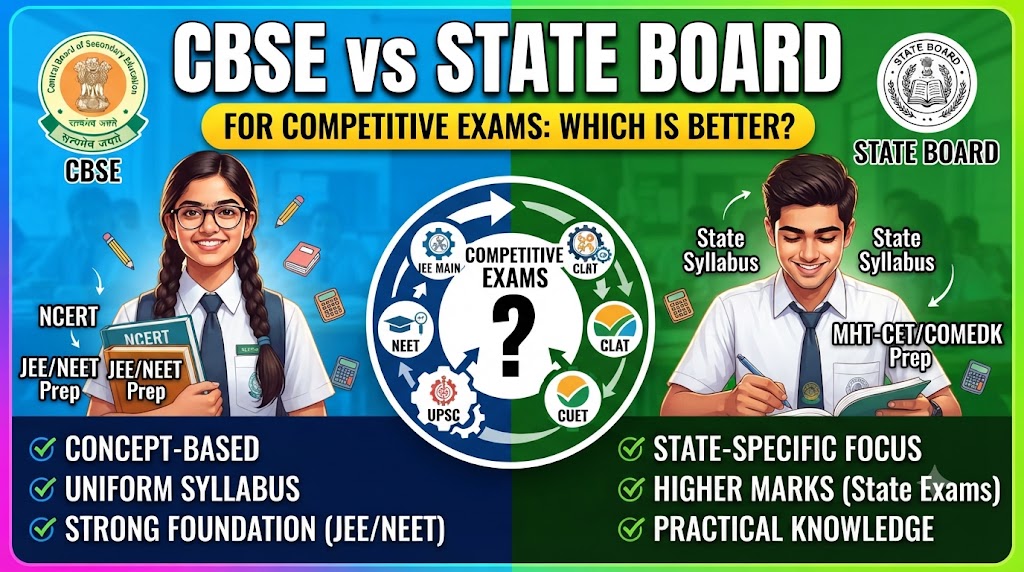
CBSE vs State Board for Competitive Exams
Introduction
Choosing between CBSE and a State Board can influence how students prepare for competitive exams such as JEE, NEET, CUET, and other entrance tests. Both boards provide recognized school education, but their syllabuses, teaching approaches, examination patterns, and learning resources can differ. CBSE follows a national curriculum framework, while State Boards follow the curriculum prescribed by their respective state education authorities. The better choice depends on the competitive exam a student plans to take, the quality of teaching available, and how effectively the student develops conceptual understanding and problem-solving skills.
Students preparing for competitive exams often need to study beyond their regular school syllabus. CBSE can offer a convenient starting point for national entrance examinations because its curriculum is generally aligned with NCERT textbooks, which are important for many entrance-exam topics. However, State Board students can also succeed in competitive exams with appropriate study materials, consistent practice, and good coaching or self-study. Instead of choosing a board based only on its reputation, parents and students should compare syllabus coverage, teaching quality, language preferences, examination workload, and preparation requirements before making a decision.
Quick Comparison Table
| Feature | CBSE | State Board |
|---|---|---|
| Curriculum | National curriculum framework | Curriculum set by the respective state |
| NCERT alignment | Generally strong | Varies by state and subject |
| JEE and NEET preparation | Often convenient for syllabus overlap | May require additional NCERT-based study |
| School examination pattern | CBSE-prescribed pattern | Depends on the state board |
| Study language | English, Hindi, and other available options depending on the school | Often includes the regional language and other available options |
| Coaching compatibility | Commonly available alongside CBSE schooling | Depends on local coaching and school schedules |
| Transfer between states | Generally convenient because of a national framework | May require adjustment to a different state syllabus |
| Best suited for | Students seeking national-curriculum continuity | Students who benefit from the state curriculum, local language, or a suitable local school |
1. Syllabus and Curriculum
CBSE
CBSE schools generally follow a national curriculum framework and use NCERT textbooks for many core subjects. This can help students build familiarity with concepts that appear in national competitive examinations. Students may find it easier to coordinate school lessons with NCERT-based entrance-exam preparation, although the exact overlap depends on the subject and current exam syllabus.
State Board
State Boards design their curricula according to their respective state education requirements. Some have substantial overlap with NCERT, while others differ in chapter coverage, sequencing, or emphasis. Students may need supplementary NCERT study and additional practice to cover the complete syllabus of a national entrance examination.
Verdict: CBSE often offers a more convenient starting point for national competitive exams, but the actual syllabus of the target examination should always be checked.
2. Preparation for JEE and NEET
CBSE
Students preparing for JEE or NEET may benefit from the familiarity between CBSE science subjects and NCERT-based preparation resources. This can make it easier to coordinate school learning with entrance-exam preparation. However, JEE also requires substantial numerical problem-solving, while NEET requires extensive practice and careful revision.
State Board
State Board students can also prepare successfully for JEE and NEET. They may need to supplement their regular textbooks with NCERT material, exam-specific practice questions, mock tests, and additional conceptual explanations where syllabus differences exist.
Verdict: CBSE may provide a practical advantage through curriculum alignment, but neither board guarantees a competitive-exam result.
3. Teaching Quality and Conceptual Understanding
CBSE
CBSE affiliation alone does not guarantee excellent teaching. Some schools have experienced teachers, laboratories, and structured academic support, while others may have limited resources. Students should assess the actual teaching quality rather than relying on the board’s name.
State Board
State Board schools also vary considerably. A well-managed State Board school with strong subject teachers can provide better learning than a poorly managed CBSE school. Clear explanations, regular doubt-solving, and individual attention are particularly valuable for competitive-exam preparation.
Verdict: The quality of the school and its teachers can matter more than the board itself.
4. School Exams and Competitive-Exam Workload
CBSE
CBSE students still need to prepare for school examinations, practical work where applicable, and entrance examinations. Even when the syllabuses overlap, competitive exams often demand deeper application, faster problem-solving, and more practice than school examinations alone.
State Board
State Board students must manage their board examinations alongside entrance-exam preparation. Where the syllabus or question style differs from the target entrance examination, additional study may be necessary. A realistic timetable can help avoid excessive workload.
Verdict: Neither board removes the need for a separate competitive-exam preparation plan.
5. Study Resources and Coaching
CBSE
Students can access a wide range of NCERT-based books, online lessons, question banks, and coaching resources. This may simplify the process of matching school learning with entrance-exam preparation.
State Board
State Board students can use the same national-level preparation resources. However, they may need to coordinate state-syllabus lessons with NCERT-based resources and entrance-exam practice. The availability and quality of local coaching can also influence the decision.
Verdict: CBSE may offer a simpler resource-alignment process, but effective preparation resources are available to students from both boards.
6. Language and Learning Comfort
CBSE
CBSE schools offer different medium-of-instruction options depending on the school. Students should check whether the teaching language supports their understanding of scientific concepts and examination terminology.
State Board
State Boards may provide strong regional-language learning options, depending on the state and school. Students who understand concepts better in their preferred language may benefit from this environment, provided they also become comfortable with the language and terminology used in their target entrance examination.
Verdict: Choose the medium in which the student can understand concepts clearly while developing the examination-language skills they will need.
7. Cost and Accessibility
CBSE
CBSE schools differ widely in fees. Some are relatively affordable, while others charge considerably more for facilities and additional services. School fees should be assessed alongside transport, books, coaching, and other preparation expenses.
State Board
Government State Board schools can be a more affordable option in many areas, while private State Board schools may charge a wide range of fees. Lower schooling costs can leave more room in the family budget for entrance-exam preparation, if needed.
Verdict: Compare the actual cost and quality of individual schools rather than assuming every CBSE school is expensive or every State Board school is inexpensive.
8. Which Board Is Better for Different Students?
| Student’s situation | Practical choice |
|---|---|
| Planning to take JEE or NEET | CBSE can be convenient because of NCERT alignment |
| Already studying in a good State Board school | Staying may be sensible if learning is strong and preparation gaps are addressed |
| Needs regional-language instruction | Choose a suitable school and medium that support understanding |
| Has access to excellent local State Board teaching | State Board can be a strong option |
| May move between states | CBSE can offer continuity through a national curriculum |
| Has a limited education budget | Compare affordable schools and total preparation costs |
Advantages and Disadvantages
CBSE
Advantages
- Generally strong alignment with NCERT-based preparation.
- Convenient for students targeting many national entrance examinations.
- National curriculum framework can ease transfers between states.
Disadvantages
- School quality and teaching support vary.
- Schoolwork alone is not sufficient for most competitive exams.
- Some schools and associated services may be costly.
State Board
Advantages
- Can provide strong education through a good local school.
- May offer suitable regional-language learning options.
- Government schools can be affordable in many areas.
Disadvantages
- Curriculum alignment with NCERT varies by state.
- Additional entrance-exam resources may be necessary.
- Moving to another state’s curriculum may require adjustment.
Final Verdict: CBSE vs State Board for Competitive Exams
CBSE is often the more convenient choice for students targeting JEE, NEET, and other national competitive examinations, particularly when their school uses NCERT textbooks effectively and provides strong teaching support. Its curriculum alignment can reduce some of the extra coordination required between school studies and entrance-exam preparation.
However, State Board students can achieve excellent results with a suitable preparation plan, NCERT study where required, regular mock tests, and consistent revision. A strong State Board school may be a better choice than a weak CBSE school. Before deciding, compare the student’s target examination, school teaching quality, language needs, total cost, and available preparation time.
Disclaimer: Board curricula, school facilities, fees, and entrance-exam syllabuses may change. Check the latest official CBSE, relevant State Board, and examination-authority information before making an educational decision.