Rooftop Solar vs Ground-Mounted Solar: Which Is Better?
Introduction
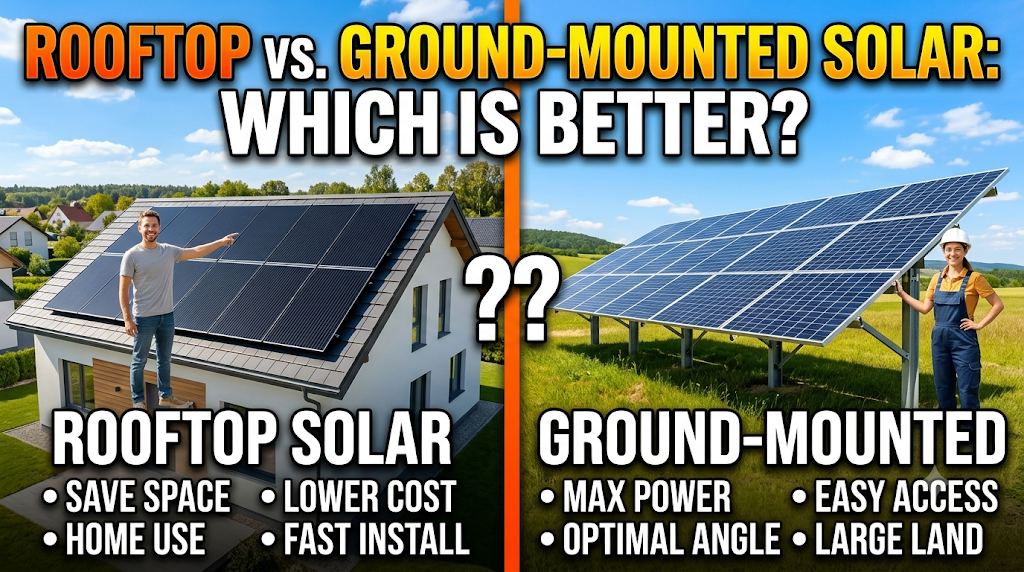
Rooftop solar and ground-mounted solar are two popular ways to install solar panels and generate electricity for homes, businesses and other properties. Both systems use photovoltaic (PV) panels to convert sunlight into electricity, but they differ in installation location, available space, mounting structures and maintenance requirements. Rooftop solar panels are installed on existing building roofs, while ground-mounted solar panels are installed on specially designed structures placed directly on the land. The choice between these systems depends on property size, roof condition, sunlight availability and electricity requirements.
Choosing between rooftop solar and ground-mounted solar is important because the installation location can affect system design, installation costs, performance and future maintenance. Rooftop solar generally makes better use of existing building space, while ground-mounted solar offers greater flexibility in panel positioning, orientation and expansion. Both options can provide long-term electricity savings when properly designed and installed. Understanding their differences can help property owners select a solar installation that matches their available space, budget and energy goals.
Quick Comparison Table
| Feature | Rooftop Solar | Ground-Mounted Solar |
|---|---|---|
| Installation location | Building rooftop | Open land |
| Land requirement | Uses existing roof | Requires available land |
| Initial installation cost | Generally lower | Generally higher |
| Mounting structure | Roof-mounted structure | Ground support structure |
| Panel positioning | Limited by roof design | More flexible |
| Sunlight exposure | Depends on roof orientation and shading | Can be selected based on site conditions |
| Maintenance access | May be difficult | Generally easier |
| Cleaning | Can require roof access | Usually easier to access |
| Cooling and ventilation | Depends on roof clearance and design | Often better airflow |
| System expansion | Limited by roof area | Generally easier with additional land |
| Roof condition | Must be structurally suitable | Roof condition is not relevant |
| Land use | Does not occupy additional ground space | Uses open land |
| Best suited for | Homes and buildings with suitable roofs | Properties with sufficient open land |
1. What Is Rooftop Solar?
Rooftop solar is a solar power system installed on the roof of a residential, commercial or industrial building. Solar panels are attached to mounting structures designed for the particular roof type.
The panels capture sunlight and generate direct current (DC) electricity. An inverter converts this electricity into alternating current (AC) for use by household appliances, office equipment and other electrical loads.
In a grid-connected rooftop solar system, electricity can be used directly by the building, while eligible surplus electricity may be exported to the utility grid under the applicable metering arrangement.
Main Benefits of Rooftop Solar
- Uses existing roof space instead of requiring separate land.
- Generally requires less civil construction.
- Can reduce electricity bills through solar self-consumption.
- Suitable for residential and commercial buildings.
- Can be connected to the electricity grid.
- Keeps open ground areas available for other activities.
- Can provide some shading to the roof beneath the panels.
2. What Is Ground-Mounted Solar?
Ground-mounted solar is a solar power system installed on structures built directly on the ground. Instead of using a building roof, the solar panels are supported by specially designed mounting frames fixed to suitable foundations.
This installation method provides greater flexibility in selecting the panel direction, tilt angle and overall system layout. It can be useful for properties with large open areas, unsuitable rooftops or higher electricity requirements.
Ground-mounted systems can be designed for residential properties, commercial facilities, agricultural land and large solar power projects.
Main Benefits of Ground-Mounted Solar
- Greater flexibility in panel positioning and orientation.
- Easier access for cleaning and maintenance.
- Better opportunities for ventilation beneath the panels.
- Easier system expansion when sufficient land is available.
- Does not depend on the building roof’s structural condition.
- Can accommodate larger installations on suitable properties.
- Allows more flexibility in selecting the installation location.
3. Difference in Installation Location
The most obvious difference is where the solar panels are installed.
Rooftop solar uses the existing roof of a house, office, factory or other building. The installer must evaluate roof strength, available space, orientation, shading and mounting requirements before installation.
Ground-mounted solar requires suitable open land. The installation location must be evaluated for sunlight exposure, soil conditions, drainage, access and foundation requirements.
Rooftop solar is generally more practical when sufficient roof space is available, while ground-mounted solar is useful when there is adequate open land.
4. Difference in Installation Cost
Rooftop solar generally has lower installation costs because it uses the existing building structure and usually requires less civil work.
Ground-mounted solar can cost more because it may require foundations, additional mounting structures, land preparation, trenching and longer electrical cable routes.
However, the actual cost depends on system capacity, equipment quality, roof type, soil conditions, installation complexity and local labour charges.
For smaller residential installations, rooftop solar is often the more economical option. Ground-mounted solar can be worth the additional investment when better positioning or larger installation capacity is required.
5. Difference in Solar Power Generation
Both rooftop and ground-mounted systems can generate electricity efficiently when properly designed.
However, ground-mounted systems offer more flexibility in selecting the direction and tilt of solar panels. This can help installers position the panels to receive suitable sunlight throughout the year.
Rooftop solar performance depends more heavily on the existing roof’s direction, slope, available area and surrounding shade.
Ground-mounted systems may also benefit from better airflow beneath the panels, which can help manage operating temperatures. However, the actual energy output depends on panel quality, sunlight, temperature, shading, inverter performance and installation design.
Neither installation type automatically produces more electricity. A well-designed rooftop system can perform better than a poorly positioned ground-mounted system.
6. Difference in Maintenance and Cleaning
Maintenance is another important consideration when choosing between these solar installations.
Ground-mounted solar panels are generally easier to access because they are installed closer to ground level. This can make cleaning, visual inspections and certain repair activities more convenient.
Rooftop solar panels may require ladders, roof access equipment and additional safety precautions. Maintenance can become more difficult when the roof is steep, high or has limited access.
Both systems require periodic inspections, cleaning when necessary and attention to electrical connections, mounting structures and inverter performance.
7. Difference in Space Requirements
Rooftop solar makes use of an existing building area. This is especially useful in urban locations where open land is limited or expensive.
Ground-mounted solar requires dedicated land for panels, mounting structures, spacing between rows and access paths. The total land requirement depends on system capacity, panel arrangement, tilt angle and the need to prevent one row from shading another.
For homes with small plots, rooftop solar is generally more practical. For farms, industrial properties and large commercial sites, ground-mounted solar may offer greater installation flexibility.
8. Difference in Expansion and System Size
Expanding a rooftop solar installation can be difficult when the available roof area is limited. Additional panels may also be restricted by roof strength, shading, existing equipment and electrical system capacity.
Ground-mounted solar systems can generally be expanded more easily when additional suitable land is available. Owners can add more mounting structures and panels while considering electrical design and grid connection limits.
This makes ground-mounted solar attractive for businesses and property owners who may need greater solar capacity in the future.
9. Difference in Roof and Land Requirements
Rooftop solar requires a structurally suitable roof that can support the additional weight and withstand wind loads. The roof should also have sufficient usable space and a suitable orientation.
If the roof needs major repairs or replacement, it is generally better to complete that work before installing solar panels.
Ground-mounted solar does not depend on roof strength or condition. However, the land must be suitable for installing foundations and mounting structures. Soil stability, drainage, slope, shading and available access should be evaluated.
10. Rooftop Solar vs Ground-Mounted Solar: Which Is Better?
Rooftop solar is generally better for homeowners and businesses that have sufficient unused roof space and want to reduce electricity bills without using additional land. It is often more economical for smaller installations because it can use existing building infrastructure.
Ground-mounted solar is generally better for property owners who have sufficient open land and want more flexibility in panel positioning, maintenance access and future expansion.
Overall, rooftop solar is usually the more practical and economical choice for ordinary homes and buildings, while ground-mounted solar is often better for large properties, farms and businesses with sufficient available land.
The final decision should depend on installation cost, roof suitability, land availability, expected electricity generation, maintenance access and future energy requirements.
Frequently Asked Questions (FAQs)
1. What is the main difference between rooftop solar and ground-mounted solar?
The main difference is the installation location. Rooftop solar panels are installed on building roofs, while ground-mounted solar panels are installed on specially designed structures placed on open land.
2. Which is cheaper, rooftop solar or ground-mounted solar?
Rooftop solar is generally cheaper because it uses existing roof space and requires less civil construction. Ground-mounted solar may cost more because of foundations, mounting structures and land preparation.
3. Does ground-mounted solar generate more electricity?
Not automatically. Ground-mounted systems offer greater flexibility in panel positioning and may have better ventilation, but actual generation depends on sunlight, orientation, shading, temperature and system design.
4. Does rooftop solar require a strong roof?
Yes. The roof must have sufficient structural strength to support the panels and mounting structures while withstanding local wind and weather conditions.
5. Is ground-mounted solar easier to maintain?
Generally, yes. Ground-mounted panels are easier to access for cleaning, inspection and certain repair activities compared with panels installed on high or difficult-to-access rooftops.
6. Can ground-mounted solar be installed on agricultural land?
Yes, subject to land suitability, applicable land-use regulations, permissions and other local requirements. Agricultural solar projects may also use specialized designs that allow farming activities alongside solar generation.
7. Can rooftop solar be expanded later?
Yes, if sufficient roof space, structural capacity, electrical capacity and applicable grid connection approvals are available.
8. Which solar system is better for a residential home?
Rooftop solar is generally the more practical choice for residential homes because it uses existing roof space and avoids requiring additional land. Ground-mounted solar can be suitable for homes with large open plots and unsuitable rooftops.
Disclaimer
This article is intended for general informational and educational purposes. Solar installation costs, structural requirements, land-use permissions, electricity generation and grid connection regulations may vary depending on location and project conditions. Before installation, consult a qualified solar professional to evaluate roof strength, soil conditions, sunlight exposure, mounting requirements and applicable electricity regulations. Actual solar performance depends on equipment quality, system design, weather and maintenance.