All-in-One vs Split Solar Street Light
Introduction
Solar street lights are becoming a practical lighting solution for residential streets, village roads, parking areas, commercial properties and public spaces. Two common designs are available: all-in-one solar street lights and split solar street lights. Both use solar panels to generate electricity, store energy in batteries and power LED lights at night. However, their component arrangements, installation requirements, maintenance needs and system flexibility are different. Choosing the right design depends on the lighting requirements, available sunlight, installation location and expected operating hours.
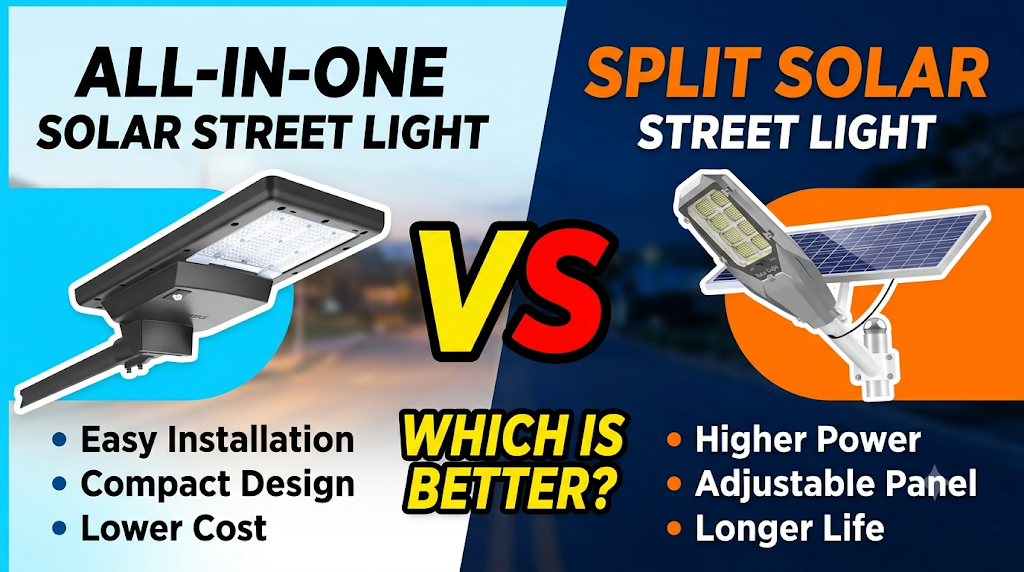
An all-in-one solar street light combines the solar panel, battery, charge controller and LED light into a single unit. In comparison, a split solar street light uses separate components, allowing the solar panel and battery to be installed independently of the LED lamp. This difference affects panel positioning, battery capacity, maintenance and installation costs. While an all-in-one design is convenient for straightforward installations, a split system offers greater flexibility for projects requiring larger solar panels, bigger batteries or customized configurations.
Quick Comparison Table
| Feature | All-in-One Solar Street Light | Split Solar Street Light |
|---|---|---|
| Design | All components integrated into one unit | Components installed separately |
| Solar Panel | Built into the light housing | Separately mounted |
| Battery | Inside the main housing | Installed in a separate enclosure |
| Charge Controller | Integrated | Usually separately installed |
| Installation | Easier and faster | Requires more installation work |
| Wiring | Minimal external wiring | More connecting cables |
| Panel Position | Limited by light mounting position | Can be adjusted independently |
| Battery Capacity | Limited by housing size | More flexible capacity |
| Maintenance | May require removing the complete unit | Individual components can be serviced |
| Initial Cost | Generally lower for comparable small systems | Can be higher |
| Flexibility | Limited customization | Greater customization |
| Best For | Homes, pathways and small roads | Main roads and larger projects |
1. Design and Working Principle
All-in-One Solar Street Light
An all-in-one solar street light combines its main components into a single housing. The solar panel is attached to the top or integrated surface, while the battery, charge controller and LED lighting system are fitted inside the same unit.
During the daytime, the solar panel generates electricity and charges the internal battery. After sunset, the stored electricity powers the LED light automatically through its controller.
This design reduces the number of separate components that need to be installed on a pole. It is particularly useful for locations where simple installation and a compact appearance are important.
Split Solar Street Light
A split solar street light uses separate components connected through electrical cables. The solar panel is mounted independently, usually on a pole bracket, while the LED lamp is installed on a separate arm.
The battery and charge controller are generally placed inside a separate protective enclosure. This arrangement allows installers to select suitable panel sizes, battery capacities and mounting positions according to the project requirements.
It is useful for larger lighting installations where greater system flexibility is needed.
2. Installation and Setup
All-in-One Solar Street Light
Installation is relatively simple because the main components are already assembled inside one housing. The installer generally needs to mount the unit on a suitable pole, position it for sunlight and complete the necessary connections.
There is no need to install a separate battery box or connect multiple components across the pole. This can reduce installation time and labour requirements.
Split Solar Street Light
A split solar street light requires separate installation of the solar panel, LED lamp, battery enclosure and associated wiring. The installer must also ensure that the cables and electrical connections are properly protected.
Although the installation process takes more time, the separate arrangement provides greater freedom to position each component according to site conditions.
Winner: All-in-One Solar Street Light for easier and faster installation.
3. Solar Panel Performance and Positioning
All-in-One Solar Street Light
The solar panel is attached to the lighting unit, so its position and angle are generally determined by how the complete light is mounted.
This arrangement is convenient when the pole location receives sufficient direct sunlight. However, nearby buildings, trees or other obstacles can affect solar charging if the panel cannot be positioned independently.
The available panel size may also be restricted by the dimensions of the light housing.
Split Solar Street Light
A split solar street light allows the solar panel to be installed separately from the LED lamp. The installer can adjust its direction and tilt to improve sunlight exposure according to the location.
A larger panel can also be selected when the system requires more daily energy.
This flexibility is particularly useful in locations where the lighting pole is shaded but a nearby position receives better sunlight.
Winner: Split Solar Street Light for panel positioning and customization.
4. Battery Capacity and Backup
All-in-One Solar Street Light
The battery is fitted inside the main housing, which limits the available space for battery installation.
Its backup capacity depends on the actual battery specifications, lighting power, operating schedule and energy consumption.
For ordinary lighting applications, an appropriately sized all-in-one system can provide sufficient overnight operation. However, projects requiring extended backup during cloudy or rainy weather may need a larger system than the housing can accommodate.
Split Solar Street Light
A split system provides more flexibility in selecting battery capacity because the battery is installed separately.
Depending on the design, a larger battery bank can be used to support longer operating hours or additional backup requirements.
The battery can also be placed in a suitable protected enclosure, away from direct exposure to sunlight.
Winner: Split Solar Street Light for greater battery capacity flexibility.
5. Maintenance and Repair
All-in-One Solar Street Light
The integrated design has fewer external connections, which simplifies routine installation and inspection.
However, accessing the internal battery, controller or other components may require removing the lighting unit from its mounting position. Repair options depend on whether the manufacturer provides replaceable internal modules.
Split Solar Street Light
Individual components can generally be inspected and serviced separately.
For example, if the battery stops working, it can be replaced without necessarily changing the LED lamp or solar panel. Similarly, a damaged panel or controller can be replaced independently.
This arrangement can make component-level maintenance easier, although the additional cables and connections also require inspection.
Winner: Split Solar Street Light for easier individual component replacement.
6. Initial Cost and Installation Expenses
All-in-One Solar Street Light
All-in-one models generally have fewer separate installation requirements. Their integrated construction can reduce wiring, mounting accessories and labour expenses.
They are often a cost-effective option for smaller projects where standard lighting performance is sufficient.
However, actual prices depend on battery quality, solar panel capacity, LED output, materials and manufacturer specifications.
Split Solar Street Light
Split systems may require additional brackets, battery enclosures, cables and installation labour.
These requirements can increase the initial project cost. However, they also allow buyers to select individual components according to their energy requirements rather than being restricted to one integrated design.
For larger installations, comparing the complete installed system cost is more useful than comparing individual light prices.
Winner: All-in-One Solar Street Light for simpler installations and generally lower initial costs in comparable small applications.
7. Durability and Weather Protection
All-in-One Solar Street Light
An all-in-one system has a compact construction with fewer external electrical connections. A properly sealed housing can protect its internal components against dust and rain.
However, the battery and electronics are housed together, so thermal management and component quality are important considerations, especially in hot climates.
Split Solar Street Light
A split system allows the battery to be installed in a separate protective enclosure. This can provide better control over its exposure to heat and environmental conditions.
However, the additional cables, connectors and mounting points must be properly protected against moisture, dust and corrosion.
Neither design is automatically more durable. The quality of the enclosure, installation and electrical components determines long-term reliability.
Winner: Depends. Both can offer good durability when properly designed and installed.
8. Applications and Suitable Locations
All-in-One Solar Street Light
All-in-one solar street lights are suitable for:
- Residential streets and internal roads.
- Garden pathways and walking tracks.
- Parking areas and small compounds.
- Farmhouses and private properties.
- Small village roads.
- Commercial premises with moderate lighting requirements.
Their compact construction and simple installation make them practical for projects where standard lighting performance is sufficient.
Split Solar Street Light
Split solar street lights are suitable for:
- Main roads and wider streets.
- Highways and larger public areas.
- Industrial premises and warehouses.
- Large parking facilities.
- Locations requiring higher battery capacity.
- Sites where the solar panel needs independent positioning.
Their flexible configuration makes them useful for demanding lighting projects with specific energy requirements.
9. Advantages and Disadvantages
All-in-One Solar Street Light
Advantages
- Compact and integrated construction.
- Faster and simpler installation.
- Fewer external electrical connections.
- No separate battery enclosure required.
- Generally lower installation labour costs.
- Clean and modern appearance.
Disadvantages
- Solar panel positioning is less flexible.
- Battery capacity is restricted by available housing space.
- Internal repairs may require removing the complete unit.
- Heat management inside the housing is important.
- Limited customization compared with separate systems.
Split Solar Street Light
Advantages
- Flexible solar panel positioning.
- Supports larger solar panels.
- Greater battery capacity options.
- Individual components can be replaced.
- Suitable for customized lighting projects.
- Battery can be installed in a separate protected location.
Disadvantages
- More complicated installation.
- Requires additional wiring and mounting accessories.
- More components need inspection.
- Separate enclosures require proper protection.
- Initial installation costs can be higher.
10. Which One Should You Choose?
The right choice depends on your lighting requirements, installation location and available budget.
Choose an all-in-one solar street light if you need a compact, convenient and easy-to-install lighting system for residential streets, pathways, gardens, parking spaces or small compounds.
Choose a split solar street light if you need greater flexibility in solar panel positioning, larger battery capacity or customized lighting for main roads, industrial areas and larger public projects.
Before purchasing either type, compare the actual LED light output, solar panel wattage, battery capacity in Wh, operating hours, backup days, charging time and weather-protection rating. Do not select a product based only on its advertised wattage.
Conclusion
All-in-one and split solar street lights both provide useful solutions for outdoor lighting, but they serve different installation requirements. All-in-one systems offer convenience, compact construction and easier installation, making them suitable for ordinary lighting applications. Split systems provide greater flexibility in panel positioning, battery capacity and component replacement, making them more suitable for larger or demanding projects.
Overall, an all-in-one solar street light is a practical choice for simple installations, while a split solar street light is better when customization and higher energy capacity are priorities. The best option is the one that meets the required lighting performance and backup needs at a reasonable total installation cost.
Frequently Asked Questions (FAQs)
1. What is the main difference between all-in-one and split solar street lights?
An all-in-one solar street light combines the solar panel, battery, controller and LED lamp in one housing. A split solar street light installs these components separately and connects them through electrical cables.
2. Which solar street light is better for home use?
An all-in-one solar street light is generally suitable for home entrances, gardens, private roads and parking areas because it is compact and easier to install.
3. Which solar street light is better for highways?
A split solar street light can be more suitable for highways because it allows larger solar panels, greater battery capacity and customized system configurations. The final choice depends on the required lighting design and energy calculations.
4. Do all-in-one solar street lights have batteries?
Yes. They contain rechargeable batteries inside the main housing. These batteries store electricity generated by the solar panel during the daytime.
5. Can the battery of a split solar street light be replaced separately?
Yes. In most split systems, the battery is installed in a separate enclosure and can be replaced independently without changing the entire lighting system.
6. Which solar street light requires less maintenance?
An all-in-one system has fewer external connections, which can simplify routine maintenance. However, a split system may make individual component replacement easier. Actual maintenance depends on product design and quality.
7. Do split solar street lights work better during cloudy weather?
A split system can accommodate a larger solar panel and battery, which may improve energy collection and backup capacity. However, neither design generates full solar energy during prolonged cloudy weather. Performance depends on system sizing and available sunlight.
8. Are all-in-one solar street lights waterproof?
Many models are designed with weather-resistant housings, but their actual protection depends on the IP rating and construction quality. Always check the manufacturer’s specifications before purchasing.
Disclaimer
The specifications, performance, battery capacity, solar panel size, prices and installation requirements of solar street lights vary by manufacturer and model. Actual performance depends on sunlight availability, weather conditions, installation position, battery quality and lighting requirements. Always verify the product specifications and consult a qualified installer before purchasing or installing a solar street lighting system.