
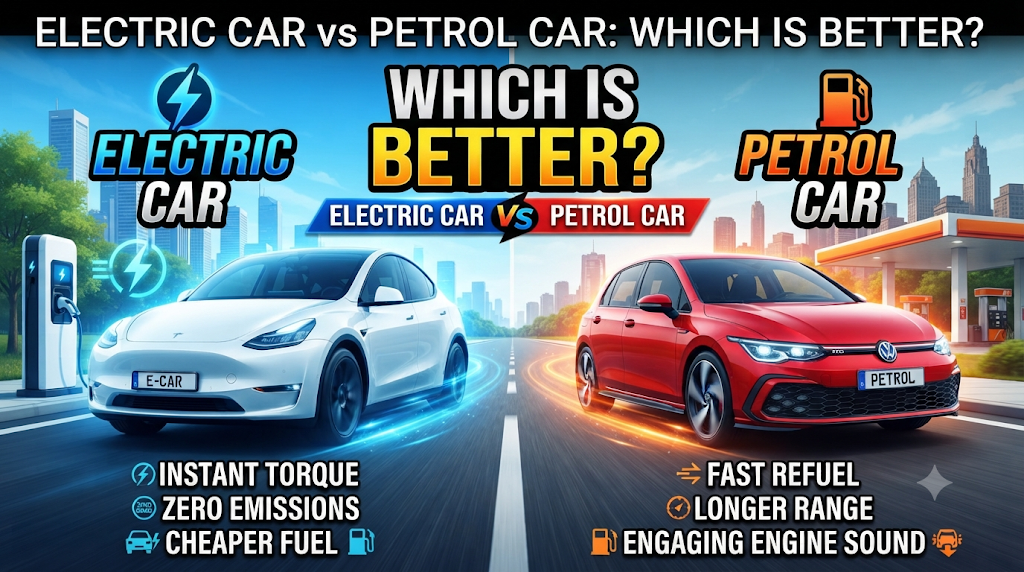
Electric Car vs Petrol Car
Introduction
Electric cars and petrol cars are two major options for people looking to buy a personal vehicle. Electric cars run on rechargeable battery packs and use electric motors, while petrol cars use internal combustion engines powered by petrol. Both offer different advantages in terms of running costs, performance, maintenance, convenience and driving range. Choosing between them depends on your daily travel distance, charging facilities, budget and driving requirements.
Electric cars are becoming increasingly popular because they offer lower energy costs per kilometre, quiet operation and zero tailpipe emissions. Petrol cars, on the other hand, have an established fuel station network, familiar technology and generally quicker refuelling. Although electric cars can be economical over long-term ownership, petrol cars may still be more practical for people who frequently travel long distances or do not have convenient access to charging facilities.
Quick Comparison Table
| Feature | Electric Car | Petrol Car |
|---|---|---|
| Power source | Rechargeable battery | Petrol |
| Engine | Electric motor | Petrol engine |
| Running cost | Generally lower | Generally higher |
| Refuelling | Charging required | Petrol filling |
| Charging/refuelling time | Usually longer | Usually a few minutes |
| Maintenance | Generally lower | Generally higher |
| Driving range | Depends on battery capacity | Depends on fuel tank |
| Performance | Instant torque | Depends on engine |
| Noise | Very quiet | Comparatively noisier |
| Tailpipe emissions | Zero | Produces exhaust emissions |
| Long-distance travel | Requires charging planning | Generally convenient |
| Home energy option | Home charging possible | Not applicable |
1. Power Source and Working Technology
Electric Car
An electric car uses electricity stored in a rechargeable battery pack to operate an electric motor. When the driver presses the accelerator, the motor converts electrical energy into mechanical power to move the wheels. Electric cars do not require petrol, engine oil or conventional exhaust systems.
Petrol Car
A petrol car uses an internal combustion engine. It burns petrol inside the engine cylinders to generate power, which is transferred to the wheels through a transmission system. It requires several mechanical components, including fuel injectors, spark plugs, an exhaust system and engine lubrication.
Winner: Electric Car – Its simpler powertrain has fewer moving parts and does not require petrol combustion.
2. Running Cost
Electric Car
Electric cars generally have lower running costs because electricity is often cheaper per kilometre than petrol. Charging at home can be particularly economical, depending on electricity tariffs, charging efficiency and battery size.
Petrol Car
Petrol cars usually have higher running costs because they need regular fuel purchases. Actual expenses depend on petrol prices, engine efficiency, traffic conditions and driving habits.
Winner: Electric Car – It generally costs less to travel the same distance, particularly when home charging is available.
3. Charging and Refuelling Time
Electric Car
Electric cars require charging to replenish their batteries. Home AC charging can take several hours, depending on the charger and battery capacity. DC fast charging can reduce charging time considerably, but availability varies by location and vehicle.
Petrol Car
Petrol cars can be refuelled at petrol stations within a few minutes. Drivers do not need to wait for a battery to recharge, making petrol cars convenient when travelling long distances.
Winner: Petrol Car – Refuelling is significantly quicker and more widely available.
4. Maintenance and Servicing
Electric Car
Electric cars generally require less routine maintenance because they do not have conventional engines, engine oil, spark plugs or complex exhaust systems. However, tyres, brakes, suspension, cooling systems and battery-related components still require attention.
Petrol Car
Petrol cars need regular engine oil changes, air filter replacements, spark plug inspections and other engine-related servicing. Their larger number of mechanical components can increase routine maintenance requirements.
Winner: Electric Car – It generally requires less routine powertrain maintenance, although repair costs can vary by model.
5. Driving Range and Convenience
Electric Car
The driving range of an electric car depends on battery capacity, vehicle efficiency, speed, temperature, air conditioning usage and driving conditions. Drivers may need to plan charging stops during longer journeys, especially where charging stations are limited.
Petrol Car
Petrol cars generally offer convenient long-distance driving because petrol stations are widely available. Refuelling takes only a few minutes, and drivers can continue their journey without waiting for battery charging.
Winner: Petrol Car – It offers greater refuelling convenience for frequent long-distance journeys.
6. Performance and Acceleration
Electric Car
Electric cars can deliver maximum torque almost immediately when accelerating. This provides quick initial acceleration and smooth power delivery. Many electric cars also offer quiet driving without traditional engine vibrations.
Petrol Car
Petrol cars produce power through engine combustion and transmission systems. Their acceleration depends on engine capacity, turbocharging, vehicle weight and gearbox performance. Some high-performance petrol cars offer excellent acceleration and driving characteristics.
Winner: Depends – Electric cars often offer quicker initial acceleration, while petrol cars provide a different driving experience depending on engine and transmission design.
7. Environmental Impact
Electric Car
Electric cars produce zero tailpipe emissions while driving. However, electricity generation, battery manufacturing and battery material extraction can create environmental impacts. Their overall emissions depend partly on how the electricity is generated.
Petrol Car
Petrol cars release carbon dioxide and other pollutants through their exhaust systems. Petrol extraction, refining and transportation also contribute to their overall environmental impact.
Winner: Electric Car – Electric cars generally have lower lifetime greenhouse gas emissions than comparable petrol cars, although the exact difference depends on electricity generation and vehicle manufacturing.
8. Initial Purchase Price
Electric Car
Electric cars can have a higher initial purchase price than comparable petrol cars because battery packs and electric vehicle technology contribute significantly to manufacturing costs. However, prices vary across vehicle categories and manufacturers.
Petrol Car
Petrol cars are available across a wide range of budgets. Their established manufacturing technology and variety of models make it easier to find options at different price levels.
Winner: Petrol Car – Petrol cars generally offer more affordable entry-level choices, although some electric models can be competitively priced.
9. Home Charging and Fuel Availability
Electric Car
Electric car owners can install a compatible home charging point, subject to electrical capacity, installation requirements and suitable parking arrangements. This makes overnight charging convenient for people with dedicated parking.
Petrol Car
Petrol cars do not require home charging equipment. Drivers can purchase fuel from petrol stations, making them suitable for people who cannot install a home charger.
Winner: Depends – Electric cars are convenient with home charging, while petrol cars are more practical without dedicated charging facilities.
10. Battery Life and Replacement Cost
Electric Car
Electric car batteries are designed to last for many years, but their capacity gradually decreases with use and ageing. Battery replacement can be expensive, although actual costs depend on the vehicle, battery condition, warranty and availability of replacement components.
Petrol Car
Petrol cars do not have large traction batteries. However, they still use conventional 12V batteries and require maintenance or replacement of engine and transmission components over time.
Winner: Petrol Car – It avoids the potential expense of replacing a large traction battery, although long-term repair costs for petrol vehicles can also be substantial.
11. Driving Experience and Noise
Electric Car
Electric cars provide quiet operation, smooth acceleration and minimal vibration because they do not use conventional engine combustion. Their regenerative braking systems can also help recover some energy during deceleration.
Petrol Car
Petrol cars produce engine sounds and vibrations. Some drivers enjoy the traditional engine response, gear changes and sound, while others may prefer a quieter driving experience.
Winner: Electric Car – It offers quieter and generally smoother everyday driving.
12. Long-Term Ownership Cost
Electric Car
Electric cars can offer lower long-term running and routine maintenance expenses. However, the total ownership cost depends on purchase price, electricity tariffs, insurance, depreciation, battery warranty and charging arrangements.
Petrol Car
Petrol cars may cost less to purchase initially, but fuel expenses and regular engine maintenance can increase ownership costs over time. Their total cost also depends on fuel efficiency, annual driving distance and resale value.
Winner: Depends – Electric cars can be more economical for high-mileage owners with affordable charging, while petrol cars may be financially practical for lower-mileage drivers or buyers with limited charging access.
13. Resale Value
Electric Car
The resale value of an electric car depends on battery health, remaining warranty, vehicle condition, brand reputation and demand in the used-car market. Buyers may also consider battery replacement costs and available charging facilities.
Petrol Car
Petrol cars have an established used-car market. Their resale value depends on brand, mileage, maintenance history, age and overall condition. Buyers are familiar with petrol engine technology.
Winner: Petrol Car – It generally benefits from a more established second-hand market, although resale values vary by model.
Which Car Should You Choose?
| Your Requirement | Better Choice |
|---|---|
| Lower running cost | Electric Car |
| Lower routine maintenance | Electric Car |
| Daily city commuting | Electric Car |
| Quick refuelling | Petrol Car |
| Frequent long-distance travel | Petrol Car |
| Lower initial purchase budget | Petrol Car |
| Quiet driving experience | Electric Car |
| No home charging facility | Petrol Car |
| Zero tailpipe emissions | Electric Car |
| Established resale market | Petrol Car |
Final Verdict: Electric Car vs Petrol Car – Which Is Better?
An electric car is a better choice for people who have home charging facilities, regularly drive within the city and want lower running costs with less routine maintenance. It also offers quiet operation, smooth acceleration and zero tailpipe emissions.
A petrol car is more suitable for people who frequently travel long distances, need quick refuelling, have limited access to charging stations or prefer a lower initial purchase price.
Overall Winner: Electric Car for suitable daily-use conditions. However, petrol cars remain a practical choice where charging access, purchase budget and long-distance convenience are more important. The best option depends on your driving habits and total ownership cost rather than the power source alone.
Frequently Asked Questions (FAQs)
1. Is an electric car cheaper to run than a petrol car?
Generally, yes. Home electricity charging usually costs less per kilometre than petrol. However, the actual savings depend on electricity tariffs, petrol prices and vehicle efficiency.
2. Which car requires less maintenance, electric or petrol?
Electric cars generally require less routine maintenance because they do not have conventional engines, engine oil or spark plugs. However, battery and other component repairs can be expensive.
3. Are electric cars suitable for long-distance travel?
Yes. Electric cars can be used for long journeys, but drivers need to plan charging stops according to the vehicle’s range and charging station availability.
4. Do electric cars produce pollution?
Electric cars produce zero tailpipe emissions. However, electricity generation and battery manufacturing can create emissions, so their overall environmental impact is not zero.
5. Which car has better resale value?
Petrol cars generally have a more established resale market. Electric car resale value depends heavily on battery condition, warranty and demand.
6. Is an electric car worth buying in India?
An electric car can be worth buying in India if you have convenient charging facilities, drive regularly and plan to keep the vehicle for several years. Buyers should compare the complete ownership cost before making a decision.
Disclaimer
Vehicle prices, specifications, driving range, battery warranties, charging costs, petrol prices and government policies may change over time. Actual performance and ownership expenses depend on the vehicle model, driving conditions, location and usage. Always verify the latest manufacturer specifications and warranty conditions before purchasing.
Research references: Government of India’s Bureau of Energy Efficiency, NITI Aayog and CEEW. beeindia.gov.in+2