iPhone vs Samsung
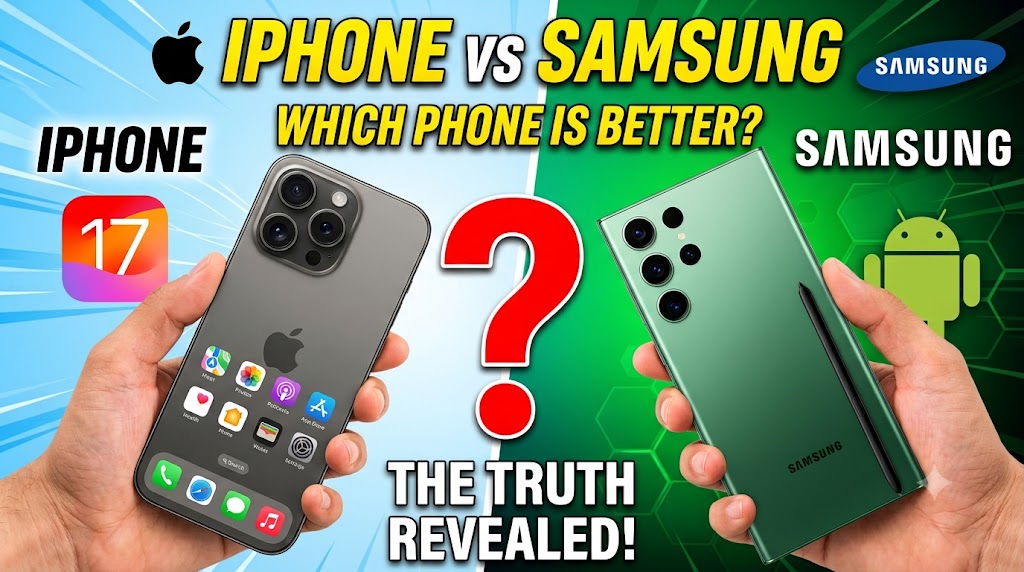
Apple’s iPhone and Samsung Galaxy phones are two of the strongest choices in the premium smartphone market. In 2026, Apple’s flagship range includes the iPhone 17 Pro and iPhone 17 Pro Max, powered by the A19 Pro chip and running iOS 26. The iPhone 17 Pro features a 6.3-inch OLED display, while the Pro Max has a 6.9-inch display. Apple also emphasizes camera processing, video recording, ecosystem integration, and long-term software support. The iPhone 17 Pro starts at ₹134,900 in India. (Apple)
Samsung’s flagship Galaxy S26 series includes the Galaxy S26, S26+, and S26 Ultra, with the Ultra positioned as the most feature-rich model. The Galaxy S26 Ultra has a 6.9-inch QHD+ Dynamic AMOLED 2X display with a 120Hz adaptive refresh rate, Snapdragon 8 Elite Gen 5 for Galaxy, a 200MP main camera, multiple telephoto cameras, a 5,000mAh battery, and Android 16 with One UI 8.5. Samsung also adds features such as an S Pen and built-in Privacy Display to the Ultra. Its India price starts at ₹130,999 for 256GB at the time of checking. (Samsung Global Newsroom)
Quick Comparison Table
| Feature | iPhone | Samsung Galaxy |
|---|---|---|
| Current Flagship | iPhone 17 Pro / Pro Max | Galaxy S26 Ultra |
| Operating System | iOS 26 | Android 16 + One UI 8.5 |
| Flagship Processor | A19 Pro | Snapdragon 8 Elite Gen 5 for Galaxy |
| Display | Super Retina XDR OLED, up to 120Hz | QHD+ Dynamic AMOLED 2X, 120Hz |
| Main Camera | 48MP | 200MP |
| Telephoto | Up to 8x optical-quality zoom | 3x and 10x optical zoom |
| Battery | Up to 31/37 hours video playback depending on model | 5,000mAh |
| Charging | Up to 50% in 20 minutes with 40W+ adapter | Up to 75% in around 30 minutes with compatible charging |
| Customization | More controlled | More extensive |
| Stylus | No built-in stylus | S Pen on S26 Ultra |
| Ecosystem | Apple ecosystem | Samsung/Android ecosystem |
| Starting Flagship Price in India | ₹134,900 | ₹130,999 |
| Best For | iOS, video, ecosystem | Zoom, customization, productivity |
1. Operating System and User Experience
| iPhone | Samsung |
|---|---|
| iOS 26 | Android 16 with One UI 8.5 |
| More controlled interface | More customization |
| Strong Apple-device integration | Strong Galaxy and Android integration |
| Consistent software experience | More flexibility in system features |
The biggest difference is not simply the operating system name. iPhone gives users a more controlled software environment, while Samsung gives users more freedom to customize the interface, manage files, use multitasking features, and change how the phone behaves.
🏆 Winner: Depends on User’s Needs
Choose iPhone if you prefer simplicity and Apple-device integration. Choose Samsung if customization and flexibility are more important.
2. Display
| iPhone | Samsung |
|---|---|
| Super Retina XDR OLED | QHD+ Dynamic AMOLED 2X |
| ProMotion up to 120Hz | Adaptive 1–120Hz |
| 6.3-inch iPhone 17 Pro | 6.9-inch Galaxy S26 Ultra |
| Up to 3,000 nits outdoor brightness on iPhone 17 Pro | QHD+ resolution and Vision Booster |
Both offer high-end displays with adaptive refresh rates up to 120Hz. However, the Galaxy S26 Ultra provides a larger 6.9-inch QHD+ panel, while the iPhone 17 Pro offers a 6.3-inch display and the Pro Max offers 6.9 inches. Samsung also adds its built-in Privacy Display to the S26 Ultra. (Apple)
🏆 Winner: Samsung
Samsung has the stronger display specification package for users who prioritize a large, high-resolution screen and additional display functionality.
3. Performance
| iPhone | Samsung |
|---|---|
| A19 Pro | Snapdragon 8 Elite Gen 5 for Galaxy |
| 6-core CPU | High-end Snapdragon platform |
| 6-core GPU with Neural Accelerators | High-performance CPU/GPU/NPU platform |
| Hardware-accelerated ray tracing | Advanced gaming and AI processing |
Both phones use flagship-level processors designed for demanding applications, gaming, photography, video editing, and AI features. Apple uses its A19 Pro chip in the iPhone 17 Pro models, while Samsung uses the Snapdragon 8 Elite Gen 5 for Galaxy in the S26 Ultra. (Apple)
The practical difference is less about whether either phone is “fast enough”—both are—and more about the software ecosystem and applications the user prefers.
🏆 Winner: Tie
Neither has a sufficiently broad real-world advantage to make one universally better for all users.
4. Camera
| iPhone | Samsung |
|---|---|
| 48MP main, 48MP ultra-wide and 48MP telephoto on Pro models | 200MP main, 50MP ultra-wide, 50MP and 10MP telephoto |
| Up to 8x optical-quality zoom | Up to 10x optical zoom |
| Strong computational photography | High-resolution sensor and multiple zoom options |
| Strong video features | Strong zoom and camera versatility |
The iPhone 17 Pro uses three 48MP cameras and supports up to 8x optical-quality zoom. Samsung’s S26 Ultra uses a 200MP main camera plus 50MP ultra-wide and two telephoto cameras, including 10x optical zoom. (Apple)
This gives Samsung an advantage for users who regularly photograph distant subjects and want more dedicated zoom options. The iPhone remains particularly strong for users who prioritize its integrated photo and video workflow.
🏆 Winner: Samsung
Samsung wins this category for overall camera versatility and dedicated long-range zoom.
5. Video Recording
| iPhone | Samsung |
|---|---|
| Advanced video recording features | Advanced video recording features |
| Dolby Vision up to 4K at 120fps on iPhone 17 | Advanced Nightography Video and stabilization features |
| Strong integration with Apple ecosystem | Strong camera and AI-based video tools |
| ProRes and Pro-level recording features | Broad shooting and editing flexibility |
Video is an area where iPhone has a particularly strong feature set. Apple lists Dolby Vision recording up to 4K at 120fps on the iPhone 17 Pro, alongside professional recording options. Samsung also provides advanced stabilization and low-light video features on the S26 Ultra. (Apple)
For someone who records a lot of video for social media, content creation, or professional workflows, iPhone offers a very mature video-focused feature set.
🏆 Winner: iPhone
6. Battery Life and Charging
| iPhone | Samsung |
|---|---|
| Up to 31 hours video playback on iPhone 17 Pro | 5,000mAh battery on S26 Ultra |
| Up to 37 hours on iPhone 17 Pro Max | Up to 75% charge in around 30 minutes according to Samsung |
| Up to 50% charge in 20 minutes with 40W+ adapter | Super Fast Charging 3.0 |
| Battery capacity is not published by Apple in the same way as Samsung | 5,000mAh rated capacity |
Battery comparisons between iPhone and Android phones should not be based only on mAh because the operating systems, processors, displays, and power management differ. Apple rates the iPhone 17 Pro for up to 31 hours of video playback and the Pro Max for up to 37 hours. Samsung lists a 5,000mAh battery for the S26 Ultra and fast charging of up to 75% in around 30 minutes under its specified conditions. (Apple)
🏆 Winner: Tie
Samsung has the advantage in charging speed and published battery capacity, while Apple provides strong claimed video-playback endurance. The better choice depends on usage.
7. Features and Productivity
| iPhone | Samsung |
|---|---|
| Apple Intelligence | Galaxy AI |
| Face ID | Fingerprint and other authentication options |
| Camera Control | S Pen on Galaxy S26 Ultra |
| Strong Apple ecosystem integration | Multitasking and broader customization |
Samsung has a clear hardware advantage for productivity because the Galaxy S26 Ultra includes an S Pen. Its large display, multitasking capabilities, and Android flexibility can also be useful for users who work directly from their phone. Samsung additionally includes Galaxy AI features. (Samsung Global Newsroom)
iPhone instead focuses heavily on integration with Apple devices and software features such as Apple Intelligence.
🏆 Winner: Samsung
Samsung is the more feature-rich choice for users who want an integrated stylus and greater flexibility.
8. Software and Ecosystem
| iPhone | Samsung |
|---|---|
| iOS 26 | Android 16 + One UI 8.5 |
| Apple Watch, Mac, iPad and AirPods integration | Galaxy Watch, Galaxy Buds, Galaxy Tab and Windows/Android integration |
| Controlled ecosystem | More open and flexible ecosystem |
| Easy continuity between Apple devices | Strong Galaxy ecosystem features |
The better ecosystem depends heavily on the devices a user already owns. Someone using a Mac, Apple Watch, iPad, and AirPods can get more value from an iPhone. A user already invested in Galaxy devices may find Samsung more practical.
🏆 Winner: Depends on User’s Needs
9. Price and Value for Money
| iPhone | Samsung |
|---|---|
| iPhone 17 Pro starts at ₹134,900 in India | Galaxy S26 Ultra starts at ₹130,999 for 256GB on Samsung India |
| Pro Max starts at ₹149,900 | Higher storage configurations cost more |
| Premium pricing | Premium pricing |
| Strong ecosystem value | More hardware features at the flagship level |
At the time of checking, Apple lists the iPhone 17 Pro from ₹134,900 in India. Samsung lists the Galaxy S26 Ultra 256GB at ₹130,999, with higher storage versions priced higher. Prices and promotional offers can change. (Apple)
The Samsung flagship offers features such as an S Pen, 200MP camera, QHD+ display and 5,000mAh battery at a slightly lower starting price than the iPhone 17 Pro. However, value also depends on the ecosystem and software experience the buyer wants.
🏆 Winner: Samsung
Samsung currently offers more hardware-focused features for the starting flagship price, although iPhone can provide better value for users already invested in Apple’s ecosystem.
Final Comparison Table
| Category | iPhone | Samsung | Winner |
|---|---|---|---|
| Operating System | iOS 26 | Android 16 + One UI 8.5 | Depends on User |
| Display | Excellent OLED, up to 120Hz | QHD+ AMOLED, 120Hz | Samsung |
| Performance | A19 Pro | Snapdragon 8 Elite Gen 5 | Tie |
| Camera | Excellent overall system | More versatile zoom system | Samsung |
| Video | Strong professional video features | Strong advanced video features | iPhone |
| Battery | Strong claimed video playback | 5,000mAh + faster charging | Tie |
| Productivity | Strong ecosystem | S Pen + multitasking | Samsung |
| Ecosystem | Excellent Apple integration | Excellent Galaxy integration | Depends on User |
| Value for Money | Premium | More hardware features | Samsung |
Final Verdict
There is no single answer to “iPhone vs Samsung: Which phone is better?” because the better choice depends on what you value most.
Choose iPhone if you:
- Prefer iOS and a controlled software experience.
- Already use a Mac, iPad, Apple Watch, or AirPods.
- Prioritize advanced video recording.
- Want strong integration between Apple devices.
- Prefer a simpler and consistent user experience.
Choose Samsung if you:
- Want more customization and Android flexibility.
- Prioritize camera zoom and versatility.
- Want an S Pen for productivity.
- Prefer a large, high-resolution display.
- Want more hardware features at the flagship level.
🏆 Overall Result: Depends on the User’s Needs
iPhone is the better choice for Apple ecosystem users and people who prioritize video and software integration. Samsung is the better choice for users who want camera versatility, customization, productivity features, and a feature-rich Android experience.
Neither brand is objectively better for everyone. The right choice depends on the user’s existing ecosystem, priorities, and budget.
Disclaimer
Prices, specifications, features, software capabilities, and availability can change over time and may vary by market. Always verify the latest information and current price from Apple or Samsung before purchasing.