PS5 vs Gaming PC
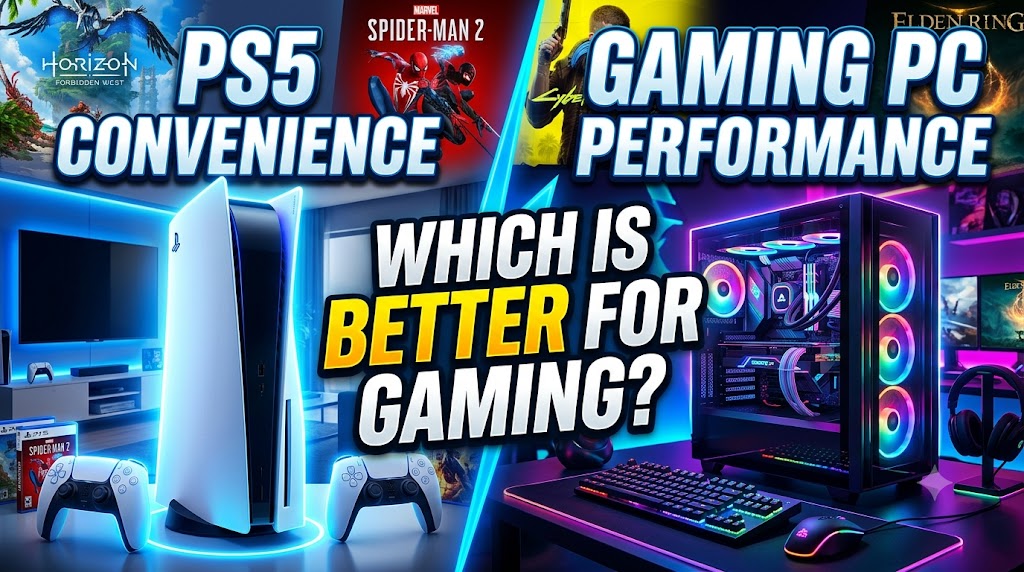
The PlayStation 5 is Sony’s current-generation home gaming console, designed to provide a straightforward gaming experience without requiring users to select individual computer components. The PS5 includes a high-speed SSD, supports 4K output, and features technologies such as ray tracing, Tempest 3D AudioTech, and the DualSense controller’s haptic feedback and adaptive triggers. Depending on the model, players can use physical game discs or purchase games digitally. Sony also offers the PS5 Pro as a more powerful option within the PlayStation family.
Gaming PC
A gaming PC is not a single standardized machine. Its performance depends on the processor, graphics card, memory, storage, cooling system, power supply, and other components selected by the buyer. This flexibility allows a PC to be built for different budgets and performance targets, from mainstream 1080p gaming systems to powerful 1440p or 4K machines. Modern graphics cards such as NVIDIA’s GeForce RTX 50 Series also provide technologies including ray tracing, DLSS, and frame-generation features on supported games.
Quick Comparison Table
| Feature | PS5 | Gaming PC |
|---|---|---|
| Type | Dedicated gaming console | Configurable computer |
| Setup | Simple | More involved |
| Hardware choice | Fixed by model | Highly customizable |
| Graphics settings | Mostly developer-defined presets | Extensive settings available |
| Upgradeability | Very limited | High |
| 4K Gaming | Supported | Depends on hardware |
| High Refresh Rate Gaming | Supported in compatible games/displays | Depends on hardware and game |
| Controller Gaming | Excellent | Supported |
| Keyboard & Mouse | Limited compared with PC | Excellent |
| Game Library | PlayStation ecosystem | PC ecosystem |
| PlayStation PC Releases | Some PlayStation titles are available | Many PlayStation titles available on PC, depending on release |
| Mod Support | Very limited | Broad support in compatible games |
| Non-Gaming Use | Limited | Excellent |
| Portability | Low | Depends on PC type |
| Hardware Maintenance | Low | Higher |
| Upgrade Potential | Low | High |
| Ease of Use | Excellent | Depends on configuration |
| Best For | Simple console gaming | Flexibility and customization |
1. Gaming Performance
PS5
The PS5 uses fixed hardware, which means developers know the capabilities of the platform when optimizing games. The original PS5 specification includes an AMD-based CPU/GPU architecture, 16GB of GDDR6 memory and an SSD designed around high-speed storage. Sony lists 448GB/s memory bandwidth and a raw SSD read bandwidth of 5.5GB/s for the original PS5 specification.
The major advantage is consistency. Every standard PS5 has the same basic hardware configuration, so developers can optimize their games specifically for the console.
Gaming PC
A gaming PC can be substantially faster than a PS5, but there is no single PC performance level. A system using a modern high-end CPU and GPU can provide considerably more graphical processing power, while a budget PC can perform below console level in demanding games.
For example, NVIDIA’s RTX 50 Series includes GPUs designed for high-performance gaming, with features such as ray tracing, DLSS and Multi Frame Generation on supported models and games.
What this means for the user: A PS5 provides predictable performance, while a gaming PC gives you the option to spend more for higher performance.
🏆 Winner: Gaming PC — when comparing a properly equipped modern gaming PC with a standard PS5, the PC has a higher performance ceiling.
2. Graphics Quality
PS5
The PS5 is designed for modern high-resolution gaming and supports features including ray tracing and 4K output. Sony also provides a PS5 Pro for users who want enhanced graphics and performance in supported games.
However, PS5 games generally use developer-selected graphics modes rather than giving users the extensive collection of individual graphics settings available on PC.
Gaming PC
PC gaming provides much greater control over graphics settings. Players can normally adjust resolution, texture quality, shadows, ray tracing, anti-aliasing, frame-rate limits and other settings depending on the game.
A powerful GPU can also provide advanced features such as DLSS and ray tracing. NVIDIA’s current GeForce RTX 50 Series supports DLSS technologies and hardware-accelerated ray tracing.
What this means for the user: If you want maximum control over image quality and performance, PC offers more options. If you simply want to select a graphics/performance mode and start playing, PS5 is easier.
🏆 Winner: Gaming PC
3. Ease of Setup and Use
PS5
The PS5 is built specifically for gaming. You connect it to a display, connect to the internet, update the system, sign in, and install or insert a game. Sony’s setup guidance follows this straightforward process.
There is no need to select a CPU, GPU, motherboard, RAM or power supply.
Gaming PC
A prebuilt gaming PC can also be relatively simple to set up, but PC gaming generally involves more configuration. Users may need to install Windows updates, graphics drivers, launchers, game updates and sometimes troubleshoot compatibility issues.
Building a PC yourself requires even more knowledge.
What this means for the user: If your priority is “connect it and play,” the PS5 has a clear advantage.
🏆 Winner: PS5
4. Upgradeability
PS5
The PS5 has very limited hardware upgradeability. Users cannot replace its CPU or GPU with newer desktop components.
Storage can be expanded using a compatible M.2 SSD, but the fundamental processing hardware remains fixed.
Gaming PC
Upgradeability is one of the biggest strengths of a gaming PC. Depending on the system, users can replace or upgrade the graphics card, processor, RAM, storage, power supply and other components.
This makes it possible to improve performance over time rather than replacing the entire computer.
What this means for the user: PC is much better if you want to gradually upgrade your gaming system.
🏆 Winner: Gaming PC
5. Game Library
PS5
The PS5 provides access to PlayStation games through the PlayStation Store and physical game releases where supported. Sony continues to publish and support PS5 games, including major first-party titles.
Some PlayStation Studios games are also released on PC, but PC releases do not necessarily happen at the same time as their PlayStation releases. Sony’s official PC information lists PlayStation Studios titles available on PC through digital PC storefronts such as Steam and Epic Games.
Gaming PC
PC has access to a very large game ecosystem through platforms such as Steam, Epic Games Store and other digital storefronts. It also supports games designed specifically for Windows and a wide range of older PC titles.
What this means for the user: PS5 is particularly attractive if you want the PlayStation ecosystem. PC is stronger if you want access to a broader computer-gaming environment.
🏆 Winner: Gaming PC — for overall platform flexibility.
6. Exclusive and First-Party Games
PS5
PlayStation remains an important platform for Sony’s first-party games. Some titles launch on PlayStation before eventually reaching PC, while other games may have different release strategies.
This gives PS5 an advantage for players who want to play new PlayStation releases directly on a console.
Gaming PC
PC now receives a growing selection of PlayStation Studios games, but availability and release timing vary by title. Sony itself notes that PlayStation games are available on PC and that more games are announced over time.
What this means for the user: If you specifically want the PlayStation experience and want access to PlayStation releases on the console, PS5 remains the more direct choice.
🏆 Winner: PS5 — for direct access to the PlayStation console ecosystem.
7. Keyboard and Mouse Gaming
PS5
The PS5 supports various accessories, but controller gaming is its primary experience. Keyboard and mouse support can vary depending on the game.
Gaming PC
Keyboard and mouse are fundamental PC input methods. They are particularly useful for first-person shooters, strategy games, simulation games and other genres where precise cursor or aiming control is important.
PlayStation also confirms that its PC games can support keyboard and mouse alongside controllers, although specific features can vary by title.
What this means for the user: PC is the better choice if keyboard-and-mouse gaming is important to you.
🏆 Winner: Gaming PC
8. Controller Experience
PS5
The PS5’s DualSense controller is one of its major advantages. Compatible games can use haptic feedback and adaptive triggers to provide additional physical feedback during gameplay. Sony also highlights 3D Audio support as part of the PS5 experience.
Gaming PC
Gaming PCs support a wide variety of controllers, including PlayStation and Xbox-style controllers. However, controller features can vary between games and platforms.
Sony states that the DualSense can be used with PlayStation PC games, although specific DualSense features and wireless support vary by title.
What this means for the user: Both platforms can provide excellent controller gaming, but PS5 offers the most consistent DualSense-focused experience.
🏆 Winner: PS5
9. Mod Support
PS5
Console games generally provide limited access to modifications compared with PC. Whether a game supports mods is controlled by the developer and platform.
Gaming PC
PC is the preferred platform for game modifications. Many PC games have active mod communities that create graphical improvements, gameplay changes, maps, user interfaces and additional content.
However, mod support is not universal, and some online games restrict modifications for security or competitive reasons.
What this means for the user: If experimenting with mods is important, PC provides much more flexibility.
🏆 Winner: Gaming PC
10. Upfront Cost and Total Cost
PS5
With a PS5, the main hardware platform is fixed. You do not need to separately purchase a CPU, graphics card, motherboard, RAM or power supply.
However, you still need a display and games, and online multiplayer on PS5 requires a PlayStation Plus subscription where applicable. Sony states that a paid PlayStation Plus subscription is required for online multiplayer on PS5.
Gaming PC
The cost of a gaming PC varies dramatically according to its components. A basic system can cost less than a high-end gaming machine, while a powerful PC can become significantly more expensive once a strong GPU, CPU, monitor and peripherals are included.
PC games can also be available through different stores and sales, so the long-term software cost can vary.
What this means for the user: There is no universal winner based purely on price because PC configurations vary so much.
🏆 Winner: Depends on User’s Budget
11. Long-Term Upgrade Potential
PS5
The PS5’s fixed hardware provides consistency, but it also means that meaningful improvements in processing performance generally require moving to another console model rather than replacing individual components.
Sony currently offers the PS5 Pro as a higher-performance member of the PS5 family.
Gaming PC
A PC can evolve over several years. You may upgrade only the GPU, for example, instead of replacing the entire machine.
The upgrade path depends on motherboard compatibility, power supply capacity, cooling and other components.
What this means for the user: PC is better suited to someone who wants to maintain and upgrade a system over time.
🏆 Winner: Gaming PC
12. Non-Gaming Use
PS5
The PS5 is primarily a gaming and entertainment device. It can also be used for supported streaming and media applications, but it is not intended to replace a general-purpose computer.
Gaming PC
A gaming PC can be used for gaming, web browsing, office work, programming, video editing, photo editing, streaming and many other tasks.
What this means for the user: If the device needs to perform jobs beyond gaming, a PC provides substantially more flexibility.
🏆 Winner: Gaming PC
13. Maintenance and Troubleshooting
PS5
Console hardware is standardized, so users generally have fewer component compatibility decisions to make. System software and games still require updates, but there are fewer hardware variables.
Gaming PC
PCs offer more control but also introduce more potential points of failure or configuration problems. Drivers, Windows settings, game launchers, component compatibility and hardware upgrades can require additional attention.
What this means for the user: PS5 is generally better for people who do not want to spend time troubleshooting hardware and software.
🏆 Winner: PS5
14. Portability
PS5
A PS5 can be moved between locations, but it is designed primarily as a home console and requires a display and power connection.
Gaming PC
A desktop gaming PC has similar limitations and can be difficult to move because of its size and peripherals. However, gaming PCs also exist in compact configurations, while gaming laptops provide a completely portable alternative.
For this particular comparison, a typical desktop gaming PC and PS5 are both primarily stationary gaming systems.
🏆 Winner: Tie
15. Online Gaming
PS5
Online multiplayer on PS5 generally requires PlayStation Plus for games that require the subscription, with some exceptions depending on the game.
Gaming PC
PC multiplayer access varies according to the game and its platform. There is generally no console-style systemwide multiplayer subscription requirement equivalent to PlayStation Plus for standard PC online gaming.
What this means for the user: PC can be more convenient for players who regularly play online multiplayer and do not want a console-wide online subscription.
🏆 Winner: Gaming PC
Final Comparison Table
| Category | Winner |
|---|---|
| Gaming Performance | Gaming PC |
| Graphics Flexibility | Gaming PC |
| Ease of Setup | PS5 |
| Upgradeability | Gaming PC |
| Game Library Flexibility | Gaming PC |
| PlayStation Ecosystem | PS5 |
| PlayStation Console Releases | PS5 |
| Keyboard & Mouse | Gaming PC |
| Controller Experience | PS5 |
| Mod Support | Gaming PC |
| Cost | Depends on User’s Budget |
| Long-Term Upgrades | Gaming PC |
| Non-Gaming Use | Gaming PC |
| Maintenance Simplicity | PS5 |
| Portability | Tie |
| Online Gaming | Gaming PC |
Final Verdict
Choose PS5 if:
- You want a simple plug-and-play gaming experience.
- You prefer console gaming over PC configuration.
- You want the PlayStation ecosystem.
- You like playing with the DualSense controller.
- You do not want to upgrade or troubleshoot computer hardware.
- You want a consistent gaming platform without choosing individual components.
Choose a Gaming PC if:
- You want higher potential gaming performance.
- You want extensive graphics settings.
- You want keyboard-and-mouse gaming.
- You want game mods where supported.
- You want to upgrade hardware over time.
- You also need the machine for work, study, editing or other computer tasks.
- You want broader flexibility across PC gaming platforms.
Overall Winner: Depends on Your Needs
There is no universal winner between a PS5 and a gaming PC.
PS5 is the better choice for simplicity, console-focused gaming and the PlayStation ecosystem. Its fixed hardware makes setup and maintenance straightforward.
Gaming PC is the better choice for flexibility, upgradeability, graphics customization and broader computer functionality. A sufficiently powerful PC can also exceed console performance, although achieving that level can require a significantly higher investment.
For a gamer who simply wants to sit down and play without dealing with PC hardware, PS5 is the easier choice. For someone who wants maximum control and expects to use the machine for gaming and other computing tasks, Gaming PC is the stronger long-term platform.
Disclaimer
Gaming performance varies by game, software version, display, settings and PC hardware configuration. PC performance cannot be represented by one fixed specification because gaming PCs use different components. Prices, availability, game releases and hardware specifications can change over time. Always check the manufacturer’s current specifications before making a purchase.