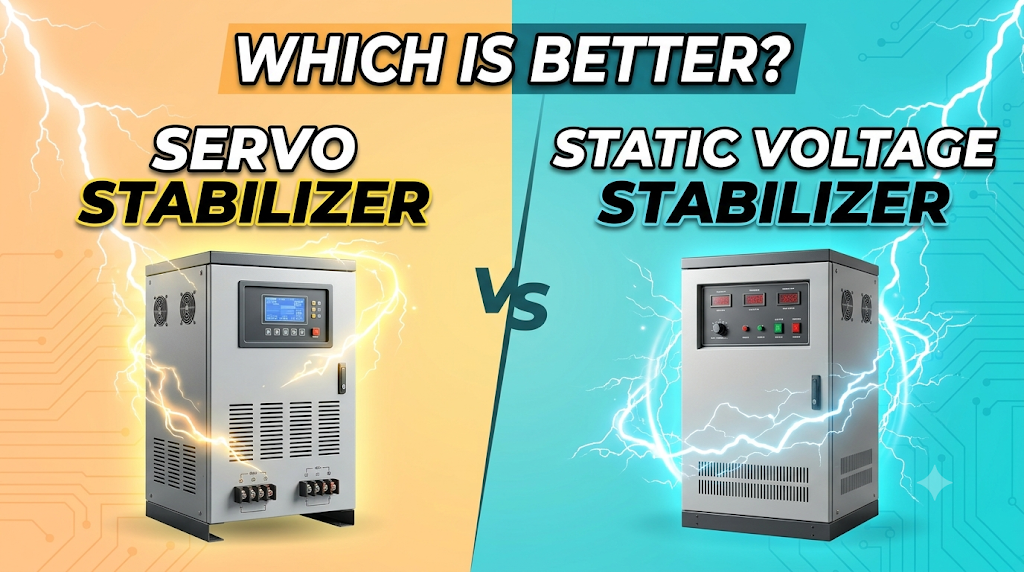
Servo Stabilizer vs Static Voltage Stabilizer
Introduction
A servo voltage stabilizer and a static voltage stabilizer are designed to protect electrical equipment from voltage fluctuations by maintaining a more consistent output voltage. Both can be used in homes, offices, commercial buildings and industrial installations, but they use different technologies to regulate electricity. A servo stabilizer relies on a motor-driven mechanism, whereas a static stabilizer uses electronic power components to make voltage corrections. Understanding these differences is important when choosing a stabilizer for equipment that requires a reliable and stable power supply.
The main difference between these two stabilizers is their correction speed, internal construction, maintenance requirements and cost. Servo stabilizers are commonly considered for applications involving motors, machinery and larger electrical loads. Static stabilizers are useful where fast voltage correction, silent operation and fewer moving parts are important. However, neither technology is automatically suitable for every installation. The correct choice depends on the connected load, voltage fluctuation pattern, required accuracy and the manufacturer’s specifications.
Quick Comparison Table
| Feature | Servo Voltage Stabilizer | Static Voltage Stabilizer |
|---|---|---|
| Working Technology | Servo motor and transformer | Electronic power components |
| Voltage Correction | Mechanical adjustment | Electronic adjustment |
| Response Speed | Comparatively slower | Very fast |
| Voltage Accuracy | Generally high | Model-dependent, can be very high |
| Moving Parts | Yes | No moving regulation parts |
| Maintenance | Requires periodic mechanical inspection | Generally lower mechanical maintenance |
| Operating Noise | May produce motor noise | Generally silent |
| Size | Often larger and heavier | Often more compact |
| Initial Cost | Generally lower | Generally higher |
| Heavy Load Applications | Suitable when correctly rated | Depends on electronic overload capacity |
| Repair Requirements | Motor, brush and transformer servicing | Electronic component servicing |
| Best For | General electrical and industrial loads | Sensitive equipment requiring fast correction |
1. Working Principle
Servo Voltage Stabilizer
A servo voltage stabilizer uses a servo motor, control circuit, variable autotransformer and buck-boost transformer. When the input voltage changes, the control circuit detects the variation and operates the motor to adjust the transformer position. This changes the correction voltage and helps maintain the required output voltage.
The system provides continuous voltage adjustment, but its correction process depends on mechanical movement. Therefore, the time required to correct a large voltage change can be longer than that of an electronic stabilizer.
Static Voltage Stabilizer
A static voltage stabilizer uses electronic components such as IGBTs, SCRs or other semiconductor switching devices, depending on its design. Its electronic control system detects voltage variations and adjusts the output without using a motor-driven brush mechanism.
Because voltage correction does not depend on mechanical movement, a properly designed static stabilizer can respond much faster to sudden voltage changes.
2. Voltage Correction Speed
Servo stabilizers correct voltage through mechanical movement. They can maintain a stable output, but sudden and large voltage fluctuations may take longer to correct.
Static stabilizers use electronic switching, allowing them to respond to voltage changes in milliseconds or within a few AC cycles, depending on their design.
Winner: Static Voltage Stabilizer for applications where fast voltage correction is a priority.
3. Voltage Accuracy
Voltage accuracy determines how closely a stabilizer maintains its output around the required voltage.
Servo stabilizers can provide highly accurate voltage regulation and are available in different accuracy ratings. Static stabilizers can also provide highly accurate output, with some models offering very tight regulation.
Actual accuracy depends on the stabilizer’s design, input voltage range, load conditions and manufacturer specifications.
Verdict: Tie. Both can provide accurate voltage regulation when properly designed and selected.
4. Maintenance Requirements
Servo stabilizers contain moving mechanical components, including a motor and brush mechanism. These components may require inspection, cleaning or replacement after prolonged operation.
Static stabilizers do not use moving mechanical parts for voltage correction. This reduces mechanical maintenance, although their electronic components, cooling fans and electrical connections still require proper inspection.
Winner: Static Voltage Stabilizer for lower mechanical maintenance requirements.
5. Noise During Operation
Servo stabilizers may produce some noise when their motors operate to correct voltage fluctuations. The amount of noise depends on the stabilizer’s construction and operating conditions.
Static stabilizers generally operate silently because their voltage correction process does not require motor movement.
Winner: Static Voltage Stabilizer for quieter operation.
6. Load Handling Capacity
Servo stabilizers are available in a wide range of capacities and can be suitable for heavy electrical loads, including industrial machinery, pumps, motors and commercial installations.
Static stabilizers can also support substantial loads, but their semiconductor components have specific current, temperature and overload limits. Their ability to handle motor starting currents and sudden load changes must be checked carefully.
Verdict: Depends. Servo stabilizers are often a practical option for conventional heavy loads, while static models can be suitable when their overload specifications match the application.
7. Size and Installation
Servo stabilizers generally contain transformers, motors and mechanical adjustment systems. Depending on their capacity, they can be relatively large and heavy.
Static stabilizers can have a more compact design because they use electronic voltage correction. However, cooling arrangements and power ratings also affect their overall size.
Winner: Static Voltage Stabilizer in many comparable installations where compact construction is important.
8. Initial Purchase Cost
Servo stabilizers are generally more economical than comparable static stabilizers, although prices vary according to capacity, input voltage range, accuracy and manufacturer.
Static stabilizers usually have a higher initial purchase cost because of their electronic power components and control systems.
Winner: Servo Voltage Stabilizer for buyers prioritising lower initial investment.
9. Applications and Suitable Uses
Where Is a Servo Voltage Stabilizer Suitable?
- Industrial motors and machinery
- Pumps and compressors
- Commercial electrical installations
- Manufacturing equipment
- Buildings with larger electrical loads
- Applications involving continuous voltage fluctuations
Where Is a Static Voltage Stabilizer Suitable?
- Sensitive electronic equipment
- Laboratory instruments
- Automation systems
- Precision manufacturing equipment
- Telecommunications installations
- Applications requiring very fast voltage correction
The stabilizer must always be selected according to the equipment manufacturer’s power-quality requirements.
10. Which Stabilizer Is Better for Home Use?
For ordinary home electrical loads, a servo stabilizer can be a practical choice when the installation experiences significant voltage fluctuations and requires a suitable higher-capacity stabilizer.
A static stabilizer may be worth considering when sensitive electronics need particularly fast voltage correction, silent operation or reduced mechanical maintenance.
However, buying either stabilizer without checking the total connected load, starting current of motors and air conditioners, input voltage range and protection features can lead to an unsuitable installation.
For homes with multiple air conditioners, water pumps and other heavy appliances, professional load assessment is important before choosing the stabilizer capacity.
Advantages and Disadvantages
Servo Voltage Stabilizer
Advantages
- Generally lower initial purchase cost.
- Suitable for many heavy electrical applications.
- Provides continuous voltage adjustment.
- Available in a wide range of capacities.
- Established technology with familiar servicing requirements.
Disadvantages
- Contains moving mechanical parts.
- Requires periodic mechanical maintenance.
- Slower correction than static technology.
- May produce operating noise.
- Can require more installation space.
Static Voltage Stabilizer
Advantages
- Very fast electronic voltage correction.
- No motor-driven moving parts.
- Generally lower mechanical maintenance.
- Silent operation.
- Can provide highly accurate voltage regulation.
- Often available in compact designs.
Disadvantages
- Generally higher initial purchase cost.
- Electronic components require proper cooling.
- Repairs may require specialised technical support.
- Overload capacity must be checked carefully.
- Performance depends on electronic design and component ratings.
Frequently Asked Questions (FAQs)
1. What is the main difference between servo and static voltage stabilizers?
A servo stabilizer uses a motor-driven transformer adjustment mechanism, while a static stabilizer uses electronic components to regulate voltage. Static models generally provide faster correction.
2. Which stabilizer is faster, servo or static?
A static voltage stabilizer is generally faster because it uses electronic switching instead of mechanical movement.
3. Which stabilizer requires less maintenance?
A static stabilizer generally requires less mechanical maintenance because it does not have motor-driven brushes or other moving regulation parts.
4. Is a static voltage stabilizer better for sensitive electronic equipment?
It can be a better option when very fast voltage correction is required. However, the stabilizer’s actual accuracy, protection features and compatibility must be checked.
5. Is a servo stabilizer suitable for heavy machinery?
Yes. Servo stabilizers are widely used for motors and industrial machinery when their capacity, voltage range and overload ratings are suitable.
6. Do servo and static stabilizers provide battery backup?
No. Both regulate voltage but do not normally provide backup electricity during a power failure. A UPS or inverter with batteries is required for backup.
7. Which stabilizer is more economical?
Servo stabilizers generally have a lower initial purchase cost. Static stabilizers can cost more but may offer advantages in correction speed and mechanical maintenance.
Conclusion
Both servo and static voltage stabilizers can provide effective protection against voltage fluctuations, but their technologies serve different requirements. A servo voltage stabilizer is a practical choice for many conventional electrical installations, heavy loads and buyers looking for a comparatively economical solution. A static voltage stabilizer is better suited to applications where fast voltage correction, silent operation and reduced mechanical maintenance are important. Ultimately, the best choice depends on the connected equipment, voltage conditions, required accuracy and total cost of ownership.
Disclaimer
Voltage stabilizer performance, accuracy, response time, capacity and pricing vary by manufacturer and model. Always check the official technical datasheet, overload rating, input voltage range and equipment compatibility before purchasing or installing a stabilizer. Consult a qualified electrical professional for installations involving heavy electrical loads.
Technical reference: The comparison is based on the operating principles described in Fuji Electric’s servo stabilizer technical guide and the WHO technical guidance on voltage stabilizers. Actual performance varies by model.