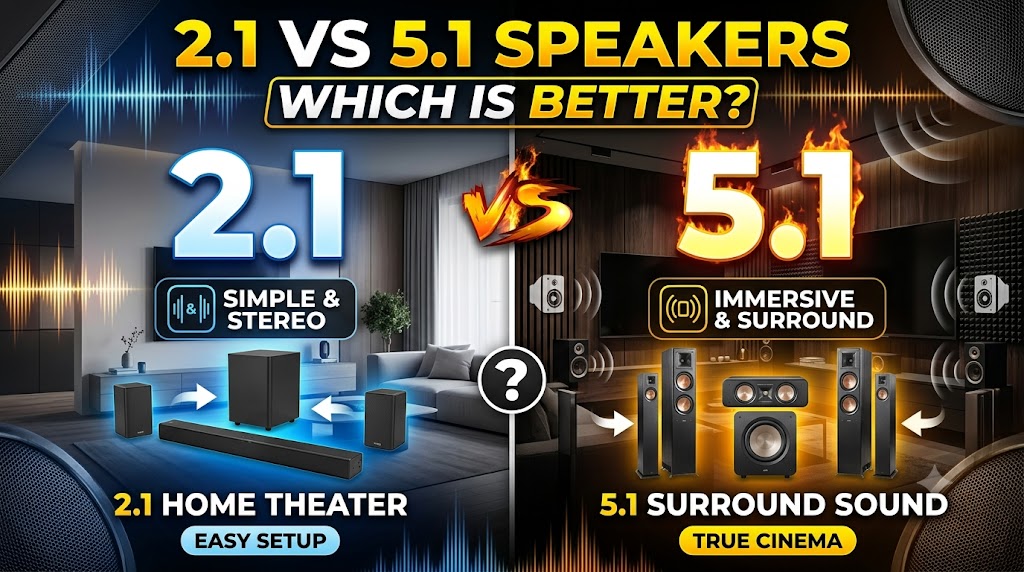
2.1 vs 5.1 Speakers
Choosing the right speaker system depends on the type of sound experience you want, the size of your room, and how much space you can dedicate to speakers. The 2.1 vs 5.1 speakers comparison is especially useful for people deciding between a simple stereo setup with a subwoofer and a more immersive surround-sound system. A 2.1 setup uses two main speakers and one subwoofer, while a 5.1 setup uses five main speakers and one subwoofer. (Dolby Helix)
A 2.1 system is generally simpler to install and works well for music, TV watching, gaming, and smaller rooms. In contrast, a 5.1 system adds a center speaker and two surround speakers, allowing compatible content to place sound around the listener. Therefore, the better option depends on whether you prioritize simplicity and space or a more immersive home-theater experience. (Dolby Helix)
Quick Comparison: 2.1 vs 5.1 Speakers
| Feature | 2.1 Speakers | 5.1 Speakers |
|---|---|---|
| Main speakers | 2 | 5 |
| Subwoofer | 1 | 1 |
| Center speaker | No | Yes |
| Surround speakers | No | Yes |
| Sound experience | Stereo + bass | Surround sound + bass |
| Setup | Simple | More complex |
| Space required | Less | More |
| Movie experience | Good | Better for surround content |
| Music | Very good | Good to very good |
| Gaming | Good | Better for supported surround audio |
| Cable management | Easier | More demanding |
| Best for | Music, TV, small rooms | Home theater, movies, gaming |
| Overall immersion | Good | Excellent |
What Is a 2.1 Speaker System?
A 2.1 speaker system consists of two main speakers and one subwoofer. The two main speakers normally handle the left and right audio channels, while the subwoofer is dedicated to low-frequency sound and bass. (Dolby Helix)
This configuration is similar to a traditional stereo setup but adds a dedicated subwoofer. As a result, it can produce stronger and deeper bass than many basic two-speaker systems.
The simple arrangement also makes a 2.1 system easier to position around a TV, desktop computer, or music setup. You typically place the two speakers on the left and right of the listening position and position the subwoofer where it integrates well with the room.
Advantages of 2.1 Speakers
- Simple installation
- Requires less space
- Easier cable management
- Good stereo sound
- Dedicated subwoofer for stronger bass
- Suitable for music and everyday entertainment
- Usually easier to configure
Limitations of 2.1 Speakers
The biggest limitation is the lack of dedicated center and surround speakers. Therefore, a conventional 2.1 system cannot provide the same physical surround-speaker arrangement as a 5.1 system.
Some systems can use virtual processing to create a wider or more immersive effect, but that should not be confused with having separate physical surround speakers.
🏆 Winner: 2.1 for simplicity and space efficiency
What Is a 5.1 Speaker System?
A 5.1 speaker system uses five main speakers and one subwoofer. The five main channels are normally arranged as left front, center, right front, left surround, and right surround, while the .1 represents the dedicated low-frequency effects/subwoofer channel. (Dolby Helix)
The center speaker is particularly useful for dialogue and central audio information, while the surround speakers can reproduce sounds positioned around the listener.
This makes 5.1 particularly suitable for movies, TV shows, and games that provide compatible multichannel audio.
🏆 Winner: 5.1 for surround-sound immersion
2.1 vs 5.1 Speakers: Sound Quality
Sound quality depends heavily on the actual speakers, amplifier, room acoustics, source material, and placement. Therefore, having more channels does not automatically mean that every 5.1 system will sound better than every 2.1 system.
A good 2.1 system can produce clear stereo imaging and strong bass. Because the speakers are positioned primarily in front of the listener, the soundstage is focused toward the front.
A 5.1 system adds dedicated center and surround channels. With suitable multichannel content, this allows sound to be distributed around the listening position rather than remaining primarily in front.
🏆 Winner: 5.1 for immersive sound; 2.1 for a focused stereo presentation
2.1 vs 5.1 Speakers: Bass Performance
Both systems normally include one subwoofer. The “.1” indicates a dedicated low-frequency channel rather than an additional full-range speaker. (Sony)
Because both configurations can have a dedicated subwoofer, you should not assume that a 5.1 system automatically has stronger bass than a 2.1 system.
Bass performance depends more on the subwoofer’s design, placement, room acoustics, crossover settings, and the capabilities of the complete system.
🏆 Winner: Tie
2.1 vs 5.1 Speakers: Movie Experience
For movies, 5.1 generally has a major advantage.
A 5.1 arrangement provides separate left, center, right, and surround channels. This allows compatible movie soundtracks to create effects around the listener. Sony describes 5.1-channel audio as using two front channels, one center channel, two surround channels, and an LFE subwoofer channel. (Sony)
A 2.1 system can still provide an enjoyable movie experience, especially when paired with good speakers and a capable TV or receiver. However, it lacks the physical rear surround channels of a conventional 5.1 setup.
🏆 Winner: 5.1
2.1 vs 5.1 Speakers: Music
For music, the decision is less straightforward.
Most traditional music is designed around stereo playback, making a good 2.1 system a natural choice. The two main speakers create left-right stereo imaging while the subwoofer handles deeper bass.
A 5.1 system can also play music and may provide an engaging experience when multichannel or processed audio is used. However, additional speakers do not automatically make a stereo music recording better.
For someone who mainly listens to music, a well-designed 2.1 system can therefore be a very sensible choice.
🏆 Winner: 2.1 for traditional stereo music
2.1 vs 5.1 Speakers: Gaming
Gaming can benefit significantly from a 5.1 setup when the game, console, PC, and audio equipment support compatible surround sound.
With speakers positioned around the player, audio effects can come from different directions. This can make explosions, environmental effects, and other directional sounds feel more immersive.
A 2.1 system still works well for gaming and can provide strong front-stage sound and bass. It is also easier to set up around a desk.
🏆 Winner: 5.1 for supported surround gaming
2.1 vs 5.1 Speakers: Dialogue Clarity
The 5.1 system has an important advantage because it includes a dedicated center speaker.
In a conventional 5.1 setup, the center channel is positioned in front of the listener and is used for central audio information. This can be especially useful for movie and TV dialogue. (Sony)
A 2.1 system does not have a dedicated center speaker. Dialogue is reproduced through the left and right speakers.
That does not mean every 5.1 system will automatically provide clearer dialogue. Speaker quality, positioning, room acoustics, and audio settings still matter.
🏆 Winner: 5.1
2.1 vs 5.1 Speakers: Setup and Installation
A 2.1 system is considerably easier to install.
You have two main speakers and one subwoofer, so there are fewer speakers to position and fewer cables to manage. This is particularly convenient for a desktop, bedroom, apartment, or compact living room.
A 5.1 setup requires five main speakers to be positioned appropriately around the listening area. Dolby recommends paying attention to seating position and speaker placement when setting up surround systems. (Dolby)
Consequently, installation can take more time, especially if the surround speakers need wall mounting or longer cable runs.
🏆 Winner: 2.1
2.1 vs 5.1 Speakers: Space Requirements
Space is another important difference.
A 2.1 system needs only left and right speaker positions near the front of the room, along with a suitable location for the subwoofer.
A conventional 5.1 system needs additional positions behind or beside the listener for the surround speakers. Therefore, it is more suitable for rooms where those speakers can be positioned properly.
If your room is small or furniture makes rear-speaker placement difficult, a 2.1 system can be more practical.
🏆 Winner: 2.1
2.1 vs 5.1 Speakers: Cable Management
Cable management is normally easier with 2.1 speakers because there are fewer main speakers.
A 5.1 system can require connections running to the center and surround speakers, depending on the system design. Wireless rear speakers can reduce visible cables, but they may still require power connections.
If you want a clean and simple installation, 2.1 has the advantage.
🏆 Winner: 2.1
2.1 vs 5.1 Speakers: Ease of Use
A 2.1 setup generally has fewer components and fewer positioning requirements.
A 5.1 system can require more configuration, including speaker levels, distances, channel assignments, and room positioning, depending on the receiver or system.
Once correctly configured, however, a 5.1 system can provide a more comprehensive home-theater experience.
🏆 Winner: 2.1
2.1 vs 5.1 Speakers: Room Size
Room size can strongly influence the better choice.
For a small room, a 2.1 system may provide a balanced combination of stereo sound and bass without requiring additional surround speakers.
A medium or large room can provide more opportunities to position five speakers around the listening area. In such a room, 5.1 can make better use of the available space for a surround experience.
However, room size alone should not determine the decision. Speaker placement and listening position remain important.
🏆 Winner: Depends on the room
2.1 vs 5.1 Speakers: Which Is Better for TV?
For ordinary TV viewing, both can work well.
A 2.1 system is a practical upgrade over basic TV audio because it adds dedicated left and right speakers plus a subwoofer.
A 5.1 system is more appropriate when you frequently watch movies, shows, or other content with multichannel surround sound.
Therefore, casual TV viewers may prefer 2.1, while home-theater users will generally benefit more from 5.1.
🏆 Winner: Depends on usage
2.1 vs 5.1 Speakers: Which Is Easier to Upgrade?
A 2.1 system can be easier to start with because it has fewer components. However, whether it can be expanded to 5.1 depends entirely on the receiver, amplifier, connections, and speaker system.
A proper home-theater receiver can support multiple channels and provide a path toward a more advanced surround setup.
Before buying, check the manufacturer’s specifications rather than assuming that any 2.1 system can be upgraded.
🏆 Winner: 5.1 for a dedicated home-theater system
2.1 vs 5.1 Speakers: Which One Offers Better Value?
Value depends on how you will use the system.
If you mainly listen to music, watch regular TV, or need speakers for a smaller room, spending more on additional surround speakers may not provide much practical benefit.
On the other hand, if movies and surround gaming are your priorities, the additional speakers in a 5.1 system can provide a meaningful improvement in immersion.
Therefore, the cheapest system is not necessarily the best value. The better value is the system that matches your actual usage.
🏆 Winner: Depends on your needs
2.1 vs 5.1 Speakers: Pros and Cons
2.1 Speakers
Pros
- Simple setup
- Requires less space
- Easier cable management
- Good stereo performance
- Dedicated subwoofer
- Excellent choice for music
- Suitable for small rooms
Cons
- No dedicated center speaker
- No physical surround speakers
- Less immersive for surround movies
- Limited directional sound compared with 5.1
5.1 Speakers
Pros
- True multi-speaker surround arrangement
- Dedicated center channel
- Dedicated surround channels
- Excellent for movies
- Better for supported surround gaming
- More immersive home-theater experience
Cons
- Requires more space
- More complicated installation
- More cables or components
- Proper placement is more important
- Can be unnecessary for simple stereo listening
Final Comparison Table
| Category | Winner |
|---|---|
| Basic setup | 2.1 |
| Ease of installation | 2.1 |
| Space requirements | 2.1 |
| Cable management | 2.1 |
| Traditional stereo music | 2.1 |
| Bass | Tie |
| Movie surround sound | 5.1 |
| Dialogue channel | 5.1 |
| Surround gaming | 5.1 |
| Home theater | 5.1 |
| Small rooms | 2.1 |
| Larger dedicated theater rooms | 5.1 |
| Overall simplicity | 2.1 |
| Overall immersion | 5.1 |
Final Verdict: 2.1 vs 5.1 Speakers — Which Is Better?
The 2.1 vs 5.1 speakers decision ultimately depends on your priorities.
Choose 2.1 speakers if you want a simple, compact system for music, everyday TV watching, desktop use, or a smaller room. It gives you two-channel stereo sound with the added benefit of a dedicated subwoofer without the complexity of multiple surround speakers.
Choose 5.1 speakers if your priority is movies, home theater, or gaming with compatible surround audio. The additional center and surround speakers allow the system to reproduce a more immersive sound field around the listener. (Dolby Helix)
Overall Winner: 5.1 Speakers
For pure home-theater immersion, 5.1 is the better choice. However, 2.1 is the better choice for simplicity, smaller spaces, and traditional stereo listening. There is no universal winner because the right system depends on your room, content, budget, and listening preferences.
Disclaimer
Speaker performance varies by brand, model, amplifier, room acoustics, placement, and source material. A high-quality 2.1 system can outperform a poorly designed 5.1 system in some situations. Always check the manufacturer’s specifications and consider your room and intended use before purchasing.