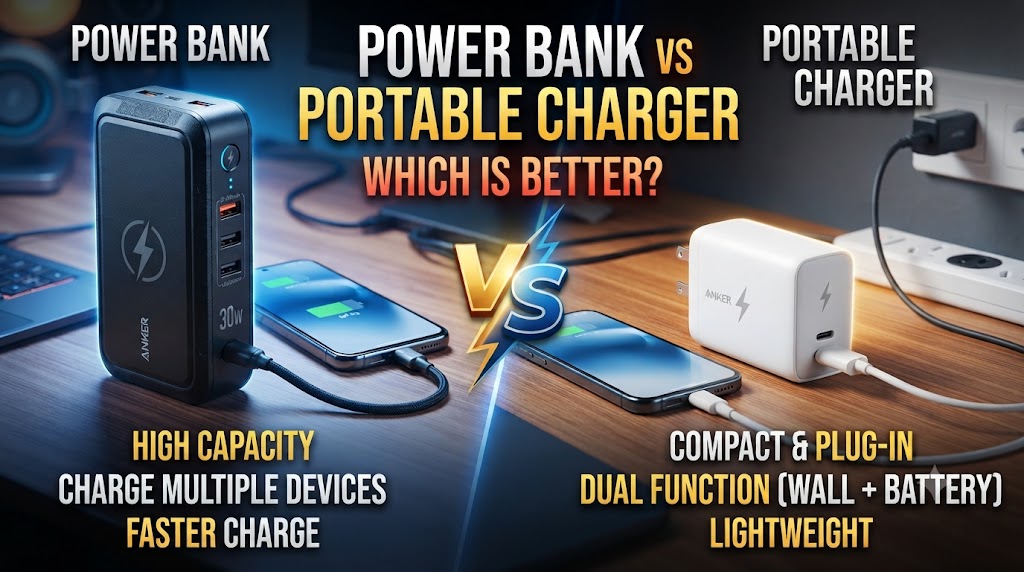
Power Bank vs Portable Charger
A power bank vs portable charger comparison can be confusing because the two terms are often used to describe the same type of device. In everyday use, a power bank is a portable battery that stores electrical energy and can later charge a phone, tablet, earbuds, or another compatible device. The term portable charger is broader and can describe different portable charging solutions.
In this power bank vs portable charger comparison, we will look at their meaning, charging capability, portability, capacity, compatibility, convenience, and practical use. Understanding the terminology can help you choose the right portable charging solution without paying for features you do not need.
Quick Comparison Table
| Feature | Power Bank | Portable Charger |
|---|---|---|
| Basic meaning | Portable battery used to charge devices | Broad term for portable charging devices |
| Battery storage | Yes | Depends on the type |
| Common use | Charging phones and other devices away from outlets | Portable charging in different forms |
| Charging ports | USB-A, USB-C, or both depending on model | Depends on the device |
| Capacity | Usually measured in mAh or Wh | Depends on the type |
| Portability | Usually compact and travel-friendly | Varies by design |
| Charging speed | Depends on output and supported standards | Depends on the charger type |
| Device compatibility | Usually broad | Depends on the specific product |
| Best for | Backup battery power | General portable charging needs |
| Terminology | More specific | More general |
Power Bank vs Portable Charger: Main Difference
The main difference is usually terminology rather than technology.
A power bank normally contains a built-in rechargeable battery. You charge the power bank first, and it stores energy for later use. When your phone or another device needs power, you connect it to the power bank.
“Portable charger” is a broader term. In many online stores and everyday conversations, it is simply another name for a power bank. However, the term can also refer to other portable charging products.
Winner: Tie for everyday usage.
If you are comparing a conventional power bank with a product marketed as a portable charger that also contains a battery, they may effectively be the same type of device.
What Is a Power Bank?
A power bank is a portable battery pack designed to provide power when a wall outlet is not conveniently available.
Most power banks include one or more charging ports. Depending on the model, these can include USB-A and USB-C. Some models also support wireless charging or built-in cables.
Power banks come in different capacities and sizes. A higher-capacity model can generally store more energy, although it may also be larger and heavier.
What Is a Portable Charger?
Portable charger is a more general description.
In many cases, manufacturers and retailers use “portable charger” as another name for a power bank. Therefore, searching for a portable charger will often show products that are technically power banks.
However, the name alone does not tell you important specifications such as battery capacity, charging speed, port type, or supported charging standards.
Therefore, always check the actual specifications before buying.
Battery Capacity
Battery capacity is one of the most important specifications when choosing a power bank.
Manufacturers commonly advertise capacity in mAh, or milliampere-hours. A higher number generally indicates greater stored charge, but advertised capacity should not be interpreted as the exact amount of energy your phone will receive.
Energy is lost during voltage conversion and charging. As a result, the usable output can be lower than the advertised battery capacity.
For this reason, comparing power banks only by their mAh number is not enough.
Winner: Depends on the specific model.
A larger-capacity power bank can be useful for multiple charges, while a smaller model can be easier to carry.
Charging Speed
Charging speed depends on the power bank’s output and the charging technology supported by both the charger and your device.
For example, a power bank may support USB-C Power Delivery or another fast-charging standard. However, your phone must also support the relevant charging technology to achieve the expected speed.
Therefore, do not assume that every portable charger provides fast charging.
Check:
- Maximum output power
- USB-C support
- USB Power Delivery support
- Other supported charging standards
- Your phone’s charging requirements
Winner: Depends on specifications.
Ports and Compatibility
Modern power banks can include different types of ports.
A model with USB-C can be useful for newer phones, tablets, headphones, and other devices. Some models also retain USB-A ports for compatibility with older cables and accessories.
Portable chargers can vary considerably because the term covers a broader category of products.
Before buying, check the connectors you already use.
Winner: Power Bank when you want a clearly specified multi-device battery pack.
Portability
Portability is one of the main advantages of both options.
A small power bank can fit easily into a pocket or small bag. However, high-capacity models tend to be larger and heavier.
A compact portable charger may be more convenient for short trips, while a larger battery pack can be more useful when you expect to be away from a power outlet for a long time.
Winner: Depends on capacity and design.
Convenience
A power bank is convenient because it stores energy in advance.
You can charge it at home and carry it with you. When your smartphone battery becomes low, you can connect the phone without searching for a wall outlet.
Some models also have built-in cables, which can reduce the number of accessories you need to carry.
Winner: Power Bank for straightforward backup power.
Can a Power Bank Charge More Than a Phone?
Yes.
Depending on its capacity, output power, ports, and compatibility, a power bank may charge devices such as:
- Smartphones
- Wireless earbuds
- Smartwatches
- Tablets
- Cameras
- Portable gaming devices
- Some laptops
However, not every power bank can provide enough power for every device.
For example, a laptop may require considerably more power than a smartphone. In such cases, check the power bank’s maximum output and the laptop’s charging requirements before purchasing.
Power Bank vs Portable Charger for Travel
For travel, a power bank can be useful when you spend long periods away from electrical outlets.
A compact model may be suitable for everyday commuting, while a higher-capacity model may be better for longer trips.
However, airline rules can apply to spare lithium batteries and power banks. Before flying, check the current requirements of your airline and the relevant aviation authority.
Which One Is Better for Daily Use?
For most people, there is no meaningful difference between a standard power bank and a portable charger when both refer to a rechargeable battery pack.
Instead of focusing on the name, compare the actual specifications.
Look at:
- Battery capacity
- Output power
- USB-C availability
- Fast-charging support
- Number of ports
- Size and weight
- Safety features
- Compatibility with your devices
These factors matter more than whether the product is called a power bank or portable charger.
Power Bank vs Portable Charger: Which Should You Buy?
Choose a power bank if:
- You want a rechargeable battery for backup power.
- You need to charge your phone away from an outlet.
- You want to compare capacity and output specifications clearly.
- You need portable power for multiple devices.
- You want a compact emergency charging solution.
A portable charger can also be the right choice when the product you’re considering meets your requirements. In many cases, it will simply be another name for a power bank.
Final Verdict
The power bank vs portable charger comparison does not usually produce a clear winner because the two terms often describe the same basic product.
A power bank is the more specific term for a portable rechargeable battery pack, while portable charger is a broader term commonly used for portable charging products and often for power banks themselves.
So, when shopping, focus less on the name and more on capacity, output power, charging standards, ports, compatibility, size, and safety features. These specifications determine whether the product is actually suitable for your devices.
Disclaimer
Specifications, charging speeds, compatibility, battery capacity, prices, and available features can vary by brand, model, region, and product version. Always check the manufacturer’s specifications and current travel or airline requirements before using or carrying a power bank.