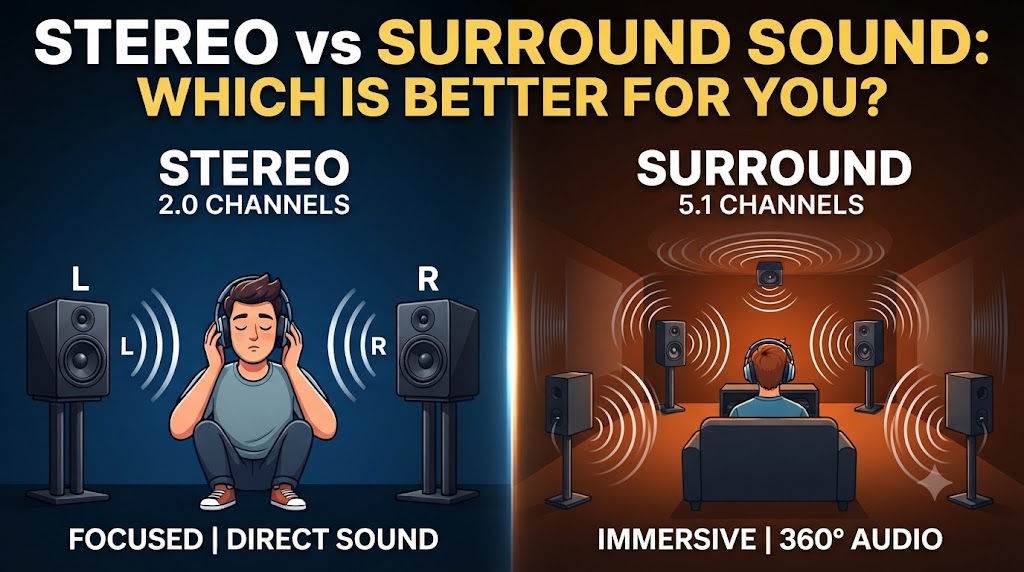
Stereo vs Surround Sound
Stereo and surround sound are two different ways of creating an audio experience. Stereo sound uses two main audio channels, usually left and right, to create a sense of direction and space. Surround sound uses multiple audio channels positioned around the listener to create a more immersive environment.
The better choice depends on the type of content and the equipment being used. Stereo can be simple, compatible, and effective for music and everyday listening, while surround sound can create a more immersive experience for movies, games, and other content designed for multiple audio channels.
Quick Comparison Table
| Feature | Stereo Sound | Surround Sound |
|---|---|---|
| Main Channels | 2 | Multiple |
| Audio Direction | Mainly left and right | Front, sides, rear, and sometimes height |
| Immersion | Good | Generally more immersive |
| Music | Excellent for most music | Depends on content and mix |
| Movies | Good | Well suited to cinematic content |
| Gaming | Good | Useful for positional audio |
| Setup | Simple | Usually more complex |
| Equipment | 2 speakers or headphones | Multiple speakers or compatible virtual system |
| Space Required | Low | Usually higher |
| Cost | Often lower | Can be higher depending on setup |
What Is Stereo Sound?
Stereo sound uses two audio channels: left and right.
The two channels can contain slightly different audio information. Your brain uses these differences to perceive direction, width, and positioning.
Stereo is widely used for music, videos, podcasts, games, television, computers, and headphones.
Advantages of Stereo Sound
- Simple setup
- Works with a wide range of devices
- Excellent compatibility
- Suitable for music
- Easy to configure
- Usually requires less equipment
Limitations of Stereo Sound
Stereo has fewer physical audio channels than a traditional surround system. As a result, it does not normally provide the same level of directional coverage around the listener.
However, good stereo speakers or headphones can still create a convincing sense of space.
What Is Surround Sound?
Surround sound uses multiple audio channels to place sounds around the listener.
A traditional surround setup may use speakers positioned in front, beside, and behind the listener. More advanced formats can also include height channels to create a three-dimensional audio experience.
Surround sound is commonly used for movies, television, gaming, and other immersive entertainment.
Advantages of Surround Sound
- More immersive presentation
- Better directional coverage
- Useful for cinematic content
- Can improve positional awareness in supported games
- Creates a larger sound environment
Limitations of Surround Sound
Surround systems generally require more equipment and setup than stereo.
The actual experience also depends on the source content, speaker placement, room acoustics, and the surround technology being used.
Stereo vs Surround Sound: Number of Channels
The fundamental difference is the number and placement of audio channels.
Stereo uses two main channels, while surround sound uses several channels to distribute audio around the listener.
More channels do not automatically mean better sound quality. They primarily provide additional opportunities to position sounds around the listener.
Stereo vs Surround Sound for Music
Stereo remains a common format for music and works with virtually all conventional music playback systems.
Many music recordings are specifically mixed for stereo, making a good stereo setup an effective choice for music listening.
Some music is also available in multichannel or spatial formats, but the experience depends on whether the recording and playback system support that format.
Practical meaning: For conventional music listening, stereo provides a straightforward and widely compatible solution.
Stereo vs Surround Sound for Movies
Surround sound can provide a more immersive movie experience when the movie soundtrack contains compatible multichannel audio.
Background effects can be positioned around the listener, while dialogue and other sounds can occupy different parts of the sound field.
Stereo can still provide enjoyable movie audio, especially through headphones, televisions, or two-speaker systems.
Practical meaning: If your main goal is a cinema-like home audio experience, a properly configured surround system can add greater spatial immersion.
Stereo vs Surround Sound for Gaming
Both stereo and surround sound can work for gaming.
Stereo can provide directional information through differences between the left and right channels. Surround systems can add more physical or virtual channels, potentially providing more positional information around the player.
Modern gaming platforms and headphones may also use virtual surround or spatial-audio technologies.
Practical meaning: The gaming experience depends not only on the number of channels but also on the game’s audio mix, hardware, software, and implementation.
Stereo vs Surround Sound: Setup
A basic stereo system can require only two speakers or a pair of headphones.
A traditional surround system can require several speakers, an AV receiver or compatible equipment, appropriate positioning, and room calibration.
Virtual surround technologies can reduce the amount of physical equipment needed, but their performance depends on the implementation.
Stereo vs Surround Sound: Cost
Stereo systems are available across a very wide price range and can be relatively simple to build.
Surround systems can become more expensive because they may require additional speakers, amplification, receivers, cables, and other equipment.
However, the price difference is not absolute because both stereo and surround products exist at different budgets.
Which One Should You Choose?
Choose stereo sound if you prioritize:
- Music listening
- Simple setup
- Lower equipment requirements
- Broad compatibility
- Headphone listening
- Two-speaker systems
Choose surround sound if you prioritize:
- Movies and home theater
- Immersive gaming
- Directional effects
- Multi-speaker listening
- A larger sound environment
Overall Verdict
Stereo and surround sound serve different purposes rather than being direct replacements for one another. Stereo provides a simple two-channel listening experience, while surround sound uses multiple channels to create greater spatial immersion.
For everyday listening and conventional music, stereo is practical and widely compatible. For supported movies, games, and home-theater content, surround sound can provide a more immersive audio experience.
Disclaimer
Audio performance depends on the source material, speaker or headphone quality, room acoustics, placement, software, and supported audio formats. Surround sound can also work differently across physical speaker systems and virtual or spatial-audio implementations. Features and compatibility may vary by product and can change over time.