Solar String Inverter vs Microinverter
Introduction
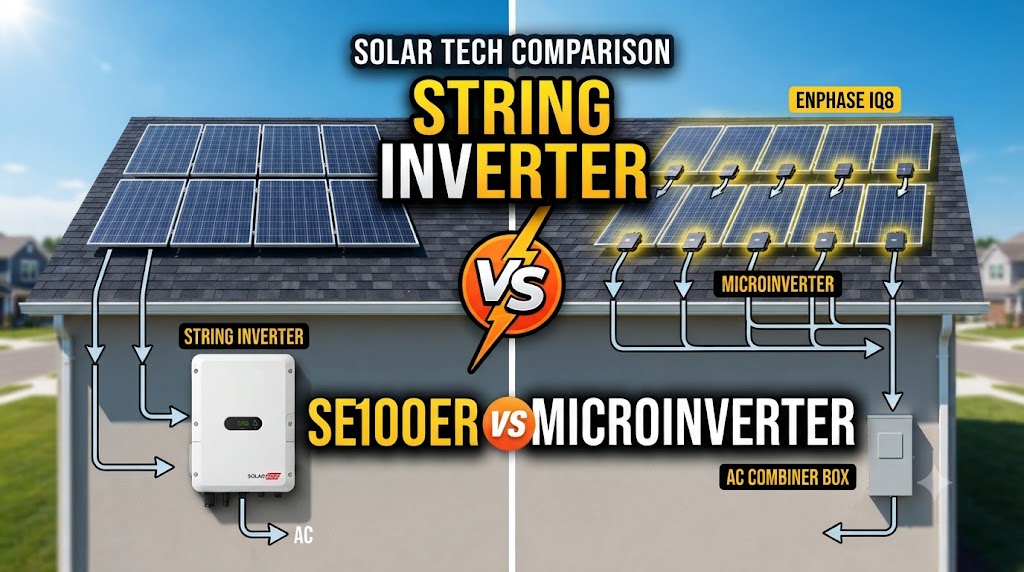
A solar inverter is an important part of a solar power system because it converts the direct current (DC) electricity produced by solar panels into alternating current (AC) electricity used by household appliances and electrical equipment. Solar string inverters and microinverters perform this function differently. A string inverter connects multiple solar panels into one or more groups, while microinverters are installed separately on individual panels.
The choice between these two inverter types can affect system design, monitoring, installation cost, maintenance, and performance under partial shading. String inverters are commonly used in residential and commercial solar installations because of their relatively simple design and competitive cost. Microinverters offer panel-level power conversion and monitoring, which can be useful when different panels receive different amounts of sunlight.
Quick Comparison Table
| Feature | Solar String Inverter | Microinverter |
|---|---|---|
| Installation | Usually one central inverter for a panel string | Individual inverter for each panel |
| Power conversion | Converts DC from a group of panels | Converts DC from each panel |
| Panel-level monitoring | Depends on additional equipment | Commonly supported |
| Partial shading | Can affect output of panels in a string | Often handles panel-level differences better |
| Initial cost | Generally lower | Generally higher |
| System expansion | Depends on inverter capacity and design | Can be easier to expand |
| Maintenance | Central inverter is one main service point | Multiple units may need servicing |
| Roof suitability | Best when panels have similar sunlight conditions | Useful for complex roofs |
| System design | Relatively simple | More distributed design |
| Common applications | Residential and commercial systems | Residential and selected commercial systems |
What Is a Solar String Inverter?
A solar string inverter is a central inverter connected to a group of solar panels wired together in a series circuit called a string. The panels generate DC electricity, which travels to the inverter. The inverter then converts it into AC electricity for household or commercial use.
A system may have one or more strings connected to a single inverter, depending on the system size and inverter design. String inverters are widely used because they offer a practical balance between cost, performance, and installation simplicity.
Advantages of Solar String Inverters
- Lower initial cost: They are generally more affordable than systems using microinverters.
- Simple installation: One central inverter can manage multiple solar panels.
- Easy maintenance access: The main inverter is usually installed in an accessible location.
- Common technology: Many solar installers are familiar with string inverter systems.
- Suitable for larger systems: They are commonly used in residential, commercial, and industrial installations.
Disadvantages of Solar String Inverters
- Shading can affect output: A shaded panel can reduce the performance of other panels in the same string, depending on the circuit design and bypass diode operation.
- Central point of failure: If the inverter stops working, the connected solar panels may stop supplying usable AC power.
- Limited panel-level visibility: Individual panel monitoring may require additional equipment.
- Roof orientation matters: Panels with significantly different sunlight conditions may need separate strings or suitable MPPT inputs.
What Is a Microinverter?
A microinverter is a small inverter installed on or near an individual solar panel. Instead of sending DC electricity from several panels to one central inverter, each microinverter converts the DC electricity from its connected panel into AC electricity.
Because power conversion takes place at the panel level, each panel can operate more independently. This can be useful on roofs where panels face different directions or experience different levels of shading.
Advantages of Microinverters
- Panel-level power conversion: Each panel has its own inverter.
- Better handling of uneven sunlight: A shaded panel is less likely to affect the output of other panels in the same way as a conventional string arrangement.
- Individual panel monitoring: Many systems allow users to check the performance of each panel.
- Flexible roof design: Panels can often be installed in different orientations more easily.
- Expandable design: Additional panels can often be added by installing compatible microinverters, subject to system limits.
Disadvantages of Microinverters
- Higher initial cost: A microinverter system can cost more than a comparable string inverter system.
- More components: Multiple inverters are installed across the solar array.
- Roof access for servicing: A faulty unit may require access to the panel and mounting area.
- System compatibility: Microinverters must be compatible with the panel specifications and electrical design.
Key Differences Between Solar String Inverters and Microinverters
1. Working Principle
A string inverter converts DC electricity from a group of connected solar panels. A microinverter converts electricity separately at each panel. This is the most important difference between the two systems.
2. Performance Under Partial Shading
In a string system, shading on one panel can affect the current and output of its string, although bypass diodes and MPPT design can reduce the impact. Microinverters allow panels to operate more independently, which can improve energy production when shading varies across the roof.
3. Installation Cost
String inverter systems generally have a lower initial cost because they use fewer inverter units. Microinverter systems usually require a separate unit for each panel, increasing equipment and installation costs.
4. Monitoring
Many microinverter systems provide individual panel-level monitoring. String inverter systems commonly provide overall system monitoring, although panel-level monitoring can be added with compatible optimisers or monitoring equipment.
5. Maintenance
A string inverter is a central component that can usually be accessed without removing solar panels. Microinverters are distributed across the array, so servicing an individual unit may require access to the roof.
6. System Expansion
Microinverter systems can offer flexibility when adding panels, provided the equipment and electrical design support expansion. String inverter expansion depends on available inverter capacity, MPPT inputs, string voltage limits, and system design.
Which Is Better for Different Applications?
| Application | Suitable Option |
|---|---|
| Unshaded rooftop with similar panel orientation | String inverter |
| Roof with partial shading | Microinverter |
| Multiple roof directions | Microinverter or carefully designed string system |
| Budget-focused solar installation | String inverter |
| Individual panel monitoring | Microinverter |
| Larger commercial installation | String inverter is commonly considered |
| Future system expansion | Microinverter may offer flexibility |
Solar String Inverter vs Microinverter: Which Should You Choose?
Choose a solar string inverter if:
- Your roof receives mostly uniform sunlight.
- Your panels face similar directions.
- You want a lower initial installation cost.
- You prefer a central inverter that is easier to access for servicing.
Choose microinverters if:
- Different panels receive different amounts of sunlight.
- Your roof has multiple orientations or partial shading.
- You want individual panel-level monitoring.
- You value a modular system design and its expansion flexibility.
Final Verdict
A solar string inverter is generally the practical choice for a straightforward rooftop installation with little shading and panels facing similar directions. It usually offers a lower initial cost and a simpler maintenance arrangement.
Microinverters can be a better option for complex rooftops, different panel orientations, or installations where partial shading is a concern. They also offer individual panel monitoring. Before choosing, compare the total installed cost, inverter efficiency, warranty, monitoring features, service availability, and expected energy generation.
Frequently Asked Questions (FAQs)
1. What is the main difference between a string inverter and a microinverter?
A string inverter converts DC electricity from a group of connected solar panels, while a microinverter converts DC electricity separately at each panel.
2. Are microinverters better in shade?
They can improve performance when shading affects individual panels differently because each panel has its own inverter. However, actual results depend on the shade pattern and system design.
3. Are string inverters cheaper?
Generally, yes. String inverter systems usually have a lower initial cost than comparable microinverter systems.
4. Can microinverters monitor individual solar panels?
Many microinverter systems provide panel-level monitoring, allowing users to check the performance of individual panels.
5. Which inverter is better for home solar systems?
A string inverter is often suitable for a simple, unshaded roof. Microinverters may be more suitable for complex roofs with different orientations or partial shading.
Disclaimer
Solar inverter efficiency, compatibility, pricing, warranties, and performance vary by manufacturer and model. Shading performance also depends on panel wiring, bypass diodes, MPPT design, and installation conditions. Always check the technical datasheet and consult a qualified solar installer before selecting an inverter.