Video Doorbell vs CCTV Camera
Introduction
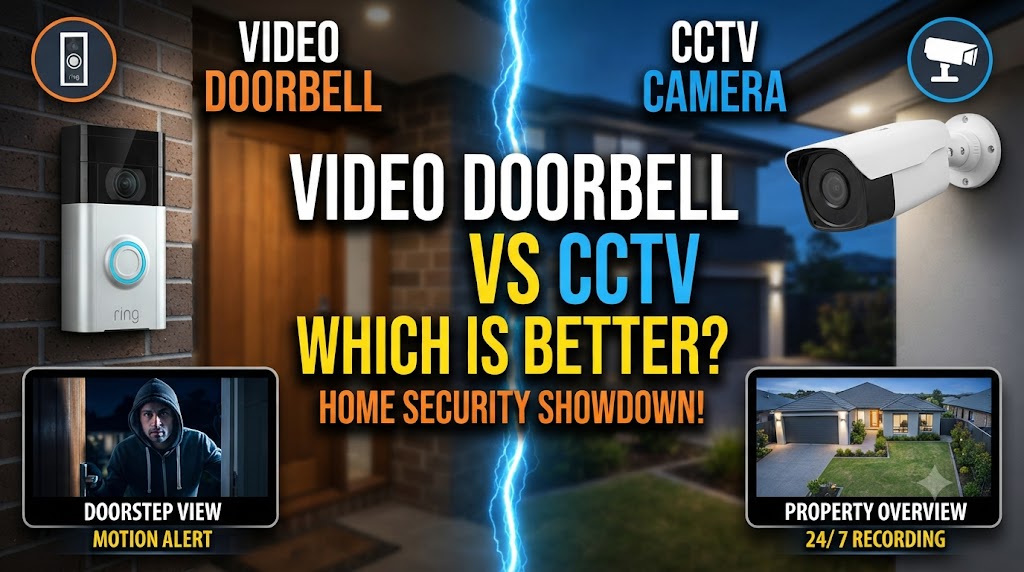
A video doorbell and a CCTV camera can both help monitor your home, but they are designed for different purposes. A video doorbell is installed near the entrance and combines a doorbell with a camera, microphone, speaker, and often motion detection. A CCTV camera is primarily designed for video surveillance and can cover areas such as entrances, driveways, gardens, parking spaces, and other parts of a property.
The right choice depends on the area you want to monitor and the features you need. A video doorbell can be useful for seeing and communicating with visitors at the front door, while a CCTV camera can provide broader or continuous surveillance depending on the system. Let’s compare them based on coverage, two-way communication, recording, installation, storage, night vision, alerts, and overall home-security use.
Quick Comparison Table
| Feature | Video Doorbell | CCTV Camera |
|---|---|---|
| Main Purpose | Door and visitor monitoring | General video surveillance |
| Typical Location | Near the entrance | Indoor or outdoor areas |
| Visitor Communication | Built-in two-way audio | Available on some models |
| Doorbell Function | Yes | No |
| Field of View | Focused around entrance | Varies by camera |
| Continuous Surveillance | Depends on model | Common in CCTV systems |
| Motion Detection | Common | Common |
| Mobile Alerts | Common on smart models | Available with compatible systems |
| Night Vision | Available on many models | Available on many models |
| Recording | Local or cloud, depending on model | Local NVR/DVR, SD card, or cloud depending on system |
| Installation | Usually simpler | Depends on wired/wireless setup |
| Multi-Camera Coverage | Limited to individual units | Designed for multi-camera systems |
| Best For | Front-door and visitor monitoring | Wider property surveillance |
Video Doorbell vs CCTV Camera: What Is the Difference?
Video Doorbell
A video doorbell combines a doorbell with a camera and communication system. When someone approaches or presses the doorbell, the device can notify you and allow you to see the visitor.
Many models also include motion detection and two-way audio. Depending on the product, video may be stored locally or through a cloud service.
CCTV Camera
A CCTV camera is primarily a surveillance device. It can be installed in different locations to monitor specific areas of a property.
CCTV systems can include multiple cameras connected to a DVR or NVR, allowing several areas to be monitored and recorded together.
Video Doorbell vs CCTV Camera: Main Purpose
Depends on what you want to monitor.
A video doorbell is specifically designed around the entrance. It is useful for identifying visitors, delivery personnel, and people approaching the door.
A CCTV camera is more flexible for general surveillance. It can monitor a gate, driveway, parking area, backyard, corridor, shop entrance, or other locations.
Therefore, neither device is automatically better for every home-security situation.
Video Doorbell vs CCTV Camera: Visitor Monitoring
Video Doorbell wins for dedicated visitor monitoring.
A video doorbell is designed specifically for people arriving at the door.
When a visitor presses the doorbell, the homeowner can receive an alert and, on supported models, see and speak with the visitor through the device.
A CCTV camera can also record visitors approaching an entrance, but it does not normally include a doorbell function.
Video Doorbell vs CCTV Camera: Two-Way Communication
Video Doorbell generally offers a more integrated experience.
Many video doorbells include a microphone and speaker for two-way communication. This allows you to speak with someone standing outside the door.
Some modern CCTV cameras also support two-way audio, but this feature is not universal across all CCTV cameras.
If communication with visitors is a primary requirement, checking the exact camera or doorbell specifications is important.
Video Doorbell vs CCTV Camera: Coverage Area
CCTV Camera generally offers more flexibility.
A video doorbell is normally positioned to view the area immediately around an entrance.
CCTV cameras are available in different designs and viewing angles. Depending on the camera, they can monitor a narrow entrance or a larger outdoor area.
For larger properties, multiple CCTV cameras can also be installed at different locations.
Video Doorbell vs CCTV Camera: Continuous Recording
CCTV Camera generally has an advantage for dedicated surveillance recording.
Many CCTV systems are designed for continuous recording and can store footage on an NVR, DVR, or other storage system.
Video doorbells vary considerably. Some support continuous recording, while others focus primarily on motion-triggered or event-based recording.
If continuous surveillance is important, check the recording mode and storage specifications before buying.
Video Doorbell vs CCTV Camera: Motion Detection
Both can provide motion detection.
Video doorbells can detect movement around the entrance and send alerts when activity is detected.
CCTV cameras can also use motion detection to trigger recording or notifications.
The actual performance depends on the model, detection technology, placement, and settings.
Video Doorbell vs CCTV Camera: Night Vision
Both can offer night vision.
Many video doorbells use infrared or other low-light technologies to provide visibility after dark.
CCTV cameras are also widely available with infrared night vision. Some models are designed specifically for outdoor nighttime surveillance.
For either device, night-vision range and image quality can vary significantly between models.
Video Doorbell vs CCTV Camera: Recording and Storage
CCTV Camera generally provides more storage flexibility in a conventional surveillance system.
CCTV systems can use DVRs or NVRs with storage drives designed to retain surveillance footage. Some cameras also support memory cards or cloud storage.
Video doorbells may use internal storage, memory cards, or cloud recording, depending on the model.
Cloud recording can also involve a subscription, so the storage method and ongoing cost should be checked before purchase.
Video Doorbell vs CCTV Camera: Installation
Video doorbell is generally simpler for a single entrance.
A video doorbell can often be installed around an existing doorbell location, although wired models may require electrical wiring.
CCTV installation depends on the type of system. Wireless cameras may be relatively simple to install, while wired PoE or traditional CCTV systems can require cable routing and additional equipment.
For multiple cameras, CCTV installation can become more involved but also provides broader coverage.
Video Doorbell vs CCTV Camera: Power
Both devices require power, but the method varies.
Video doorbells may be:
- Battery-powered
- Wired to existing doorbell wiring
- Designed with other power options depending on the model
CCTV cameras may use:
- Separate power adapters
- PoE through an Ethernet cable
- Other wired or wireless power arrangements
For outdoor installation, power availability should be considered before selecting the device.
Video Doorbell vs CCTV Camera: Mobile Alerts
Both can provide mobile alerts when supported.
Smart video doorbells can send notifications when the doorbell is pressed or motion is detected.
Network-connected CCTV cameras can also send alerts through compatible apps.
However, notification features depend on the model, software, network connection, and subscription requirements where applicable.
Video Doorbell vs CCTV Camera: Privacy
Depends on placement and usage.
A video doorbell is normally aimed at the entrance and nearby area. A CCTV camera can potentially cover a much wider area.
Cameras should be positioned responsibly and configured according to applicable privacy rules and local requirements. Avoid unnecessarily recording private areas belonging to other people.
Video Doorbell vs CCTV Camera: Multi-Camera Security
CCTV Camera wins for larger surveillance setups.
A CCTV system is designed to work with multiple cameras. You can place cameras at the front gate, entrance, driveway, backyard, parking area, and other locations.
A video doorbell normally focuses on one entrance.
For a larger property where several areas need monitoring, a multi-camera CCTV setup can provide more comprehensive coverage.
Which Is Better for Home Security?
There is no single choice that suits every home.
A video doorbell is particularly useful when your main concern is the front door and visitors. Its combination of video, doorbell functionality, motion alerts, and two-way communication makes it convenient for entrance monitoring.
A CCTV camera is more suitable when you want to monitor areas beyond the front door. Multiple cameras can provide surveillance around a property, and many systems support dedicated recording through DVRs or NVRs.
For some homes, using both can provide complementary coverage: a video doorbell for the main entrance and CCTV cameras for other areas.
Video Doorbell vs CCTV Camera: Which Should You Choose?
| If You Want… | Better Fit |
|---|---|
| Monitor visitors at the door | Video Doorbell |
| Doorbell + camera in one device | Video Doorbell |
| Talk to visitors remotely | Video Doorbell |
| Monitor a driveway | CCTV Camera |
| Monitor a backyard | CCTV Camera |
| Monitor multiple areas | CCTV Camera |
| Dedicated multi-camera surveillance | CCTV Camera |
| Continuous surveillance recording | CCTV Camera |
| Front-door monitoring plus wider property coverage | Both |
Conclusion
A video doorbell and CCTV camera solve different home-security needs. A video doorbell is centered around the entrance and provides features such as visitor monitoring, doorbell alerts, and two-way communication. A CCTV camera is more focused on surveillance and can be positioned to monitor different areas of a property.
If your priority is front-door and visitor monitoring, a video doorbell is a suitable choice. If you need broader property surveillance or multiple-camera coverage, a CCTV system is generally more appropriate. For homes requiring both visitor interaction and wider surveillance, combining a video doorbell with CCTV cameras can provide complementary coverage.
Disclaimer
This comparison is for general informational purposes. Video doorbell and CCTV features vary by model, manufacturer, installation method, storage system, and subscription plan. Recording, cloud storage, privacy, and surveillance requirements may also vary by location. Check the manufacturer’s specifications and applicable local rules before installation.