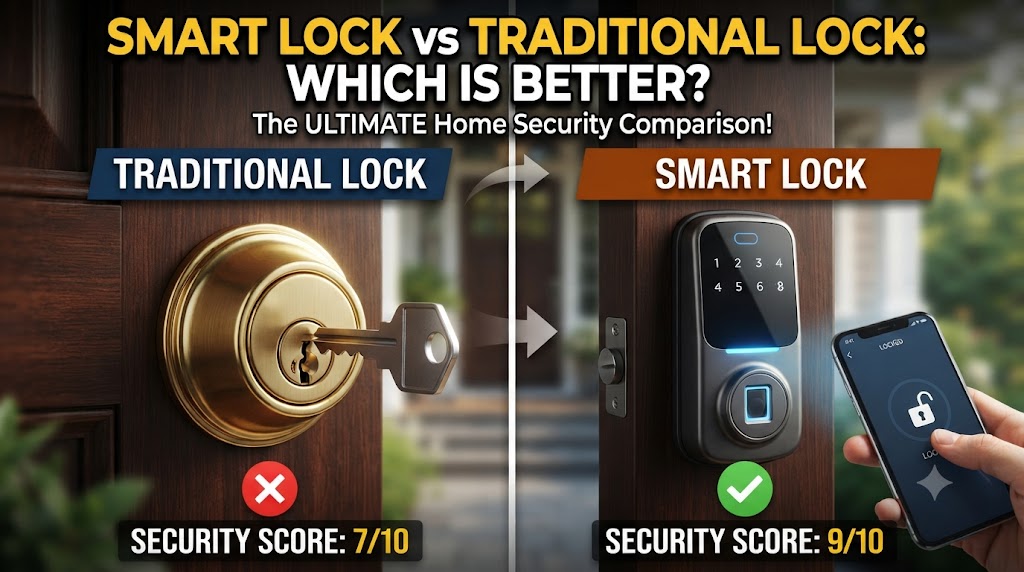
Smart Lock vs Traditional Lock
Introduction
A door lock is one of the most basic parts of home security, but the technology behind locks has changed significantly. Smart locks use electronic systems such as PIN codes, fingerprints, smartphone apps, or other access methods, while traditional locks generally use a physical key. Both can secure a home, but they differ in convenience, access control, installation, maintenance, and dependence on power or electronics.
Choosing between a smart lock and a traditional lock depends on how you use your home and what you expect from your security system. A smart lock can provide keyless entry and additional access-management features, while a traditional lock offers a simple mechanical design that does not normally require batteries, an internet connection, or an app. Let’s compare the two to understand which option may suit different home-security needs.
Quick Comparison Table
| Feature | Smart Lock | Traditional Lock |
|---|---|---|
| Unlocking | PIN, fingerprint, app, card, or other methods | Physical key |
| Keyless Entry | Yes | No |
| Remote Access | Available on some models | No |
| Temporary Access | Available on many models | Limited |
| Power Requirement | Usually battery-powered | No |
| Internet Requirement | Only for certain smart features | No |
| Installation | Can be more complex | Usually simpler |
| Maintenance | Batteries and electronics may need attention | Generally low maintenance |
| Access Management | More flexible | Basic |
| Emergency Operation | Depends on model | Physical key |
| Security | Depends on lock design and installation | Depends on lock design and installation |
| Best For | Keyless access and access control | Simple, independent locking |
Smart Lock vs Traditional Lock: How Do They Work?
Smart Lock
A smart lock replaces or works with a conventional locking mechanism and adds electronic access control. Depending on the model, you may be able to unlock the door using a PIN, fingerprint, smartphone, RFID card, or another supported method.
Some smart locks can also connect to a smartphone or smart-home system. This can allow features such as checking lock status, creating temporary access codes, or controlling the lock remotely.
Traditional Lock
A traditional lock normally relies on a mechanical key and locking mechanism. When the correct key is inserted and turned, the internal mechanism allows the door to unlock.
Its major advantage is simplicity. It does not normally depend on batteries, software, Wi-Fi, Bluetooth, or a smartphone.
Smart Lock vs Traditional Lock: Access and Convenience
Smart Lock wins for convenience.
With a smart lock, you may not need to carry a physical key. Depending on the model, you can enter using a fingerprint, PIN, smartphone, card, or another supported method.
A traditional lock requires the correct physical key. Losing the key can become inconvenient, particularly if there is no spare key available.
However, smart-lock convenience depends on the access method and model. A fingerprint reader, keypad, or app can also fail or become unavailable under certain circumstances.
Smart Lock vs Traditional Lock: Security
Depends on the lock and installation.
A smart lock is not automatically more secure simply because it is smart. Its security depends on the physical locking mechanism, electronic design, authentication method, installation, and the manufacturer’s security features.
Traditional locks also vary considerably. A well-designed mechanical lock can provide strong protection, while a basic or poorly installed lock may provide less resistance to physical attacks.
Therefore, the word “smart” should not be treated as a guarantee of higher physical security.
Smart Lock vs Traditional Lock: Keyless Entry
Smart Lock wins.
Keyless entry is one of the biggest differences between these two options.
Smart locks can support methods such as:
- PIN codes
- Fingerprints
- Smartphone apps
- RFID cards or tags
- Other electronic credentials
Traditional locks normally require a physical key.
For households that frequently forget or lose keys, keyless access can be particularly convenient.
Smart Lock vs Traditional Lock: Remote Access
Smart Lock wins, when supported.
Some connected smart locks allow remote control or monitoring through a smartphone app. This can be useful if you want to provide access to someone while you are away or check the lock’s status remotely.
A traditional mechanical lock does not provide remote access.
However, remote functionality often requires additional connectivity and may depend on the specific smart-lock model and its ecosystem.
Smart Lock vs Traditional Lock: Temporary Access
Smart Lock wins.
Many smart locks allow temporary PINs or digital access credentials to be created for guests, family members, or service providers.
For example, you may be able to provide a temporary access code instead of giving someone a physical key.
With a traditional lock, providing temporary access generally means giving someone a physical key or making another arrangement.
Smart Lock vs Traditional Lock: Power Requirement
Traditional Lock wins for simplicity.
Most smart locks use batteries or another electrical power source for their electronic functions. The exact battery life varies by model and usage.
If the battery becomes depleted, the lock’s emergency-access procedure becomes important. Some models provide backup options such as an external power connection or physical key.
A traditional mechanical lock normally does not need electrical power at all.
Smart Lock vs Traditional Lock: Internet Requirement
Traditional Lock wins for independence.
Not every smart lock needs the internet. Some smart locks can operate locally using a PIN, fingerprint, Bluetooth, or another method.
However, internet connectivity may be required for certain remote-control or cloud-based features.
A traditional lock does not need Wi-Fi, mobile data, or an internet connection to operate.
Smart Lock vs Traditional Lock: Installation
Traditional Lock is generally simpler.
Installing a traditional lock can be relatively straightforward when the replacement lock matches the existing door and lock configuration.
Smart-lock installation depends heavily on the design. Some models can be installed over or in place of an existing lock, while others may require more extensive changes.
Door compatibility should therefore be checked before purchasing a smart lock.
Smart Lock vs Traditional Lock: Maintenance
Traditional Lock generally requires less maintenance.
A traditional lock has fewer electronic components and does not need battery replacement.
A smart lock may require:
- Battery replacement or charging
- Cleaning of fingerprint sensors or keypads
- App updates
- Checking connectivity for connected features
- Occasional troubleshooting
This does not mean smart locks are difficult to maintain, but they have more components that can require attention.
Smart Lock vs Traditional Lock: Emergency Access
Depends.
Traditional locks have a straightforward emergency-access method: use the physical key.
Smart locks vary. Some provide a physical keyhole, while others offer emergency power connections, backup codes, or other methods.
Before buying a smart lock, it is important to understand exactly how it can be opened if the battery is dead or the electronic system is unavailable.
Which Is Better for Home Security?
There is no universal answer because the better choice depends on your priorities.
A smart lock may be more suitable if you want keyless entry, temporary access codes, smartphone control, or other access-management features.
A traditional lock may be more suitable if you prefer a simple mechanical system that does not depend on batteries, apps, or electronic features.
For either type, the quality of the lock, correct installation, door condition, and overall security setup are important factors.
Smart Lock vs Traditional Lock: Which Should You Choose?
| If You Want… | Better Fit |
|---|---|
| Keyless entry | Smart Lock |
| Fingerprint or PIN access | Smart Lock |
| Temporary digital access | Smart Lock |
| Remote control | Smart Lock |
| No battery dependence | Traditional Lock |
| No internet dependence | Traditional Lock |
| Simple mechanical operation | Traditional Lock |
| Minimum electronic maintenance | Traditional Lock |
Conclusion
Smart locks and traditional locks serve the same basic purpose but take different approaches to access and security. Smart locks offer greater flexibility through keyless entry, temporary access, and, on supported models, smartphone or remote-control features. Traditional locks provide a simpler mechanical solution that does not normally depend on batteries, software, or internet connectivity.
For convenience and flexible access control, a smart lock is the better fit. For simplicity and independence from electronics, a traditional lock is the better fit. Whichever you choose, focus on the quality of the locking mechanism, compatibility with your door, and proper installation rather than choosing solely based on whether the lock is “smart.”
Disclaimer
This comparison is for general informational purposes. Smart-lock features, compatibility, battery requirements, security mechanisms, and emergency-access methods vary by model and manufacturer. Traditional locks also differ in design and security level. Always check the manufacturer’s specifications and have the lock installed correctly for your specific door and security requirements.