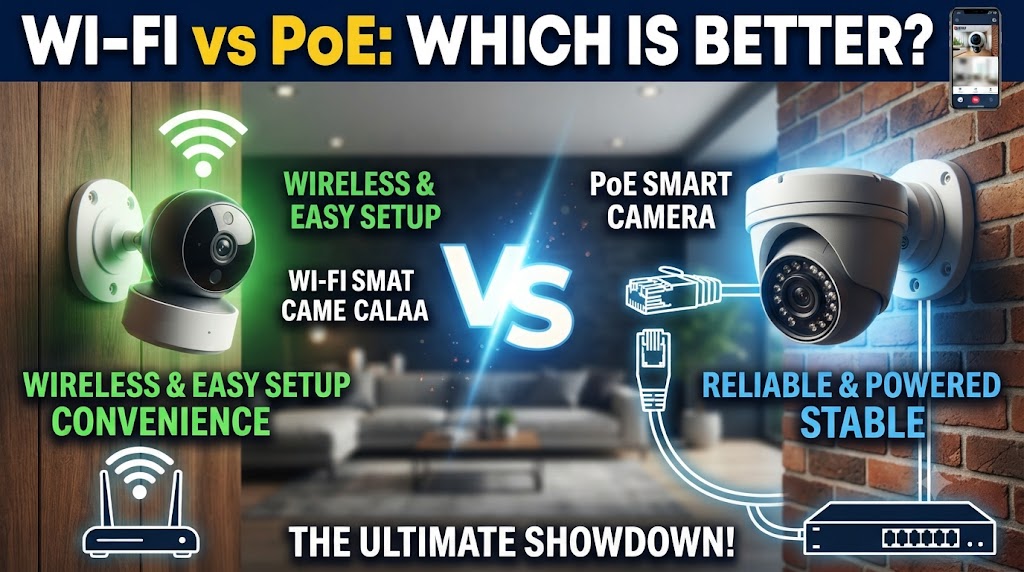
Wi-Fi Smart Camera vs PoE Smart Camera
Introduction
A smart security camera can help monitor a home, office, shop, or other property, but the way the camera connects to the network can make a major difference. Wi-Fi smart cameras connect wirelessly to a network, while PoE smart cameras use an Ethernet cable to carry both network data and power. Both can provide features such as motion detection, mobile notifications, night vision, and remote viewing, depending on the model.
The choice between Wi-Fi and PoE depends mainly on installation conditions, network reliability, power availability, recording requirements, and the number of cameras you plan to use. Wi-Fi cameras can simplify installation where running Ethernet cables is difficult, while PoE cameras can provide a wired connection and centralized power through compatible networking equipment. Let’s compare them in detail.
Quick Comparison Table
| Feature | Wi-Fi Smart Camera | PoE Smart Camera |
|---|---|---|
| Network Connection | Wi-Fi | Ethernet cable |
| Power | Adapter or other supported power source | Ethernet cable through PoE |
| Installation | Usually easier | Requires Ethernet cabling |
| Wi-Fi Dependence | Yes | No for camera-to-network connection |
| Cable Requirement | Usually power cable only | One Ethernet cable can handle power + data |
| Network Stability | Depends on Wi-Fi signal | Generally consistent wired connection |
| Remote Viewing | Available on supported models | Available on supported systems |
| Multi-Camera Setup | Possible | Well suited |
| NVR Integration | Model dependent | Common |
| Cable Distance | Limited by Wi-Fi coverage | Depends on Ethernet and network design |
| Maintenance | Relatively simple | Cabling and network equipment need attention |
| Best For | Easy installation and flexible placement | Reliable wired surveillance systems |
Wi-Fi Smart Camera vs PoE Smart Camera: How Do They Work?
Wi-Fi Smart Camera
A Wi-Fi smart camera connects to the network wirelessly. The camera normally requires a separate power source, such as an adapter or rechargeable battery, depending on its design.
Once connected to a compatible Wi-Fi network, it may allow features such as live viewing, recording, motion notifications, and remote access through an app.
PoE Smart Camera
A PoE camera uses Power over Ethernet technology. A compatible Ethernet cable can carry both electrical power and network data between the camera and PoE equipment.
The camera can be connected to a PoE switch or another compatible PoE device. In many surveillance installations, PoE cameras are also connected to an NVR for recording and management.
Wi-Fi Smart Camera vs PoE Smart Camera: Installation
Wi-Fi Smart Camera is generally easier to install when Ethernet cabling is difficult.
A Wi-Fi camera does not need an Ethernet network cable for its network connection. This can make installation convenient in locations where running network cable would be difficult.
A PoE camera requires Ethernet cabling from the camera to compatible PoE equipment. Installing cables through walls, ceilings, or other areas can require more planning and physical work.
However, PoE installation can be organized efficiently when a property is already wired for Ethernet.
Wi-Fi Smart Camera vs PoE Smart Camera: Power
PoE Smart Camera has an advantage in cable simplicity.
A PoE camera can receive power and network data through the same Ethernet cable when connected to compatible PoE equipment.
A Wi-Fi camera generally needs a separate power source even though its network connection is wireless. Depending on the model, this could be a power adapter, rechargeable battery, or another supported power arrangement.
Therefore, PoE can be particularly convenient for permanent installations where Ethernet cabling is practical.
Wi-Fi Smart Camera vs PoE Smart Camera: Network Stability
PoE Smart Camera generally provides a more consistent wired connection.
Wi-Fi performance can be affected by distance from the router or access point, walls, interference, congestion, and other environmental factors.
A PoE camera uses a wired Ethernet connection, so it does not depend on the camera receiving a strong Wi-Fi signal.
This can be useful for security cameras that need a reliable network connection for video transmission.
Wi-Fi Smart Camera vs PoE Smart Camera: Wi-Fi Dependence
PoE Smart Camera wins for avoiding Wi-Fi dependence.
A Wi-Fi camera relies on wireless network connectivity for its network functions.
A PoE camera communicates through its Ethernet connection. It therefore does not need a Wi-Fi signal at the camera location.
This can be useful in areas where Wi-Fi coverage is weak or unreliable.
Wi-Fi Smart Camera vs PoE Smart Camera: Remote Viewing
Tie, depending on the system.
Both types can support remote viewing when properly connected to a network and when the camera or surveillance system provides remote-access functionality.
A Wi-Fi camera can connect directly to a wireless network, while a PoE camera can connect through a wired network.
Remote viewing therefore depends more on the camera’s software, network configuration, and supported features than simply whether it uses Wi-Fi or PoE.
Wi-Fi Smart Camera vs PoE Smart Camera: Recording
PoE Smart Camera is often well suited to dedicated surveillance recording.
PoE cameras are commonly used with NVR-based surveillance systems. Multiple cameras can be connected to the network and managed through compatible recording equipment.
Wi-Fi cameras can also support recording, including local storage, NVR recording on compatible systems, or cloud storage depending on the model.
The exact recording options should always be checked before purchase.
Wi-Fi Smart Camera vs PoE Smart Camera: Multi-Camera Setup
PoE Smart Camera generally has an advantage for structured multi-camera installations.
PoE systems can use a PoE switch or compatible NVR to connect multiple cameras through Ethernet.
This can make PoE suitable for homes, offices, shops, warehouses, and other properties where several cameras need to be installed permanently.
Wi-Fi cameras can also be used in multi-camera setups, but the wireless network must have sufficient coverage and capacity for the cameras.
Wi-Fi Smart Camera vs PoE Smart Camera: Placement Flexibility
Wi-Fi Smart Camera generally offers more flexibility where cabling is difficult.
Because the camera does not need an Ethernet cable for network connectivity, a Wi-Fi camera can be easier to place in locations where running network cable is inconvenient.
However, the camera still needs an appropriate power source unless it is a battery-powered model.
PoE cameras require Ethernet cabling, which can limit placement unless suitable cable routes are available.
Wi-Fi Smart Camera vs PoE Smart Camera: Outdoor Installation
Depends on the installation.
Both Wi-Fi and PoE cameras are available in outdoor-rated designs.
For either type, the camera should have appropriate protection against weather and environmental conditions.
For a permanent outdoor surveillance system, PoE can be useful when Ethernet cable can be routed to the required locations. Wi-Fi can be convenient where cable installation is difficult, provided there is reliable Wi-Fi coverage.
Wi-Fi Smart Camera vs PoE Smart Camera: Maintenance
Depends on the setup.
Wi-Fi cameras can have a simpler physical installation, but wireless connectivity issues may require troubleshooting. Battery-powered models also require periodic charging or battery replacement.
PoE cameras do not normally require a separate power cable, but the Ethernet cables, PoE switch, NVR, and other networking equipment need to remain properly connected and functional.
The maintenance requirements therefore depend on the complete surveillance setup rather than only the camera type.
Wi-Fi Smart Camera vs PoE Smart Camera: Security
Depends on the complete system.
Both Wi-Fi and PoE cameras can be part of a secure surveillance system, but network and account security are important.
For Wi-Fi cameras, using a properly secured wireless network and strong account credentials is important.
For PoE systems, the wired connection removes the need for a wireless link at the camera, but the camera, NVR, network equipment, and remote-access services still need appropriate security settings.
Regular firmware updates and strong unique passwords can also be important where supported by the manufacturer.
Wi-Fi Smart Camera vs PoE Smart Camera: Cost
Depends on the complete installation.
A Wi-Fi camera may appear simpler because it does not require Ethernet cabling or a PoE switch.
A PoE system may require additional equipment such as Ethernet cables, a PoE switch, or a PoE-capable NVR.
However, the total cost depends on the number of cameras, cable length, installation work, storage requirements, and equipment already available.
It is therefore better to compare the complete system cost rather than only the camera price.
Which Is Better for Home Security?
A Wi-Fi smart camera may be suitable when you want easier installation and flexible placement, particularly when running Ethernet cable is difficult.
A PoE smart camera may be suitable when you want a permanent wired surveillance system with a consistent network connection and centralized power.
For a larger property with multiple fixed cameras, PoE can simplify the overall network and power arrangement. For a smaller installation or a location where cabling is difficult, Wi-Fi can be more convenient.
Wi-Fi Smart Camera vs PoE Smart Camera: Which Should You Choose?
| If You Want… | Better Fit |
|---|---|
| Easier wireless network installation | Wi-Fi Smart Camera |
| Flexible placement | Wi-Fi Smart Camera |
| No Ethernet network cable at the camera | Wi-Fi Smart Camera |
| Reliable wired network connection | PoE Smart Camera |
| Power and data through one Ethernet cable | PoE Smart Camera |
| Multiple permanently installed cameras | PoE Smart Camera |
| NVR-based surveillance system | PoE Smart Camera |
| Installation where Ethernet cabling is difficult | Wi-Fi Smart Camera |
| Weak Wi-Fi coverage at camera locations | PoE Smart Camera |
| A structured wired surveillance network | PoE Smart Camera |
Conclusion
Wi-Fi smart cameras and PoE smart cameras can both provide effective surveillance, but they are designed for different installation requirements. Wi-Fi cameras offer flexible placement and can be easier to install when Ethernet cabling is difficult. PoE cameras use a wired Ethernet connection and can receive both power and data through the same cable, making them well suited to permanent surveillance installations.
If your priority is simpler installation and flexible placement, a Wi-Fi smart camera may be more suitable. If you want a reliable wired connection, centralized power, and a structured multi-camera surveillance system, PoE can be a better fit. Before choosing, consider cable routes, Wi-Fi coverage, power availability, recording requirements, and the number of cameras you plan to install.
Disclaimer
This comparison is for general informational purposes. Wi-Fi and PoE camera features, network requirements, storage options, power specifications, and compatibility vary by model and manufacturer. PoE installation also requires compatible networking equipment and appropriate cabling. Always check the manufacturer’s specifications and installation requirements before purchasing or installing a security camera system.