N-Type vs P-Type Solar Panels
Introduction
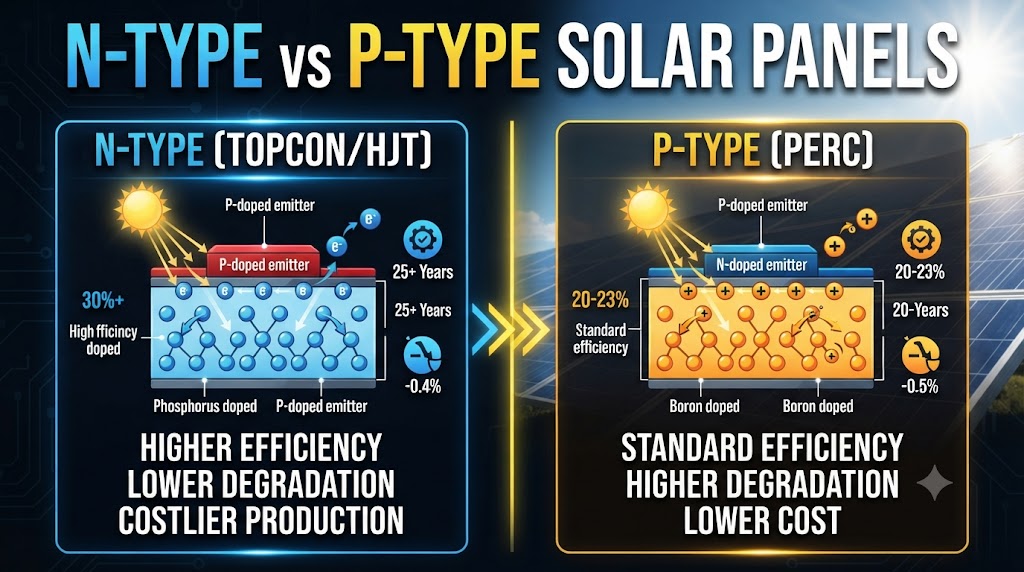
N-Type and P-Type solar panels use different types of silicon wafers to convert sunlight into electricity. The main difference lies in the electrical properties of the silicon and the way each cell is manufactured. These differences can affect efficiency, performance in high temperatures, light-induced degradation, and long-term electricity generation. Both technologies are used in solar installations, but N-Type technology has become increasingly common in modern high-efficiency solar panels.
P-Type solar cells have traditionally been popular because of their established manufacturing processes and competitive cost. N-Type solar cells generally offer lower degradation and can achieve higher efficiency in many modern panel designs. However, the better option depends on the specific panel model, installation conditions, price, and warranty. Understanding these differences can help you make a more informed solar panel purchase.
Quick Comparison Table
| Feature | N-Type Solar Panels | P-Type Solar Panels |
|---|---|---|
| Silicon type | Negative-type silicon wafer | Positive-type silicon wafer |
| Main dopant | Commonly phosphorus | Commonly boron |
| Efficiency potential | Generally higher in modern designs | Generally lower in comparable conventional designs |
| Light-induced degradation | Generally lower | Can be more affected |
| Temperature performance | Often better, depending on design | Depends on cell technology |
| Long-term degradation | Usually lower in many modern products | Can be higher in some technologies |
| Manufacturing cost | Historically higher | Traditionally lower |
| Common technologies | TOPCon, HJT | PERC |
| Market position | Widely used in newer high-efficiency panels | Established conventional technology |
What Are N-Type Solar Panels?
N-Type solar panels use silicon wafers doped with phosphorus, which provides additional electrons. The N-Type cell structure is designed to support efficient movement of electrical charges when sunlight reaches the cell.
Many modern N-Type solar panels use technologies such as TOPCon and HJT. These technologies can deliver high efficiency and low degradation, making them suitable for residential, commercial, and utility-scale solar installations.
Advantages of N-Type Solar Panels
- Higher efficiency potential: Many modern N-Type panels offer high conversion efficiency.
- Lower light-induced degradation: They are generally less affected by conventional light-induced degradation.
- Good long-term performance: Many N-Type technologies have low annual degradation rates.
- Suitable for limited roof space: Higher-efficiency models can generate more power from a given panel area.
- Advanced technology: TOPCon and HJT are important N-Type technologies used in modern solar products.
Disadvantages of N-Type Solar Panels
- Potentially higher price: Some N-Type panels cost more than comparable P-Type models.
- Technology differences: TOPCon and HJT panels have different manufacturing processes and characteristics.
- Model variation: Not every N-Type panel offers the same efficiency or warranty.
- Availability and cost: Prices and product choices vary by market and manufacturer.
What Are P-Type Solar Panels?
P-Type solar panels use silicon wafers doped with boron, creating a different electrical structure from N-Type cells. P-Type technology has been widely used in conventional solar panels, particularly PERC panels.
These panels have an established manufacturing history and can offer good performance at competitive prices. Although many manufacturers are moving towards N-Type technologies, P-Type panels remain available in some markets.
Advantages of P-Type Solar Panels
- Established manufacturing: P-Type technology has been used widely for many years.
- Competitive pricing: Some P-Type panels are available at lower prices.
- Proven applications: They have been used in residential, commercial, and large solar projects.
- Wide product history: Many manufacturers have extensive experience producing P-Type panels.
Disadvantages of P-Type Solar Panels
- Potentially higher degradation: Some P-Type technologies experience greater light-induced degradation.
- Efficiency limitations: Conventional P-Type designs may offer lower efficiency than comparable modern N-Type panels.
- Long-term performance differences: Degradation characteristics depend on the cell technology and manufacturing quality.
- Technology transition: Many newer high-efficiency product ranges focus on N-Type designs.
Key Differences Between N-Type and P-Type Solar Panels
1. Silicon Structure
N-Type cells commonly use phosphorus-doped silicon, while P-Type cells commonly use boron-doped silicon. This changes the electrical characteristics of the solar cell and influences its performance.
2. Efficiency
Modern N-Type technologies such as TOPCon and HJT can achieve higher efficiency than many conventional P-Type PERC panels. However, compare the actual efficiency ratings of the two models rather than relying only on the N-Type or P-Type label.
3. Light-Induced Degradation
Light-induced degradation is a reduction in solar cell output after exposure to sunlight. Conventional boron-doped P-Type silicon can experience this effect. N-Type cells generally have lower sensitivity to conventional light-induced degradation.
4. Temperature Performance
Many N-Type panels have favourable temperature coefficients, meaning their output may decrease less as panel temperature rises. However, this depends on the specific technology and model. Check the temperature coefficient in the manufacturer’s datasheet.
5. Long-Term Performance
N-Type panels often offer lower degradation rates in modern product ranges. This can help maintain electricity generation over the panel’s service life. Actual degradation depends on the product, environment, installation, and warranty conditions.
6. Price
P-Type panels may offer a lower initial purchase price, while N-Type panels may provide better efficiency and long-term performance. Compare the total project cost and expected electricity generation before deciding.
Which Is Better for Different Applications?
| Application | Suitable Option |
|---|---|
| Residential rooftop | N-Type is worth considering |
| Limited rooftop space | High-efficiency N-Type |
| Commercial solar project | Compare N-Type and P-Type specifications |
| Budget-focused installation | Compare the total cost of both |
| Long-term solar investment | N-Type is often attractive |
| Large open-area installation | Both can be suitable |
N-Type vs P-Type Solar Panels: Which Should You Choose?
Choose N-Type solar panels if:
- You want a modern, high-efficiency solar panel.
- Your rooftop has limited installation space.
- Lower degradation is important to your project.
- You want to compare modern TOPCon or HJT options.
Choose P-Type solar panels if:
- You find a reliable model at a competitive price.
- Your available installation area is sufficient.
- Its efficiency and warranty meet your requirements.
- The overall project economics are better than the available alternatives.
Final Verdict
N-Type solar panels are generally the better choice for a new installation when the price difference is reasonable. Modern N-Type technologies such as TOPCon and HJT can offer high efficiency, lower light-induced degradation, and favourable long-term performance.
P-Type panels can still be suitable for budget-conscious projects, particularly when a reliable model is available at a competitive price. Before buying, compare efficiency, temperature coefficient, annual degradation warranty, product warranty, rated power, and total installation cost. The actual specifications matter more than the technology label alone.
Frequently Asked Questions (FAQs)
1. What is the main difference between N-Type and P-Type solar panels?
N-Type panels use phosphorus-doped silicon wafers, while P-Type panels commonly use boron-doped silicon wafers. Their different electrical structures affect cell performance and degradation.
2. Are N-Type solar panels more efficient?
Many modern N-Type panels offer higher efficiency than conventional P-Type PERC panels. However, efficiency varies by manufacturer and model.
3. Do N-Type solar panels last longer?
Many N-Type technologies have lower degradation rates, which can help maintain output over time. Actual lifespan depends on product quality, installation, and operating conditions.
4. Are P-Type solar panels cheaper?
P-Type panels can be cheaper because their manufacturing processes are well established. Actual prices depend on the brand, wattage, technology, and market.
5. Which is better for home solar installation?
N-Type panels are often a good choice for new residential installations because of their efficiency and degradation characteristics. Compare the specifications and total cost before purchasing.
Disclaimer
Solar panel efficiency, degradation, temperature performance, pricing, and warranties vary by manufacturer and model. N-Type technology does not guarantee better performance in every installation. Always check the manufacturer’s technical datasheet and warranty documents before purchasing, and consult a qualified solar installer for system selection.