Monofacial vs Bifacial Solar Panels for Rooftops
Introduction
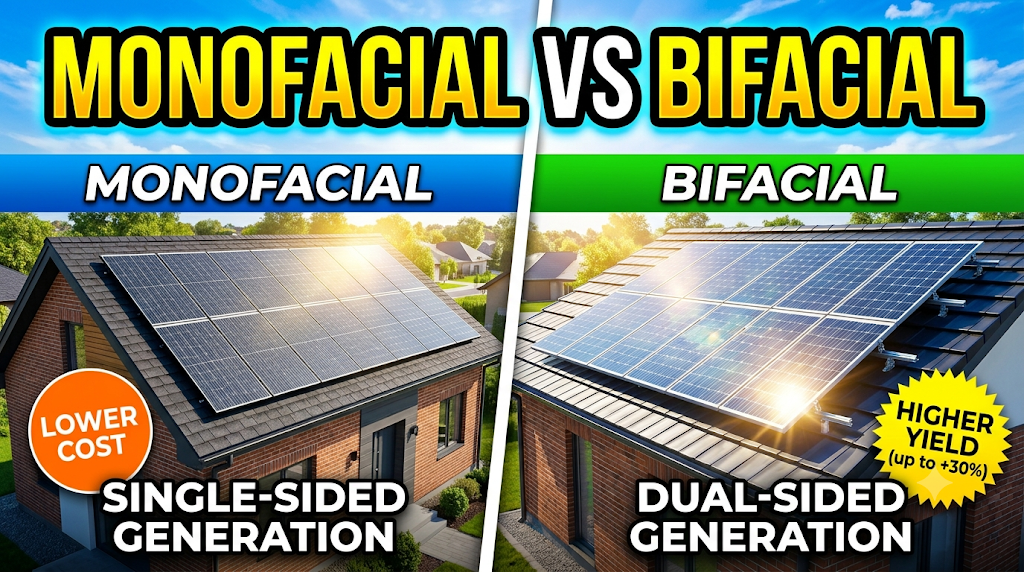
Solar panels are available in different designs, and monofacial and bifacial panels are two important options for generating electricity from sunlight. Monofacial solar panels capture sunlight mainly from their front surface, while bifacial solar panels can capture sunlight from both the front and rear surfaces. Both technologies convert sunlight into electricity, but their performance depends on installation conditions, available sunlight and the surrounding environment.
Choosing between monofacial and bifacial solar panels for a rooftop installation requires considering more than just panel technology. Roof surface, mounting height, available space, installation cost and reflected sunlight can affect their performance. Bifacial panels can generate additional electricity when sufficient sunlight reaches their rear surface, but this advantage may be limited on conventional rooftops. Understanding these differences helps homeowners and businesses select a suitable solar panel technology.
Monofacial vs Bifacial Solar Panels: Quick Comparison
| Feature | Monofacial Solar Panels | Bifacial Solar Panels |
|---|---|---|
| Electricity generation | Front side | Front and rear sides |
| Rear-side generation | No | Yes |
| Installation cost | Generally lower | Generally higher |
| Rooftop suitability | Very good | Depends on installation |
| Reflective surface requirement | Not necessary | Helpful |
| Mounting arrangement | Flexible | Rear-side light access needed |
| Installation complexity | Generally simpler | Can be more demanding |
| Maintenance | Standard | Standard, with rear access considerations |
| Performance on dark roofs | Suitable | Rear-side benefit may be limited |
| Best application | Conventional rooftops | Elevated or reflective installations |
1. Working Principle
Monofacial Solar Panels
Monofacial solar panels generate electricity by capturing sunlight through photovoltaic cells on their front surface. The rear side is generally designed as a protective backing and does not contribute meaningfully to electricity generation.
These panels are widely used in residential, commercial and industrial solar installations because their installation requirements are straightforward.
Bifacial Solar Panels
Bifacial solar panels generate electricity from both their front and rear surfaces. Their rear side can capture sunlight reflected from surfaces such as white rooftops, concrete or other reflective materials.
The additional electricity generated from the rear side depends on how much reflected sunlight reaches the panels.
2. Electricity Generation
Monofacial Solar Panels
Monofacial panels generate electricity from direct sunlight and available diffuse sunlight reaching their front surface. Their output depends on panel capacity, sunlight intensity, temperature, shading and installation direction.
They provide predictable performance in conventional rooftop installations.
Bifacial Solar Panels
Bifacial panels can produce additional electricity because they capture sunlight from both sides. However, the actual additional generation depends on rear-side illumination, mounting height, spacing and roof reflectivity.
If the rear surface receives very little sunlight, the generation advantage may be limited.
3. Installation Cost
Monofacial Solar Panels
Monofacial panels are generally more affordable and widely available. Their mounting arrangements are suitable for many standard rooftop installations.
They can be a practical choice when the main priority is installing a solar system within a controlled budget.
Bifacial Solar Panels
Bifacial panels can have a higher purchase or installation cost depending on their design and manufacturer.
Their installation may also require suitable mounting structures that allow sunlight to reach the rear surface. The additional cost should be compared with the expected increase in electricity generation.
4. Rooftop Installation Requirements
Monofacial Solar Panels
Monofacial panels are suitable for common rooftop mounting arrangements, including installations close to the roof surface.
They do not require special arrangements for rear-side sunlight, making them flexible for different roof types.
Bifacial Solar Panels
Bifacial panels need sufficient light exposure on their rear side to deliver their full potential.
Elevated mounting structures and suitable spacing can improve rear-side illumination. When installed very close to an opaque roof, their additional generation may be considerably reduced.
5. Performance on Different Roof Surfaces
Monofacial Solar Panels
Monofacial panels can work effectively on different roof surfaces because they primarily depend on sunlight reaching their front side.
The roof’s colour and reflectivity generally have less direct influence on their electricity generation.
Bifacial Solar Panels
Roof reflectivity can significantly influence bifacial panel performance.
Light-coloured or reflective surfaces can send more sunlight toward the rear side of the panels. Dark surfaces generally reflect less sunlight, which can reduce the additional generation benefit.
6. Maintenance Requirements
Monofacial Solar Panels
Monofacial panels require regular cleaning and inspection to maintain their performance. Dust, dirt, bird droppings and shading can reduce electricity generation.
Their simpler rear-side arrangement can make routine inspection easier.
Bifacial Solar Panels
Bifacial panels also require regular cleaning and inspection. Their rear surface should remain reasonably clean and unobstructed to capture reflected sunlight.
Depending on the mounting arrangement, inspecting and cleaning the rear side may require additional access.
7. Durability and Lifespan
Monofacial Solar Panels
Monofacial panels are available in different construction types, including glass-backsheet and glass-glass designs. Their durability depends on material quality, manufacturing standards and environmental conditions.
Bifacial Solar Panels
Many bifacial panels use glass-glass construction, although construction varies by model. Their durability depends on the quality of the glass, frame, encapsulation and overall manufacturing.
Both technologies can provide long-term service when properly installed and maintained.
8. Which Solar Panel Is Better for Different Rooftops?
| Rooftop Condition | More Suitable Option |
|---|---|
| Conventional residential roof | Monofacial |
| Panels installed close to the roof | Monofacial |
| White reflective rooftop | Bifacial may be suitable |
| Elevated panel mounting | Bifacial may be suitable |
| Limited installation budget | Monofacial |
| Open rooftop with rear sunlight access | Bifacial |
| Dark rooftop with little rear reflection | Monofacial |
9. Advantages and Disadvantages
Monofacial Solar Panels
Advantages
- Generally lower purchase cost.
- Suitable for conventional rooftops.
- Simple installation arrangements.
- Widely available in the market.
- No special rear-side sunlight requirement.
Disadvantages
- Generate electricity mainly from one side.
- Cannot utilize reflected sunlight through rear-side generation.
- May offer less energy generation potential in suitable bifacial installations.
Bifacial Solar Panels
Advantages
- Generate electricity from both sides.
- Can capture reflected sunlight.
- Potentially higher total electricity generation.
- Suitable for elevated mounting structures.
- Can perform well on reflective rooftops.
Disadvantages
- May cost more depending on the model.
- Require suitable rear-side light exposure.
- Installation design can be more demanding.
- Benefits may be limited on dark or obstructed rooftops.
10. Which One Should You Choose?
The choice depends on your rooftop conditions and installation requirements.
- Choose Monofacial Panels if you have a conventional residential rooftop, limited budget or panels installed close to the roof.
- Choose Bifacial Panels if your rooftop is reflective, panels can be elevated and sufficient sunlight can reach their rear surface.
Frequently Asked Questions (FAQs)
1. Are bifacial solar panels better than monofacial panels?
Bifacial panels can generate more electricity when their rear surfaces receive sufficient sunlight. However, they are not automatically better for every rooftop installation.
2. Can bifacial solar panels work on a normal rooftop?
Yes. However, if installed very close to an opaque rooftop, their rear-side electricity generation may be limited.
3. Do bifacial solar panels require more maintenance?
Their maintenance requirements are broadly similar, but cleaning and inspecting the rear surface may require additional access.
4. Which solar panels are cheaper?
Monofacial solar panels are generally more affordable, although actual prices depend on brand, technology, capacity and market conditions.
5. Do white rooftops improve bifacial solar panel performance?
Yes. White and other reflective surfaces can reflect additional sunlight toward the rear surface, potentially improving bifacial energy generation.
Conclusion
Monofacial and bifacial solar panels both provide reliable solar electricity generation, but their suitability depends on installation conditions. Monofacial panels are generally more practical and affordable for conventional residential rooftops. Bifacial panels offer additional generation potential when their rear surfaces receive sufficient reflected sunlight.
Final Verdict: Monofacial solar panels are generally the better choice for ordinary residential rooftops. Bifacial solar panels can be a better investment for elevated installations with reflective surfaces and suitable rear-side sunlight exposure.
Disclaimer
Solar panel prices, electricity generation, efficiency and performance may vary depending on manufacturer specifications, installation design, weather conditions, rooftop characteristics and local market conditions. Consult a qualified solar professional before selecting solar panels.