Fixed-Tilt vs Solar Tracking System
Introduction
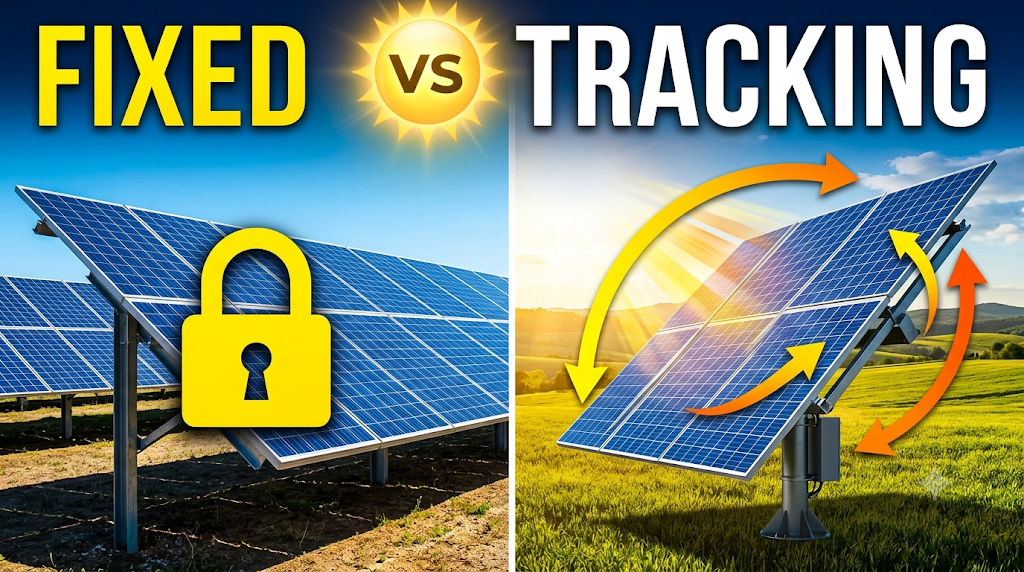
Solar panel mounting systems play an important role in determining how much electricity a solar installation can generate. Two common options are fixed-tilt mounting systems and solar tracking systems. Both are designed to position solar panels toward sunlight, but they use different approaches. A fixed-tilt system keeps panels at a set angle throughout the day, while a tracking system adjusts their position to follow the sun. Understanding their differences helps homeowners, businesses and solar project developers choose a suitable installation.
The right choice depends on several factors, including installation cost, available land, maintenance requirements, electricity generation goals and local weather conditions. Fixed-tilt systems are generally simpler and require less maintenance, whereas solar tracking systems can capture more sunlight during the day under suitable conditions. However, higher installation costs and additional mechanical components can affect their overall value. Comparing both systems helps determine which option offers better long-term performance for a particular solar project.
Fixed-Tilt vs Solar Tracking System: Quick Comparison
| Feature | Fixed-Tilt System | Solar Tracking System |
|---|---|---|
| Panel movement | Stationary | Moves to follow the sun |
| Installation cost | Generally lower | Generally higher |
| Electricity generation | Standard output | Potentially higher output |
| Sunlight positioning | Fixed angle | Adjusts with sunlight |
| Maintenance | Low | Higher |
| Mechanical components | Few | More |
| Energy consumption | No tracking motor | May use motor power |
| Installation complexity | Simple | More complex |
| Land requirements | Depends on layout | Depends on tracking design |
| Best suited for | Residential and commercial rooftops | Large solar installations |
1. Working Principle
Fixed-Tilt Solar System
A fixed-tilt solar system uses mounting structures that hold solar panels at a predetermined angle. Once installed, the panels remain in the same position throughout the day and across different seasons.
The tilt angle is generally selected according to the installation location and solar design requirements. This arrangement makes the system simple, reliable and suitable for many residential and commercial installations.
Solar Tracking System
A solar tracking system uses mechanical components and control systems to adjust the direction of solar panels according to the sun’s movement.
Depending on the design, trackers can move panels from east to west or adjust them along multiple axes. This allows the panels to receive more direct sunlight during suitable daylight conditions.
2. Electricity Generation
Fixed-Tilt Solar System
Fixed-tilt panels generate electricity according to their installed direction, tilt angle and available sunlight. Their output changes throughout the day as the sun moves across the sky.
Although they cannot continuously follow the sun, proper installation and positioning can provide reliable electricity generation.
Solar Tracking System
Solar tracking systems can increase electricity generation by keeping panels better aligned with the sun during daylight hours.
However, the actual improvement depends on geographical location, weather, tracker design, shading and installation conditions. Tracking does not guarantee the same generation increase at every site.
3. Installation Cost
Fixed-Tilt Solar System
Fixed-tilt mounting structures are generally more affordable because they require fewer mechanical components and simpler installation arrangements.
They are particularly suitable for projects where controlling the initial investment is important.
Solar Tracking System
Solar tracking systems generally cost more because they require motors, sensors, controllers, moving structures and additional installation work.
The higher initial investment should be evaluated against the additional electricity generation expected over the system’s lifetime.
4. Maintenance Requirements
Fixed-Tilt Solar System
Fixed-tilt systems have fewer moving parts, which reduces mechanical maintenance requirements. Regular panel cleaning, electrical inspections and mounting structure checks are generally sufficient.
Their simpler design can also reduce the possibility of mechanical failures.
Solar Tracking System
Tracking systems require additional maintenance because their motors, moving joints, sensors and control equipment must operate correctly.
Mechanical wear, alignment problems and electrical faults may require inspection or repairs. Maintenance requirements depend on the tracker design and operating environment.
5. Performance in Different Weather Conditions
Fixed-Tilt Solar System
Fixed-tilt panels can operate without any mechanical movement during cloudy or windy weather. Their stationary structure also makes it easier to design mounting arrangements according to local wind conditions.
Solar Tracking System
Solar trackers can adjust panel positions according to their control settings and weather-related safety requirements.
Some systems include a wind-stow feature that moves panels into a safer position during strong winds. However, tracker performance and availability can be affected by severe weather and mechanical limitations.
6. Space and Installation Requirements
Fixed-Tilt Solar System
Fixed-tilt installations can be designed for rooftops, open land and commercial buildings. Their mounting arrangements can be customized according to the available space.
Solar Tracking System
Solar tracking systems are commonly used in ground-mounted solar projects where sufficient space is available for panel movement and maintenance access.
Their layout must account for tracker movement, row spacing and possible shading between panel structures.
7. Lifespan and Reliability
Fixed-Tilt Solar System
Fixed-tilt mounting systems have a relatively simple construction with fewer moving components. Their long-term reliability depends on structural quality, corrosion protection, installation and regular inspection.
Solar Tracking System
Solar tracking systems can also provide long-term operation, but their mechanical and electronic components require proper maintenance.
The reliability of the system depends on tracker quality, environmental conditions and the availability of replacement components.
8. Which System Is Better for Different Applications?
| Application | More Suitable Option |
|---|---|
| Residential rooftop | Fixed-Tilt |
| Small commercial rooftop | Fixed-Tilt |
| Large utility-scale solar farm | Depends on project economics |
| Limited maintenance budget | Fixed-Tilt |
| Higher generation objective | Solar Tracking |
| Simple installation | Fixed-Tilt |
| Large open land | Solar Tracking may be suitable |
Advantages and Disadvantages
Fixed-Tilt Solar System
Advantages
- Lower initial installation cost.
- Simple mounting structure.
- Fewer mechanical components.
- Lower maintenance requirements.
- Suitable for residential rooftops.
Disadvantages
- Panels cannot follow the sun.
- Fixed positioning limits sunlight alignment throughout the day.
- Seasonal sunlight angles cannot be automatically adjusted.
Solar Tracking System
Advantages
- Can increase electricity generation.
- Follows the sun during daylight hours.
- Can improve energy collection under suitable conditions.
- Useful for certain large-scale solar projects.
Disadvantages
- Higher installation cost.
- More mechanical components.
- Additional maintenance requirements.
- Requires careful installation and design.
- Moving components can be affected by severe weather.
Frequently Asked Questions (FAQs)
1. Which is cheaper, fixed-tilt or solar tracking?
Fixed-tilt systems are generally cheaper because they use simpler mounting structures and do not require tracking motors or control equipment.
2. Does a solar tracking system generate more electricity?
Yes, a properly designed tracking system can generate more electricity than a comparable fixed-tilt installation. The actual improvement depends on location, weather and system design.
3. Are solar tracking systems suitable for residential rooftops?
They are possible in some situations, but fixed-tilt systems are generally more practical for residential rooftops because they are simpler, lighter in mechanical complexity and easier to maintain.
4. Do solar tracking systems require electricity?
Yes, their motors and control equipment consume some electricity. This consumption should be considered when calculating the system’s net energy benefit.
5. Which system requires less maintenance?
Fixed-tilt systems generally require less maintenance because they have fewer moving components.
Conclusion
Fixed-tilt and solar tracking systems both have important roles in solar energy installations. Fixed-tilt systems are generally more affordable, simpler to install and easier to maintain, making them suitable for most residential and many commercial projects. Solar tracking systems can increase electricity generation by following the sun, but they involve higher costs and additional maintenance requirements.
Final Verdict: Fixed-Tilt Solar System is generally the better choice for residential rooftops and projects where affordability and simplicity matter. Solar Tracking Systems can be a better option for suitable large-scale installations where additional electricity generation justifies the investment.
Disclaimer
Solar panel generation, installation costs, maintenance requirements and system performance may vary depending on location, weather conditions, equipment quality, installation design and manufacturer specifications. Consult a qualified solar professional before selecting a mounting system.