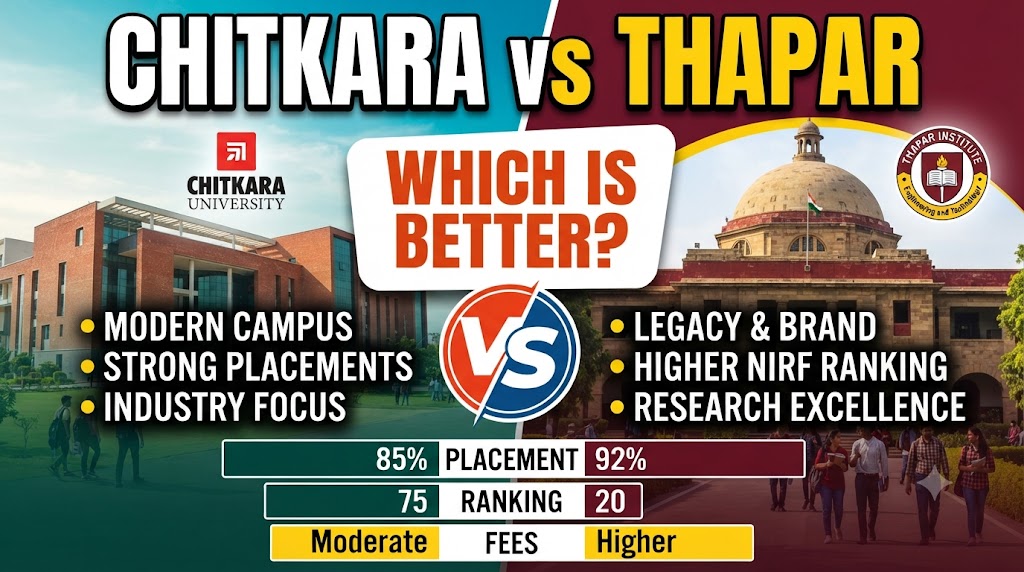
Chitkara University vs Thapar Institute of Engineering and Technology
Introduction
Chitkara University and Thapar Institute of Engineering and Technology (TIET) are two well-known private universities in Punjab offering undergraduate, postgraduate and doctoral programmes. Chitkara University is located on the Chandigarh–Patiala National Highway, while Thapar Institute is based in Patiala. Both offer engineering, technology, management and other academic programmes, but their academic structures, programme choices and institutional profiles are different. Therefore, students should compare the specific course, admission route, fees and career opportunities rather than looking only at the university name.
Chitkara University has a multidisciplinary academic structure and holds an A+ NAAC accreditation. Its official information also reports NIRF 2024 University ranking of 90. Thapar Institute has an A++ NAAC accreditation and was ranked 26th in the NIRF 2025 University category and 29th in the Engineering category. These rankings belong to different NIRF editions, so they should not be treated as a direct same-year ranking comparison. (Chitkara University)
Quick Comparison Table
| Feature | Chitkara University | Thapar Institute of Engineering and Technology |
|---|---|---|
| Location | Punjab, near Chandigarh | Patiala, Punjab |
| Type | Private University | Deemed-to-be University |
| NAAC accreditation | A+ | A++ |
| Engineering | Yes | Yes |
| Computer Science | Yes | Yes |
| Management | Yes | Yes |
| Research programmes | Yes | Yes |
| NIRF University ranking | 90 in 2024 | 26 in 2025 |
| NIRF Engineering ranking | Reported within 2024 category rankings | 29 in 2025 |
| Main engineering qualification route | Programme-specific | JEE Main for several B.E. programmes |
| Best suited to | Students seeking multidisciplinary and industry-oriented programmes | Students particularly focused on engineering and technology |
Rankings, admissions, programmes and eligibility requirements can change between academic years.
Chitkara University vs Thapar Institute: Recognition and Accreditation
Chitkara University received an A+ grade from NAAC with a CGPA of 3.26 in its accreditation cycle. The university’s official accreditation information also provides details of its NIRF participation and rankings. (Chitkara University)
Thapar Institute currently reports an A++ NAAC accreditation. Its official website also lists its NIRF 2025 positions, including 26th in the University category and 29th in Engineering. (Thapar University)
Comparison: Both institutions have established accreditation, but their current NAAC grades are different.
Chitkara University vs Thapar Institute: Courses and Academic Options
Chitkara University has a multidisciplinary academic structure covering engineering, technology, business, health sciences, design, architecture, pharmacy, law, education and other fields. Its engineering portfolio includes Computer Science, Artificial Intelligence and Machine Learning, Information Technology, Electronics and Communication, Electrical, Mechanical, Mechatronics, Automobile and Civil Engineering. (Chitkara University)
Thapar Institute has a strong focus on engineering and technology while also offering programmes in other areas. Its Computer Science and Engineering department offers B.E. programmes in Computer Engineering, Computer Science and Engineering, and Computer Science and Business Systems, along with postgraduate and doctoral programmes. (Thapar University)
Comparison: Chitkara has a broad multidisciplinary programme structure, while Thapar has a particularly strong engineering and technology orientation.
Chitkara University vs Thapar Institute: Engineering
Engineering is an important area at both institutions.
Chitkara offers several engineering disciplines, including Computer Science, AI & Machine Learning, Information Technology, Electronics and Communication, Electrical, Mechanical, Mechatronics, Automobile and Civil Engineering. It also offers specialised programmes developed with international academic partners. (Chitkara University)
Thapar offers several B.E. programmes, including Computer Engineering, Computer Science and Engineering, Electronics and Communication Engineering, Electronics and Computer Engineering, Electrical Engineering, Mechanical Engineering and other disciplines. (csed.thapar.edu)
For example, Thapar’s Computer Science and Engineering department provides exposure to areas such as machine learning and data analytics, information and cyber security, software engineering, high-performance computing, gaming and mathematics and computing. (Thapar University)
Comparison: Both provide multiple engineering specialisations. The appropriate choice depends heavily on the exact branch and the student’s admission eligibility.
Chitkara University vs Thapar Institute: Computer Science
Computer Science is offered extensively at both universities.
Chitkara offers Computer Science and related programmes including AI and Machine Learning, Information Technology and specialised programmes such as full-stack development. Its engineering material also lists international academic mentorship options in areas such as computer science and software engineering. (Chitkara University)
Thapar’s Computer Science and Engineering department offers B.E. programmes in Computer Engineering, CSE and Computer Science & Business Systems. It also offers postgraduate and doctoral programmes and has research areas covering subjects such as cloud computing, data mining, software engineering, computer networking and machine learning. (csed.thapar.edu)
Comparison: Both have substantial computer-related offerings, but Thapar provides a particularly extensive engineering and research-oriented computing structure.
Chitkara University vs Thapar Institute: Admission
Admission requirements differ by programme.
For example, Thapar’s B.E. Computer Engineering programme lists +2 and JEE Main as eligibility requirements. Specific Thapar programmes may have their own admission rules, so students should check the current programme page before applying. (Thapar University)
Chitkara also has programme-specific admission requirements, and its engineering offerings cover several disciplines and specialised pathways. Therefore, applicants should check the latest admission information for their chosen programme rather than assuming that one admission route applies to every course.
Comparison: Admission criteria are not identical, so students should compare the exact course requirements before deciding.
Chitkara University vs Thapar Institute: Placements and Industry Exposure
Both universities provide structured career and placement support.
Chitkara’s engineering information highlights industry connections and states that more than 700 blue-chip IT companies hire its engineering graduates. (Chitkara University)
Thapar’s placement information lists recruiters from technology, consulting, finance and other sectors. Its published recruiter list includes companies such as Amazon, Apple, Adobe, American Express, AMD, Accenture, Bank of America and Barclays. (Thapar University)
These recruiter lists show companies that have visited or recruited through the institutions, but they should not be interpreted as a guarantee that every student will receive an offer from a particular company.
Comparison: Both provide access to industry recruitment, while the actual placement experience can vary according to branch, academic performance, skills and the recruitment year.
Chitkara University vs Thapar Institute: NIRF Ranking
NIRF rankings provide one reference point for comparing institutions, but rankings from different years should not be treated as a direct head-to-head measurement.
Chitkara University’s official material reports a 90th position in the NIRF 2024 University category and participation in the Innovation category. (Chitkara University)
Thapar Institute’s official website reports 26th in the NIRF 2025 University category and 29th in the NIRF 2025 Engineering category. (Thapar University)
Comparison: The available NIRF editions show different positions, but the editions are not from the same year. Students should therefore check the latest NIRF edition when making a current comparison.
Chitkara University vs Thapar Institute: Campus and Location
Chitkara University Punjab is located on the Chandigarh–Patiala National Highway. The university describes its campus as being accessible from Chandigarh, Mohali, Panchkula, Ambala and Patiala. (careers.chitkara.edu.in)
Thapar Institute is located in Patiala, Punjab, and its official website reports a campus area of approximately 250 acres. (Thapar University)
Comparison: Chitkara can be convenient for students who prefer proximity to the Chandigarh region, while Thapar offers a large established campus in Patiala.
Chitkara University vs Thapar Institute: Which One Should You Choose?
The answer depends on the student’s course, admission route, budget and academic priorities.
Chitkara University may suit students who want:
- A broad multidisciplinary university environment
- Multiple engineering specialisations
- Industry-oriented programmes
- International academic partnership and mentorship options
- A campus relatively close to the Chandigarh region (Chitkara University)
Thapar Institute may suit students who want:
- A strong engineering and technology-focused academic environment
- Extensive computer science and engineering programmes
- Research-oriented opportunities in technology
- A university with strong NIRF positions in the 2025 University and Engineering categories
- A long-established engineering-focused institutional structure (Thapar University)
Conclusion
Chitkara University and Thapar Institute of Engineering and Technology both offer established academic programmes in Punjab, but their institutional structures and areas of emphasis differ. Chitkara provides a broad multidisciplinary environment with numerous professional and engineering programmes, while Thapar has a particularly strong emphasis on engineering, computer science, technology and research.
For a student choosing between them, the most useful comparison is usually course-specific. The branch, admission requirements, total fees, curriculum, campus facilities, internship opportunities and placement outcomes for that particular programme should all be checked before admission.
Disclaimer
University rankings, fees, admission requirements, programmes, accreditation information and placement details can change over time. Students should verify the latest information from the official university websites and relevant regulatory sources before making an admission decision.