Conventional OTG vs Digital OTG
Introduction
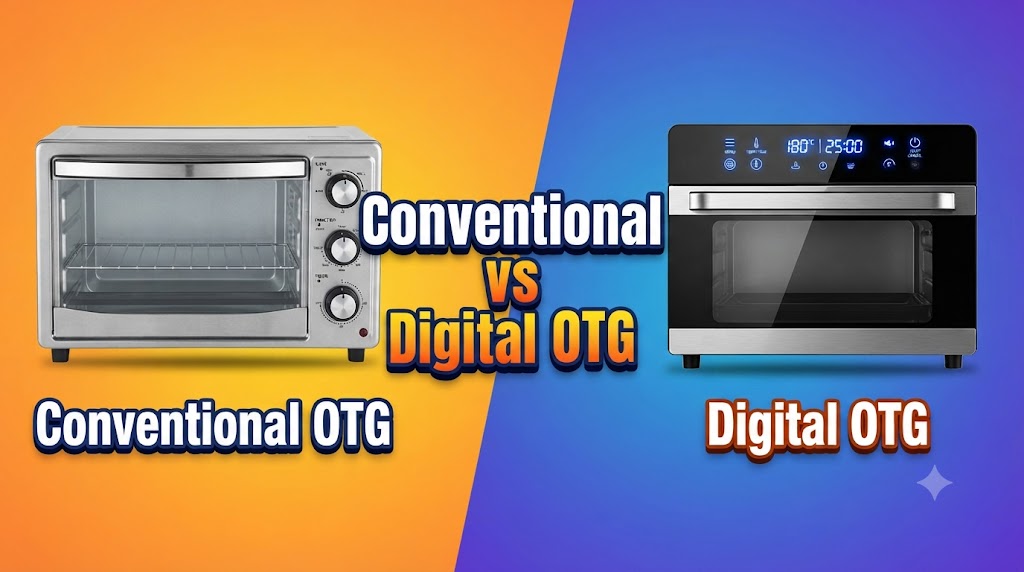
An OTG (Oven, Toaster and Griller) is a popular kitchen appliance used for baking, grilling, toasting and roasting food at home. Conventional OTGs and digital OTGs perform similar cooking functions, but they differ in their control systems and operating convenience. A conventional OTG generally uses manual knobs to control temperature, cooking time and heating modes, whereas a digital OTG uses an electronic control panel, often with a digital display and preset cooking programs.
Choosing between these two appliances depends on your cooking habits, budget and preferred level of control. A conventional OTG is generally suitable for people who prefer simple manual operation, while a digital OTG may be more convenient for users who want preset programs and easier temperature and timer adjustments. Understanding their differences can help you choose the right OTG for your kitchen.
Conventional OTG vs Digital OTG: Quick Comparison Table
| Features | Conventional OTG | Digital OTG |
|---|---|---|
| Control System | Manual knobs | Electronic controls |
| Display | Usually no digital display | Digital display |
| Temperature Setting | Manual adjustment | Digital adjustment |
| Timer | Manual timer knob | Digital timer |
| Cooking Presets | Usually limited | Often available |
| Ease of Operation | Simple | Feature-dependent |
| Cooking Modes | Depends on model | Depends on model |
| Temperature Accuracy | Depends on thermostat | Depends on electronic control |
| Power Consumption | Depends on wattage and usage | Depends on wattage and usage |
| Maintenance | Generally simpler controls | Electronic components require care |
| Price | Generally more affordable | Generally more expensive |
| Best For | Basic home cooking | Convenient, preset-based cooking |
1. Control System
Conventional OTG
A conventional OTG uses physical knobs for selecting cooking temperature, timer settings and heating modes.
Users manually turn the knobs to select the required settings. This simple control system makes it easy to understand and operate.
Digital OTG
A digital OTG uses an electronic control panel with buttons or touch controls. Users can select temperature, cooking time and available cooking programs through the display.
Some models also provide preset options for different food items.
Winner: Digital OTG for modern control features, while conventional OTGs offer simpler manual operation.
2. Temperature Control
Conventional OTG
A conventional OTG generally allows users to adjust temperature using a manual thermostat knob.
Temperature adjustment may be less precise because the setting is controlled through a mechanical system. Actual temperature accuracy depends on the appliance.
Digital OTG
A digital OTG allows users to select temperature through electronic controls.
The digital display makes it easier to set and monitor the selected temperature. However, a digital display does not automatically guarantee better actual temperature accuracy.
Winner: Digital OTG for easier temperature setting and display.
3. Timer Function
Conventional OTG
Conventional OTGs generally use a mechanical timer knob. Users turn it to select the required cooking duration.
Some models also provide an automatic shut-off function when the timer finishes.
Digital OTG
Digital OTGs generally provide an electronic timer that allows users to select cooking duration more conveniently.
The remaining time may also be displayed on the control panel.
Winner: Digital OTG for convenient timer adjustment and visibility.
4. Cooking Preset Programs
Conventional OTG
A conventional OTG generally requires users to select temperature, time and heating mode manually.
This provides flexibility but requires users to understand the appropriate settings for different recipes.
Digital OTG
Many digital OTGs offer preset cooking programs for selected food items and recipes.
These programs can simplify cooking by providing preconfigured settings, although availability varies by model.
Winner: Digital OTG for users who prefer preset cooking programs.
5. Cooking Performance
Conventional OTG
A conventional OTG can bake cakes, grill vegetables, toast bread and roast food using its heating elements.
Cooking performance depends on heating element placement, temperature control, capacity and overall construction.
Digital OTG
A digital OTG can perform similar cooking tasks. Its electronic controls may make selecting cooking settings more convenient.
However, digital controls do not necessarily make food cook faster or improve cooking quality.
Winner: Tie. Both can deliver good cooking results when properly designed and operated.
6. Ease of Use
Conventional OTG
Conventional OTGs have straightforward manual controls. Users can select the desired settings without navigating digital menus.
They are suitable for people who prefer simple appliances.
Digital OTG
Digital OTGs provide display-based controls and may include additional cooking options.
However, some users may need time to understand the different buttons, programs and settings.
Winner: Depends. Conventional models are simpler, while digital models offer more control convenience.
7. Cleaning and Maintenance
Conventional OTG
Conventional OTGs generally have simpler control systems with physical knobs.
Their maintenance mainly involves cleaning the interior, trays, racks and exterior surfaces according to manufacturer instructions.
Digital OTG
Digital OTGs require similar interior cleaning. However, their electronic control panels need additional care to prevent moisture or cleaning liquids from entering the controls.
Winner: Conventional OTG for simpler control-system maintenance.
8. Power Consumption
Conventional OTG
Power consumption depends on the appliance’s wattage, selected temperature, cooking duration and heating-element operation.
Digital OTG
Digital OTGs also use heating elements to cook food. Their digital control system does not automatically make them more energy-efficient.
Actual electricity consumption depends on the model and usage pattern.
Winner: Tie. Compare wattage, capacity and energy consumption rather than choosing based on the control system.
9. Price and Value for Money
Conventional OTG
Conventional OTGs are generally available at lower prices than comparable digital models.
They can be a practical choice for people who need basic baking, grilling and toasting functions.
Digital OTG
Digital OTGs may cost more because of electronic controls, digital displays and additional preset programs.
They can offer better convenience for users who regularly use different cooking settings.
Winner: Conventional OTG for buyers prioritising affordability.
10. Durability and Reliability
Conventional OTG
Conventional OTGs generally have simpler control mechanisms. Fewer electronic components can make their control systems easier to maintain.
However, overall durability also depends on heating elements, insulation, construction and product quality.
Digital OTG
Digital OTGs include electronic components that control the appliance. These components can require specialised servicing if they develop faults.
A good-quality digital OTG can still provide reliable long-term performance.
Winner: Conventional OTG for simpler control-system design, although actual durability depends on the model.
Advantages and Disadvantages
Conventional OTG
Advantages
- Generally more affordable.
- Simple manual controls.
- Easy to understand and operate.
- Suitable for everyday baking and grilling.
- Generally simpler control-system maintenance.
Disadvantages
- Usually lacks a digital display.
- Manual temperature and timer adjustment.
- Generally fewer preset cooking programs.
- Requires users to select settings themselves.
Digital OTG
Advantages
- Digital display for settings.
- Convenient temperature adjustment.
- Electronic timer controls.
- Preset cooking programs in many models.
- Modern control interface.
Disadvantages
- Generally more expensive.
- Electronic controls may require specialised repairs.
- Some models have complicated menus.
- Digital controls do not guarantee better cooking performance.
Which One Should You Choose?
Choose a Conventional OTG If:
- You prefer simple manual controls.
- You mainly bake cakes, grill vegetables and toast bread.
- You want an affordable kitchen appliance.
- You do not need preset cooking programs.
- You prefer a simpler control system.
Choose a Digital OTG If:
- You prefer digital temperature and timer settings.
- You regularly prepare different recipes.
- You want convenient preset cooking programs.
- You prefer a digital display.
- You are comfortable spending more for additional features.
Final Verdict: Conventional OTG vs Digital OTG
Both conventional and digital OTGs can perform essential cooking tasks such as baking, grilling, toasting and roasting. Their main difference is the control system rather than the basic cooking technology.
A conventional OTG is a practical choice for people who want an affordable appliance with simple manual controls. A digital OTG is more suitable for users who prefer electronic settings, digital displays and preset cooking programs.
Overall Winner: Digital OTG for convenience and modern control features. However, a conventional OTG offers better value for people who want basic cooking functions without additional electronic features.
Frequently Asked Questions (FAQs)
1. What is the difference between a conventional OTG and a digital OTG?
A conventional OTG uses manual knobs for temperature, timer and cooking modes, whereas a digital OTG uses an electronic control panel and display.
2. Is a digital OTG better than a conventional OTG?
A digital OTG offers more convenient controls and may include preset programs. A conventional OTG is generally more affordable and simpler to operate.
3. Does a digital OTG cook food faster?
Not necessarily. Cooking speed mainly depends on heating power, temperature, capacity, food quantity and cooking settings rather than whether the controls are digital or manual.
4. Which OTG is better for baking cakes?
Both types can bake cakes successfully. Choose a model with suitable temperature control, appropriate capacity and even heat distribution.
5. Is a conventional OTG difficult to use?
No. Conventional OTGs generally have simple manual knobs for selecting temperature, time and heating mode.
6. Does a digital OTG consume more electricity?
Not automatically. Electricity consumption depends mainly on wattage, cooking duration, temperature and usage patterns.
7. Which OTG is easier to maintain?
A conventional OTG generally has a simpler control system. Both types require regular cleaning of their interiors, trays and accessories.
8. Can a digital OTG replace a conventional OTG?
Yes. A digital OTG can perform the same basic cooking functions, provided the model includes the required baking, grilling and toasting features.
Disclaimer
This comparison is based on the general features and operating methods of conventional and digital OTGs. Actual cooking performance, temperature accuracy, power consumption, durability, prices and available features may vary depending on the brand and model. Always check manufacturer specifications before purchasing.