MagSafe Charger vs Wireless Charger
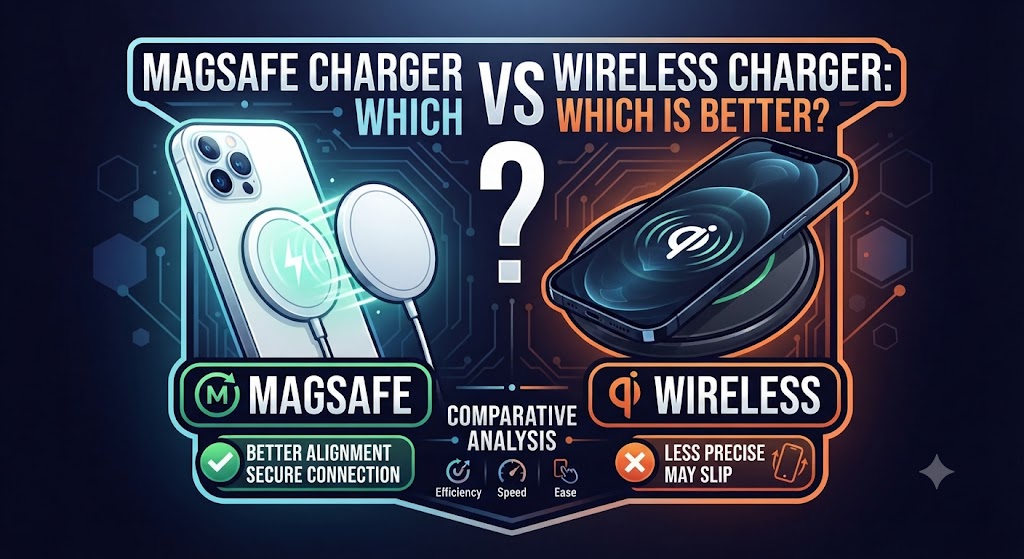
MagSafe chargers and wireless chargers both allow you to charge a compatible smartphone without plugging a charging cable directly into the phone. However, they use different approaches. A standard wireless charger usually requires you to place the phone correctly on a charging pad, while a MagSafe charger uses magnets to align the charger with compatible devices. This magnetic connection can make charging more convenient, especially when you frequently pick up or move your phone while it is charging.
The main difference between MagSafe and ordinary wireless charging is not simply charging without a cable. MagSafe adds magnetic alignment and, on compatible devices, can support features designed around that magnetic connection. Standard wireless charging can work with a wider range of Qi-compatible devices and accessories. Therefore, the better option depends on your phone, charging habits, accessory requirements, and whether magnetic alignment is important to you.
Quick Comparison Table
| Feature | MagSafe Charger | Wireless Charger |
|---|---|---|
| Charging method | Magnetic wireless charging | Wireless charging |
| Magnetic alignment | Yes, with compatible devices | Usually no |
| Phone compatibility | Mainly compatible MagSafe devices | Broad Qi/Qi2-compatible devices |
| Positioning | Easier because of magnets | Phone must be positioned correctly |
| Ease of use | Very convenient | Simple |
| Accessories | Supports magnetic accessories on compatible devices | Wide range of charging accessories |
| Charging while using phone | More convenient due to magnetic attachment | Phone normally needs to stay on the pad |
| Compatibility range | More limited | Generally broader |
| Best suited for | Compatible phones and magnetic accessories | Users wanting broad compatibility |
MagSafe Charger vs Wireless Charger: How Do They Work?
How Does a MagSafe Charger Work?
A MagSafe charger uses a magnetic ring to align the charger with a compatible device. The magnets help keep the charger in the correct position rather than relying only on the user to place the phone accurately on a charging surface.
This can make everyday charging easier because the charger is less likely to move away from the ideal charging position.
How Does a Wireless Charger Work?
A standard wireless charger transfers power through electromagnetic induction. You place a compatible phone or other device on the charging surface, and the charging coils transfer energy without requiring a physical charging cable connection.
The phone generally needs to remain properly positioned on the charging pad or stand for charging to continue efficiently.
Magnetic Alignment
Winner: MagSafe Charger
The biggest practical advantage of MagSafe is magnetic alignment. When the phone and charger support the magnetic connection, the charger automatically aligns with the charging area.
With a conventional wireless charging pad, you have to position the phone yourself. If the phone is moved too far from the charging coil, charging may stop or become less efficient.
Practical meaning: If you frequently charge your phone while using it, magnetic alignment can make MagSafe more convenient.
Compatibility
Winner: Wireless Charger
Standard wireless charging generally has broader compatibility because many devices support the Qi wireless charging standard. A wireless charger can therefore be useful if you own phones or other devices from different manufacturers.
MagSafe is more dependent on compatible devices and accessories. Some devices may support wireless charging but not the full MagSafe experience.
Practical meaning: If you want one charger that can serve different phones, a broadly compatible wireless charger can be more practical.
Ease of Use
Winner: MagSafe Charger
Both technologies are easy to use because neither requires plugging a charging cable into the phone. However, MagSafe adds magnetic positioning.
You simply bring a compatible MagSafe charger close to the back of the phone, and the magnets help position it correctly.
With a standard charging pad, you normally place the phone on the correct area manually.
Charging While Using the Phone
Winner: MagSafe Charger
MagSafe can be more convenient when you want to hold or move the phone while it is connected to the charger. The magnetic connection keeps the charger attached to the compatible device.
A conventional charging pad is less convenient in this situation because the phone normally needs to remain on the charging surface.
However, charging speed and heat can still vary depending on the phone, charger, power adapter, case, and charging conditions.
Accessory Support
Winner: MagSafe Charger
MagSafe’s magnetic system can be used for more than charging. Compatible magnetic accessories can attach to the back of supported devices.
Examples can include magnetic stands, wallets, mounts, and other accessories designed for the system.
A standard wireless charger primarily focuses on charging and does not automatically provide the same magnetic accessory ecosystem.
Charging Speed
Depends
Neither “MagSafe” nor “wireless charging” by itself guarantees one specific charging speed.
Actual charging performance depends on several factors, including:
- Phone model
- Charger model
- Supported charging standard
- Power adapter
- Charging conditions
- Case or accessories
- Heat management
A compatible MagSafe setup can offer fast wireless charging on supported devices, but a standard wireless charger can also provide different charging speeds depending on its specifications and the device being charged.
Therefore, the supported charging specifications should be checked rather than choosing a charger only because it is labelled MagSafe or wireless.
Convenience
Winner: MagSafe Charger
MagSafe offers an extra level of convenience because the magnetic connection helps keep the charger aligned with the phone.
This is particularly useful when charging at a desk, beside the bed, or while using the phone during charging.
A standard wireless charger is still very convenient, especially when you simply want to place the phone down and let it charge.
Portability
Depends
A small wireless charging pad can be extremely easy to carry. MagSafe chargers can also be compact, but the choice depends on the particular charger and accessories.
If you travel with multiple devices, a wireless charging solution that supports all your devices may be more practical than carrying a MagSafe-specific setup.
Which Is Better for Different Users?
MagSafe Charger Is Better For:
- Users with compatible MagSafe devices
- People who want magnetic alignment
- Users who frequently use their phone while charging
- People interested in magnetic phone accessories
- Users who prefer a charger that stays attached to the phone
Wireless Charger Is Better For:
- Users with different Qi-compatible devices
- People who want broad compatibility
- Users looking for a simple charging pad
- Households with phones from different manufacturers
- People who do not need magnetic attachment
MagSafe Charger vs Wireless Charger: Pros and Cons
MagSafe Charger
Pros
- Magnetic alignment
- Convenient attachment
- Easier to use while holding the phone
- Supports compatible magnetic accessories
- Helps keep the charging connection properly positioned
Cons
- Compatibility is more limited
- Compatible accessories can add to the overall cost
- Charging performance still depends on the device and charger
Wireless Charger
Pros
- Broad compatibility
- Simple to use
- Available in many designs and price ranges
- Suitable for multiple Qi-compatible devices
- No physical charging cable connection is required
Cons
- Phone positioning can be less convenient
- Charger does not normally attach magnetically
- Moving the phone can interrupt charging
- Accessory support is less integrated
Final Verdict
Overall Winner: MagSafe Charger — for compatible devices
MagSafe provides the more convenient experience when the phone supports its magnetic system. Magnetic alignment makes charging easier and can be especially useful when you want to use the phone while it is connected to the charger.
However, a standard wireless charger remains the more flexible choice when compatibility is the main priority. It can work with a broader range of Qi-compatible devices and can be a practical option for households with different smartphones.
So, choose MagSafe if you have a compatible device and value magnetic convenience; choose a standard wireless charger if you want broader compatibility and simple wireless charging.
Disclaimer
Charging speeds, compatibility, supported standards, and available features can vary by phone model, charger, power adapter, case, and manufacturer. Product specifications and prices may change over time. Check the official specifications of your specific phone and charger before purchasing.