Hand Blender vs Mixer Grinder
Introduction
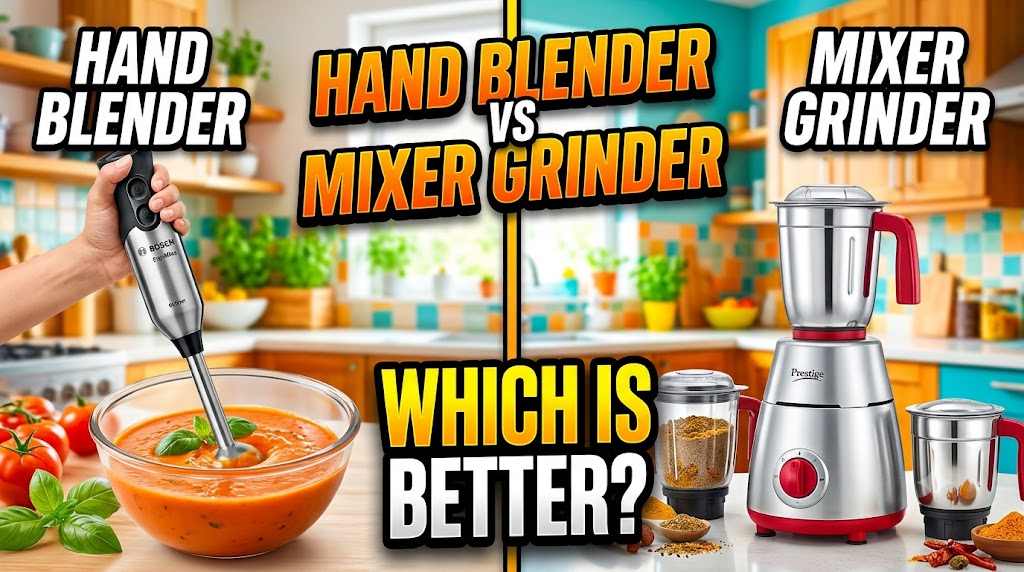
A hand blender and a mixer grinder are both useful kitchen appliances, but they are designed for different food preparation tasks. A hand blender is a handheld appliance used for blending ingredients directly in a bowl, jug, or cooking pot. A mixer grinder is a countertop appliance that uses different jars and blades to grind, mix, and blend ingredients. Although both can perform some similar functions, their working methods and practical uses are different.
Choosing between them depends on what you regularly prepare in your kitchen. A hand blender is convenient for making soups, smoothies, sauces, and purees, while a mixer grinder is more suitable for grinding spices, preparing chutneys, making pastes, and handling tougher ingredients. Understanding their features, versatility, cleaning requirements, and limitations will help you select the appliance that better matches your cooking habits.
Quick Comparison Table
| Feature | Hand Blender | Mixer Grinder |
|---|---|---|
| Design | Handheld appliance | Countertop appliance |
| Main purpose | Blending and pureeing | Grinding, mixing, and blending |
| Grinding spices | Generally not suitable | Suitable |
| Soup preparation | Very convenient | Possible with suitable jar |
| Chutney preparation | Limited, depending on model | Suitable |
| Smoothies | Suitable | Suitable |
| Food containers | Can blend in suitable containers | Uses separate jars |
| Storage | Usually compact | Requires more space |
| Cleaning | Often easy | Jars and blades require cleaning |
| Best for | Blending and pureeing | Multiple grinding and mixing tasks |
1. Working Mechanism
Hand Blender
A hand blender has a motor fitted inside a handheld body with a blending shaft and rotating blades.
You place its blending end directly into the food container and operate it using the control button. This makes it convenient for blending ingredients without transferring them into another jar.
Mixer Grinder
A mixer grinder has a motor base and separate jars fitted with different blade assemblies.
Ingredients are placed inside the appropriate jar, which is attached to the motor base. The rotating blades process the ingredients according to the selected speed or operating mode.
Winner: Depends. A hand blender is more convenient for direct blending, while a mixer grinder is better suited to grinding and processing different ingredients.
2. Grinding Performance
Hand Blender
A hand blender is primarily designed for blending and pureeing. It can process soft ingredients and certain cooked foods, depending on its power and attachments.
However, it is generally not designed for grinding dry spices, hard grains, or other tough ingredients.
Mixer Grinder
A mixer grinder is designed to handle a wider range of grinding tasks.
It can grind spices, prepare pastes, make chutneys, and process other ingredients using suitable jars and blades. Actual performance depends on the motor, blade design, and appliance specifications.
Winner: Mixer Grinder. It is designed for grinding tasks that a typical hand blender cannot perform effectively.
3. Blending and Pureeing
Hand Blender
A hand blender is particularly useful for preparing smooth soups, purees, sauces, and soft mixtures.
Since you can blend directly in a cooking pot or bowl, it reduces the need to transfer hot or liquid ingredients between containers.
Mixer Grinder
A mixer grinder can also blend ingredients using an appropriate jar.
However, transferring food into the jar and cleaning it afterward may require additional effort compared with direct blending.
Winner: Hand Blender. It is more convenient for direct blending and pureeing, especially when preparing soups and sauces.
4. Versatility and Attachments
Hand Blender
Some hand blenders come with additional attachments, such as a whisk, chopping bowl, and separate blending containers.
These attachments can increase their usefulness for different kitchen tasks. However, available functions vary by model.
Mixer Grinder
A mixer grinder generally supports several kitchen tasks through its different jars.
Depending on the model, it can grind dry ingredients, prepare wet pastes, make chutneys, and blend liquids.
Winner: Mixer Grinder for grinding versatility. A hand blender may offer more convenience for certain blending tasks, especially when supplied with useful attachments.
5. Ease of Use
Hand Blender
A hand blender is simple to operate. You place it inside the container, hold it steadily, and press the operating button.
It is particularly useful when you want to blend a small quantity without setting up a large appliance.
Mixer Grinder
A mixer grinder requires selecting a suitable jar, adding ingredients, securing the lid, and attaching the jar to the motor base.
It may involve more preparation, but it is suitable for a wider range of food-processing tasks.
Winner: Hand Blender. Its handheld design makes small blending tasks straightforward and convenient.
6. Cleaning and Maintenance
Hand Blender
A hand blender usually has fewer parts to clean after basic blending tasks.
Many models have detachable blending shafts, making cleaning easier. However, the motor body should not be immersed in water.
Mixer Grinder
A mixer grinder requires cleaning its jars, lids, and blades after use.
Food particles can remain around the blade assembly and jar corners, so careful cleaning is necessary.
Winner: Hand Blender. It generally requires less cleaning for routine blending tasks.
7. Storage and Kitchen Space
Hand Blender
A hand blender is compact and can usually fit inside a kitchen drawer or small cabinet.
It is a practical choice for kitchens where storage space is limited.
Mixer Grinder
A mixer grinder requires countertop or cabinet space for its motor base, jars, and accessories.
The amount of space required depends on the number and size of its jars.
Winner: Hand Blender. Its compact design makes it easier to store.
8. Which One Is Better for Different Kitchen Tasks?
| Kitchen Task | Recommended Appliance |
|---|---|
| Making vegetable soup | Hand Blender |
| Preparing smoothies | Either, depending on quantity |
| Grinding dry spices | Mixer Grinder |
| Making chutney | Mixer Grinder |
| Preparing soft purees | Hand Blender |
| Making ginger-garlic paste | Mixer Grinder |
| Whisking ingredients | Hand Blender with whisk attachment |
| Grinding hard ingredients | Mixer Grinder, if rated for the task |
| Blending food directly in a pot | Hand Blender |
Final Verdict: Hand Blender vs Mixer Grinder
A hand blender is the better choice if you mainly prepare soups, sauces, smoothies, and purees. It is compact, easy to operate, and convenient for blending ingredients directly in a cooking pot or container.
A mixer grinder is the better choice if your daily cooking involves grinding spices, preparing chutneys, making pastes, and processing different ingredients. Its separate jars make it more versatile for general kitchen preparation.
Overall winner: Mixer Grinder for versatility and grinding performance. However, if your main requirement is quick and convenient blending, a hand blender may be the more practical purchase. Choose according to the kitchen tasks you perform most frequently.
Frequently Asked Questions (FAQs)
1. Can a hand blender replace a mixer grinder?
No, not completely. A hand blender is useful for blending and pureeing, but a typical model cannot perform all the grinding tasks of a mixer grinder.
2. Can a hand blender make chutney?
Some hand blenders with suitable attachments may prepare certain soft chutneys in small quantities. However, a mixer grinder is generally more suitable for regular chutney preparation.
3. Can I use a hand blender to make smoothies?
Yes. A hand blender can prepare smoothies, particularly when using suitable ingredients and a compatible container.
4. Which appliance is better for grinding spices?
A mixer grinder is generally better because it is designed for grinding dry ingredients using suitable jars and blades.
5. Is a hand blender useful for making soup?
Yes. It is particularly convenient because you can blend cooked vegetables and other ingredients directly in a suitable cooking pot.
6. Which appliance is easier to clean?
A hand blender is generally easier to clean for basic blending tasks because it usually has fewer parts than a mixer grinder.
7. Should I buy both a hand blender and a mixer grinder?
If your kitchen work includes both frequent grinding and direct blending, having both appliances can be useful. Otherwise, choose the one that matches your regular cooking requirements.
Disclaimer
Appliance features, motor power, attachments, jar capacity, prices, and performance vary by brand and model. Check the manufacturer’s specifications and operating instructions before purchasing or using any appliance.