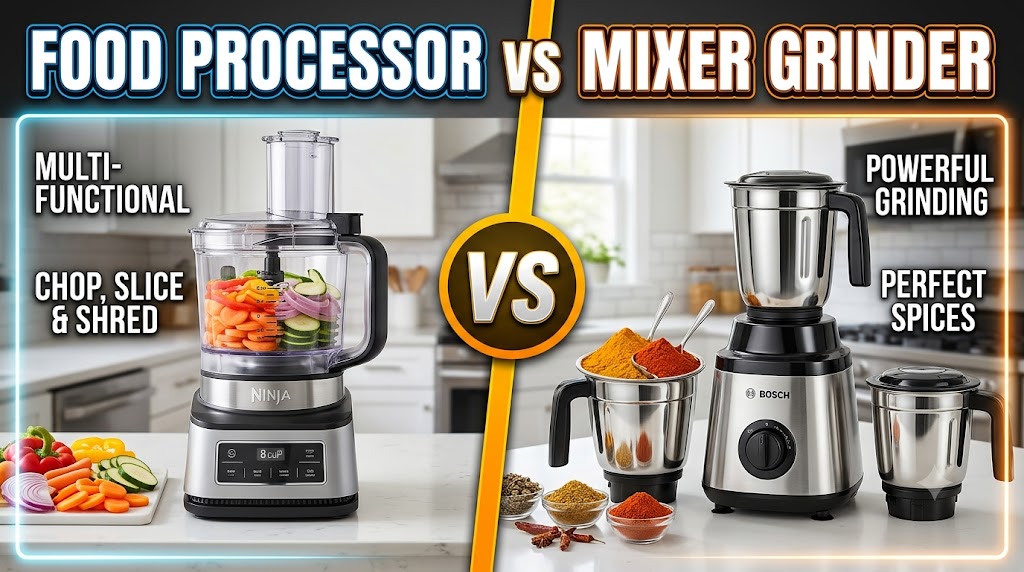
Food Processor vs Mixer Grinder
Introduction
A food processor and a mixer grinder are two useful kitchen appliances that help reduce manual food preparation. However, they are designed for different types of work. A food processor is mainly used for chopping, slicing, shredding, kneading, and mixing ingredients with different attachments. A mixer grinder is primarily designed for grinding, blending, and preparing pastes using separate jars and blades. Although some functions overlap, their capabilities and everyday applications are different.
Choosing between these appliances depends on your cooking habits and the tasks you perform regularly. A food processor is useful when you frequently chop vegetables, slice ingredients, shred cheese, or knead dough. A mixer grinder is more suitable for grinding spices, preparing chutneys, making wet pastes, and blending liquids. Understanding their features and limitations will help you select the right appliance for your kitchen.
Quick Comparison Table
| Feature | Food Processor | Mixer Grinder |
|---|---|---|
| Main purpose | Chopping, slicing, shredding, mixing | Grinding, blending, and making pastes |
| Vegetable chopping | Suitable | Limited |
| Slicing and shredding | Suitable with attachments | Generally not suitable |
| Grinding spices | Depends on model and attachment | Suitable |
| Making chutney | Depends on model | Suitable |
| Kneading dough | Suitable with dough attachment | Limited |
| Blending liquids | Depends on model | Suitable |
| Attachments | Multiple processing accessories | Mainly jars and blades |
| Storage space | Usually requires more space | Depends on jar configuration |
| Best for | Food preparation and processing | Grinding and blending |
1. Working Mechanism
Food Processor
A food processor uses a motor base with a processing bowl and different interchangeable blades or discs.
You can select the attachment according to the task, such as chopping, slicing, shredding, or kneading. The ingredients are processed inside the bowl.
Mixer Grinder
A mixer grinder uses a motor base with separate jars fitted with different blade assemblies.
Ingredients are placed inside the appropriate jar and processed using the selected speed or operating mode.
Winner: Depends. A food processor is designed for different food preparation tasks, while a mixer grinder is more focused on grinding and blending.
2. Vegetable Chopping and Slicing
Food Processor
A food processor is particularly useful for chopping vegetables and slicing ingredients into relatively uniform pieces.
Depending on its attachments, it can also shred vegetables and other suitable foods. This can save considerable manual preparation time.
Mixer Grinder
A mixer grinder can chop or process certain ingredients using suitable jars and blades, but it does not generally provide the same slicing and shredding functions as a food processor.
Winner: Food Processor. Its dedicated blades and discs make it more suitable for chopping, slicing, and shredding.
3. Grinding Spices and Preparing Pastes
Food Processor
Some food processors can grind certain ingredients when supplied with suitable attachments.
However, grinding small quantities of dry spices or preparing smooth wet pastes may not be convenient with every food processor.
Mixer Grinder
A mixer grinder is designed for grinding dry spices, preparing chutneys, making ginger-garlic paste, and processing wet ingredients.
Its different jars make it useful for several common Indian cooking requirements.
Winner: Mixer Grinder. It is generally better suited to everyday grinding and paste preparation.
4. Kneading and Mixing Dough
Food Processor
Many food processors support dough preparation through a dedicated dough blade or attachment.
They can help combine flour and other ingredients and reduce the effort involved in manual kneading. Actual dough capacity depends on the model.
Mixer Grinder
A regular mixer grinder is not primarily designed for kneading dough.
Some models may support limited mixing tasks, but they should only be used for dough preparation if the manufacturer specifically allows it.
Winner: Food Processor. It is the more suitable appliance when dough preparation is an important requirement.
5. Blending and Liquid Preparation
Food Processor
A food processor can handle certain liquid preparation tasks, depending on its bowl design and available attachments.
However, not every model is suitable for processing large quantities of thin liquids.
Mixer Grinder
A mixer grinder is commonly used for blending liquids, preparing shakes, making purees, and processing wet ingredients in suitable jars.
Its performance depends on jar capacity, motor power, and blade design.
Winner: Mixer Grinder. It is generally more convenient for regular liquid blending and wet grinding.
6. Attachments and Versatility
Food Processor
A food processor may include several attachments for chopping, slicing, shredding, kneading, whisking, and mixing.
These accessories make it useful for a wide range of food preparation tasks. However, the available functions differ between models.
Mixer Grinder
A mixer grinder usually comes with multiple jars designed for dry grinding, wet grinding, and blending.
Some models also include additional accessories, but their functions are generally more focused on grinding and blending.
Winner: Food Processor. It generally offers more types of food preparation functions through its attachments.
7. Cleaning and Maintenance
Food Processor
A food processor can have several removable parts, including blades, discs, bowls, and lids.
These components need cleaning after use. The number of accessories may increase cleaning time, and sharp blades require careful handling.
Mixer Grinder
A mixer grinder requires cleaning its jars, lids, and blades.
Food particles can collect around the blade assembly, but models with fewer accessories may be simpler to maintain.
Winner: Depends. Cleaning effort depends on the number of parts used and the design of the appliance.
8. Storage and Kitchen Space
Food Processor
A food processor often requires space for its motor base, bowl, blades, discs, and other accessories.
It can be less convenient for kitchens with limited storage space.
Mixer Grinder
A mixer grinder also needs storage space for its motor base and jars, but many models have a relatively compact arrangement.
Winner: Mixer Grinder in many compact designs. However, actual storage requirements depend on the model and included accessories.
9. Which One Is Better for Different Kitchen Tasks?
| Kitchen Task | Recommended Appliance |
|---|---|
| Chopping vegetables | Food Processor |
| Slicing potatoes | Food Processor |
| Shredding vegetables | Food Processor |
| Grinding dry spices | Mixer Grinder |
| Making chutney | Mixer Grinder |
| Preparing ginger-garlic paste | Mixer Grinder |
| Kneading dough | Food Processor with dough attachment |
| Making smoothies | Mixer Grinder |
| Mixing ingredients | Either, depending on attachments |
| Preparing wet pastes | Mixer Grinder |
Final Verdict: Food Processor vs Mixer Grinder
A food processor is the better choice if you regularly chop vegetables, slice ingredients, shred food, mix ingredients, or knead dough. Its different attachments make it useful for reducing manual food preparation.
A mixer grinder is the better choice if your daily cooking involves grinding spices, preparing chutneys, making pastes, and blending liquids. It is particularly practical for common grinding and blending requirements.
Overall winner: Depends on your cooking needs. Choose a food processor for food preparation tasks and a mixer grinder for grinding and blending. If your budget allows and you regularly perform both types of work, having both appliances can provide greater convenience.
Frequently Asked Questions (FAQs)
1. What is the main difference between a food processor and a mixer grinder?
A food processor is mainly designed for chopping, slicing, shredding, mixing, and kneading, while a mixer grinder is primarily used for grinding, blending, and preparing pastes.
2. Can a food processor replace a mixer grinder?
Not completely. Some food processors can perform limited grinding and blending tasks, but a mixer grinder is generally more suitable for regular spice grinding and wet paste preparation.
3. Can a mixer grinder chop vegetables?
A mixer grinder can process some vegetables, but it may not provide the uniform slicing and shredding available with dedicated food processor attachments.
4. Which appliance is better for Indian cooking?
A mixer grinder is generally more useful for common Indian cooking tasks such as grinding spices, making chutneys, and preparing pastes. A food processor is useful for chopping, slicing, and kneading.
5. Can a food processor knead dough?
Yes. Many food processors support dough kneading through a dedicated attachment, provided the model is designed for that task.
6. Which appliance is easier to clean?
It depends on the design and accessories. A basic mixer grinder may have fewer parts, while a food processor may require cleaning several attachments after use.
7. Should I buy a food processor or a mixer grinder?
Choose a food processor if you need chopping, slicing, shredding, and kneading. Choose a mixer grinder if grinding spices, making pastes, and blending liquids are your main requirements.
Disclaimer
Food processor and mixer grinder features, motor power, attachments, capacities, prices, and performance vary by brand and model. Check the manufacturer’s specifications and operating instructions before purchasing or using an appliance.