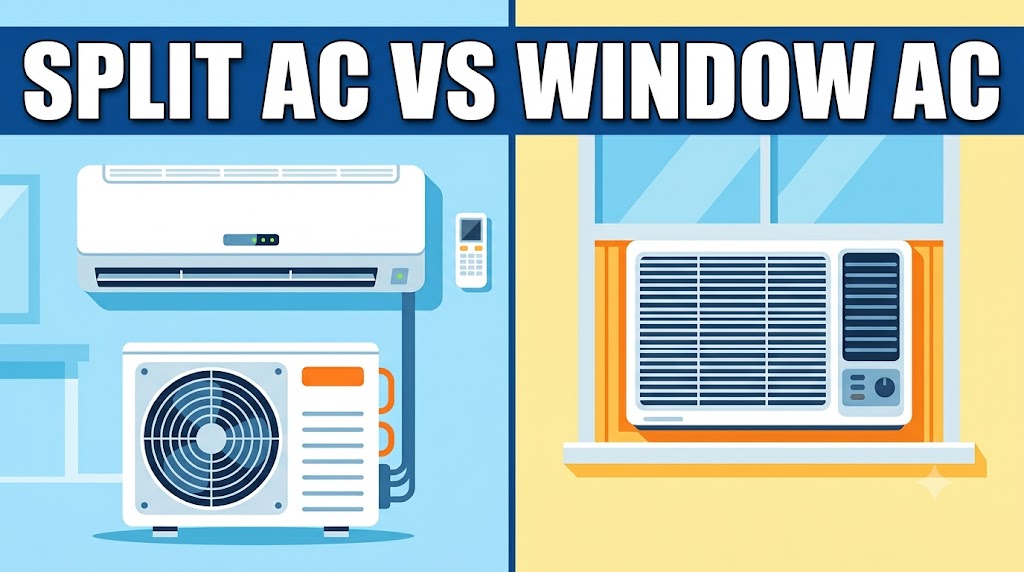
Split AC vs Window AC
Introduction
Choosing between a split AC and a window AC depends on your room size, installation options, budget, noise preferences, and cooling requirements. Both types can provide effective cooling, but their designs and installation methods are different. A split AC has separate indoor and outdoor units connected by refrigerant piping, while a window AC houses its main components in a single unit installed in a suitable window or wall opening. Understanding these differences can help you select an air conditioner that fits your room and provides suitable value for your money.
A split AC is often preferred for bedrooms and living rooms because it offers flexible installation and generally quieter indoor operation. A window AC can be a practical choice when you want a simpler installation and a potentially lower initial purchase price. However, neither type is automatically more energy-efficient in every situation. Electricity consumption depends on the model, cooling capacity, energy rating, room conditions, and usage. Comparing these factors alongside installation costs and maintenance requirements will help you choose the right AC for your home.
Quick Comparison Table
| Feature | Split AC | Window AC |
|---|---|---|
| Design | Separate indoor and outdoor units | Single integrated unit |
| Installation | Requires indoor and outdoor unit installation | Requires a suitable window or wall opening |
| Indoor noise | Generally quieter | Generally more noticeable |
| Purchase price | Often higher | Often lower |
| Installation cost | Usually higher | Often lower |
| Electricity consumption | Depends on model and energy rating | Depends on model and energy rating |
| Room suitability | Flexible placement for suitable rooms | Best suited to rooms with an appropriate opening |
| Maintenance | Requires care of both units | Requires care of the integrated unit |
| Portability | Not easily relocated | Can be relocated, but still requires suitable installation |
| Best suited for | Bedrooms and rooms where quiet operation matters | Budget-conscious buyers with suitable installation space |
1. Design and Construction
Split AC
A split AC has two main units. The indoor unit distributes cool air into the room, while the outdoor unit contains the compressor and other major components. Refrigerant piping and electrical connections link the units.
Window AC
A window AC combines the compressor, cooling components, and air-distribution system in one enclosure. It is installed in a suitable window or wall opening, with the relevant parts positioned according to the manufacturer’s installation instructions.
Winner: Depends. A split AC offers more flexibility in indoor placement, while a window AC has a simpler, integrated design.
2. Cooling Performance
Split AC
A split AC can cool a room effectively when its capacity is appropriate for the room’s size, insulation, sunlight exposure, and occupancy. Its indoor unit can distribute air from a suitable position on the wall.
Window AC
A window AC can also provide effective cooling when correctly sized and installed. Its air distribution depends on the unit’s design and placement within the room.
Winner: Depends. Neither type automatically cools faster or better. Compare cooling capacity and ensure the unit is correctly sized for your room.
3. Electricity Consumption
Split AC
Split ACs are available in inverter and non-inverter models, with different energy ratings. An efficient model with the right capacity may help control electricity costs, especially during frequent use.
Window AC
Window ACs also come in different energy-efficiency ratings and compressor types. Some models may consume more electricity than comparable split ACs, but this is not true of every model.
Winner: Depends. Compare the BEE energy label, annual electricity consumption, and cooling capacity of the specific models before purchasing.
4. Noise Levels
Split AC
The compressor is located in the outdoor unit, so the indoor unit generally produces less noise than a comparable window AC. However, fan noise and vibration can still occur.
Window AC
The compressor and other major components are housed within the same unit installed at the window or wall. Their operating noise is therefore generally more noticeable inside the room.
Winner: Split AC for quieter indoor operation in many typical installations.
5. Purchase Price
Split AC
Split ACs often have higher purchase prices because they use separate indoor and outdoor units and require more involved installation. The final price depends on capacity, energy rating, brand, and features.
Window AC
Window ACs are often less expensive to purchase for comparable basic cooling requirements. They can be suitable for buyers who want to keep initial expenses down.
Winner: Window AC for buyers prioritising a lower initial purchase price.
6. Installation Requirements
Split AC
Installing a split AC generally requires mounting both units, connecting refrigerant piping and electrical wiring, and completing the installation according to manufacturer specifications. Additional piping or difficult access can increase the cost.
Window AC
A window AC requires a suitable window or wall opening capable of supporting the unit. Proper support, sealing, drainage, and electrical connections are essential for safe operation.
Winner: Window AC when a suitable opening already exists and the installation conditions are straightforward. Otherwise, the more practical option depends on the room’s layout.
7. Maintenance and Repairs
Split AC
A split AC needs regular filter cleaning and servicing of both indoor and outdoor units. Refrigerant piping, drainage, and outdoor-unit access also need attention.
Window AC
A window AC also needs regular filter cleaning and servicing. Its integrated design may make some maintenance tasks simpler, although accessibility and repair costs depend on the specific fault.
Winner: Depends. Maintenance costs vary by model, service access, spare parts, and local technician charges.
8. Appearance and Space
Split AC
The indoor unit is mounted on a wall, leaving the window available for natural light and ventilation when needed. However, the indoor unit and outdoor installation still require suitable space.
Window AC
A window AC occupies part of a window or a dedicated wall opening. This may reduce available window space and affect the room’s appearance.
Winner: Split AC for rooms where keeping windows unobstructed and maintaining a cleaner interior appearance are priorities.
9. Which AC Should You Choose?
Choose a Split AC If:
- You want quieter indoor operation.
- You prefer flexible indoor-unit placement.
- You want to keep your window space available.
- You are willing to pay more for purchase and installation when the benefits suit your needs.
- You find a model with suitable cooling capacity and energy efficiency.
Choose a Window AC If:
- Your initial budget is limited.
- You already have a suitable window or wall opening.
- You want a single integrated unit.
- You prefer a potentially simpler and less expensive installation.
- You find a model with acceptable energy consumption and noise levels.
Final Verdict: Split AC vs Window AC
A split AC is generally the better choice for bedrooms and living spaces where quiet indoor operation, flexible placement, and an unobstructed window are important. A window AC can be a practical alternative when affordability, straightforward installation, and an existing suitable opening are the main priorities.
Before buying, compare the purchase price, installation charges, cooling capacity, BEE energy rating, annual electricity consumption, noise levels, warranty, and availability of local service. The best option is the one that fits your room and budget without compromising on suitable cooling performance.
Disclaimer
AC prices, cooling capacities, energy ratings, installation requirements, and features vary by manufacturer and model. Electricity consumption depends on usage, room conditions, outdoor temperature, installation, and maintenance. Check the latest specifications, energy label, and installation requirements before purchasing.