3-Star vs 5-Star AC
Introduction
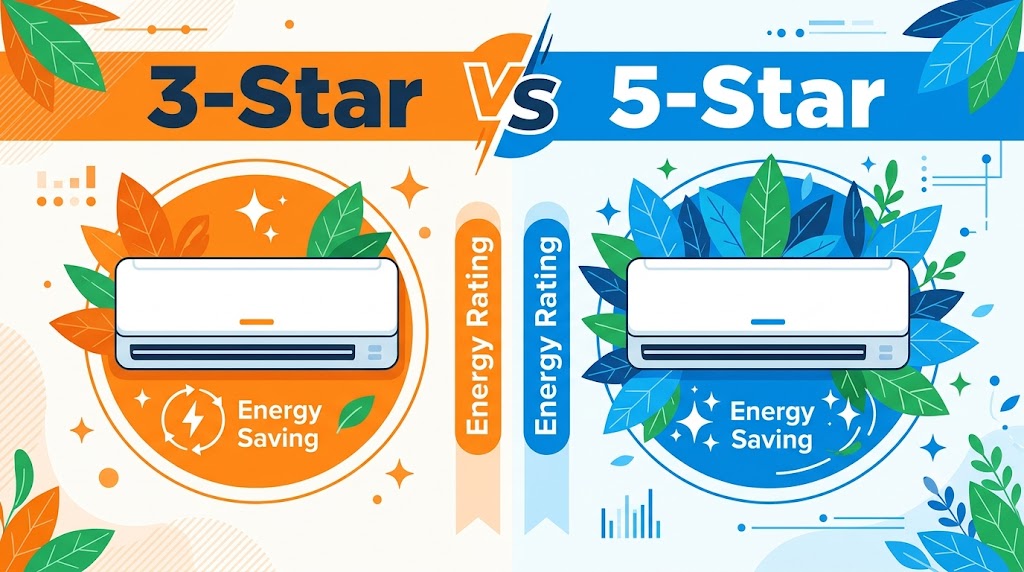
Choosing between a 3-star and a 5-star air conditioner depends on your budget, daily usage, electricity costs, and how long you plan to keep the AC. Both options can cool a room, but they differ in energy efficiency and potentially in their purchase prices. In India, the Bureau of Energy Efficiency (BEE) uses star ratings to help consumers compare the energy performance of appliances. A higher star rating indicates better energy efficiency within the applicable rating system, but the actual savings depend on the specific models and their usage.
A 3-star AC may be suitable for a household that uses air conditioning occasionally and wants to keep its initial spending lower. A 5-star AC may be a better choice for people who run their AC for several hours daily, especially during hot summers. However, the star rating alone does not determine the total cost of ownership. You should also compare the AC’s annual electricity consumption, cooling capacity, purchase price, installation costs, and BEE label validity before making a decision.
Quick Comparison Table
| Feature | 3-Star AC | 5-Star AC |
|---|---|---|
| Energy efficiency | Lower relative efficiency | Higher relative efficiency |
| Electricity consumption | Generally higher for comparable models | Generally lower for comparable models |
| Initial purchase price | Often lower | Often higher |
| Monthly electricity bill | Usually higher under comparable conditions | Usually lower under comparable conditions |
| Occasional use | Can be a practical choice | May not recover its extra cost quickly |
| Daily use | Suitable, depending on running costs | Often more economical over time |
| Cooling performance | Depends on the model and capacity | Depends on the model and capacity |
| Best suited for | Budget-conscious buyers and limited usage | Frequent users focused on long-term savings |
3-Star AC vs 5-Star AC: Key Differences
1. Energy Efficiency
A 3-star AC meets the energy-efficiency requirements for its applicable rating category. A 5-star AC meets a higher efficiency level under the same applicable rating system.
This means a 5-star model will generally use less electricity than a comparable 3-star model to provide cooling under similar conditions. However, compare the actual BEE labels rather than assuming every 5-star AC performs identically.
Verdict: 5-star AC wins for energy efficiency.
2. Electricity Consumption
Electricity consumption is one of the most important differences between these ACs. A more efficient 5-star model can use less electricity while providing comparable cooling, although the exact difference varies by model.
Actual consumption also depends on room size, outdoor temperature, thermostat setting, insulation, maintenance, and daily operating hours. Therefore, you should check the annual energy consumption stated on each model’s BEE label instead of relying only on the star rating.
Verdict: 5-star AC generally wins for lower electricity consumption.
3. Purchase Price
A 3-star AC often costs less upfront than a comparable 5-star model. This can make it attractive to buyers with a limited budget.
A 5-star AC may require a higher initial investment. Whether that extra cost is worthwhile depends on how much electricity you can save over the period you expect to use the appliance.
Before purchasing, compare the actual prices of similar-capacity models from the same or comparable product ranges.
Verdict: 3-star AC often wins on initial purchase cost.
4. Monthly Electricity Bill
A 5-star AC can reduce electricity expenses when compared with a similar 3-star model under equivalent operating conditions. The savings generally become more valuable as operating hours increase.
For example, a household running an AC for several hours every night may benefit more from higher efficiency than a household using it only occasionally. Your actual bill will also depend on your electricity tariff and other household appliances.
Verdict: 5-star AC is generally better for reducing running costs.
5. Cooling Performance
A higher star rating does not automatically mean faster cooling or a colder room. Cooling performance depends on factors such as cooling capacity, compressor design, airflow, room conditions, and installation quality.
A correctly sized 3-star AC can cool a room effectively, while an undersized 5-star AC may struggle in the same room. Compare cooling capacity in relation to your room size before choosing either model.
Verdict: Depends on the individual model and correct sizing.
6. Long-Term Value for Money
The total cost of owning an AC includes its purchase price, electricity consumption, maintenance, and repairs. A 3-star model may be more economical if it costs significantly less and is used for only a few hours occasionally.
On the other hand, a 5-star model may offer better overall value if its additional purchase cost is recovered through electricity savings. Calculate the price difference and expected annual savings before deciding.
Verdict: 5-star AC often offers better long-term value for frequent users; 3-star AC may suit occasional users.
Which AC Should You Choose?
Choose a 3-Star AC If:
- Your budget for the initial purchase is limited.
- You use the AC for relatively few hours.
- The upfront price difference is large compared with the likely electricity savings.
- You have compared the energy labels and total ownership costs.
Choose a 5-Star AC If:
- You use your AC for several hours every day.
- You want to reduce electricity consumption over time.
- You plan to keep the AC for several years.
- The expected savings justify the additional purchase price.
How to Calculate Which AC Is Cheaper
Check the annual electricity consumption printed on the BEE label of both models.
Estimated annual electricity cost = Annual energy consumption in kWh × Electricity tariff per unit
Then compare the estimated yearly costs and the difference in purchase prices.
For a simple payback estimate:
Payback period = Extra purchase cost of the 5-star AC ÷ Estimated annual electricity savings
This is an estimate, not a guarantee. Actual savings vary with usage, weather, electricity rates, and model performance.
Final Verdict: 3-Star vs 5-Star AC
A 5-star AC is generally the better choice for households that use air conditioning regularly and want lower electricity consumption over the long term. A 3-star AC can be a sensible option when the initial budget matters more and usage is limited.
Neither rating guarantees better cooling in every situation. Compare cooling capacity, annual energy consumption, purchase price, and the applicable BEE label before buying. The best AC is the one that meets your cooling needs at a reasonable total cost.
Disclaimer
AC prices, energy labels, specifications, and availability may change. Star ratings should be compared using the applicable BEE label period. Actual electricity consumption and savings depend on the model, room conditions, usage, and local electricity tariff. Verify the latest product details before purchasing.