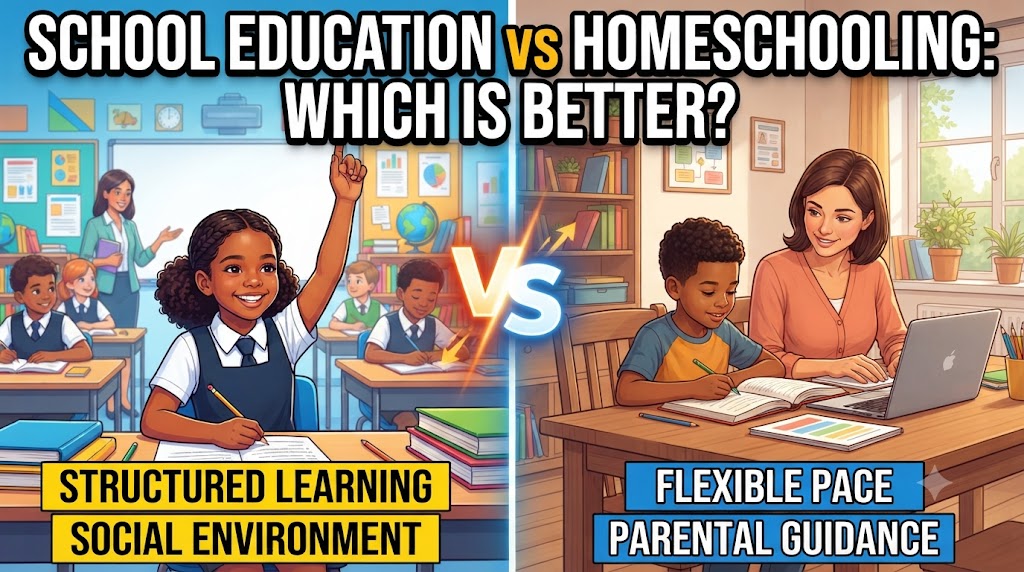
School Education vs Homeschooling
Introduction
School education and homeschooling offer two different ways for children to learn. In traditional school education, students attend a school where teachers provide instruction according to a structured curriculum and timetable. Homeschooling allows parents or guardians to take primary responsibility for education at home, using textbooks, online courses, tutors, educational platforms, or other learning resources. The choice can affect a child’s daily routine, social interaction, learning pace, parental involvement, and educational environment.
Traditional schools provide regular interaction with teachers and other students, organized activities, and a defined academic schedule. Homeschooling can provide greater flexibility and allow lessons to be adapted to an individual child’s pace and interests. However, it also requires consistent planning and involvement from parents or guardians. The better option depends on the child’s learning needs, family circumstances, available resources, social opportunities, and educational goals.
Quick Comparison Table
| Feature | School Education | Homeschooling |
|---|---|---|
| Learning Location | School | Home or another chosen location |
| Daily Schedule | Usually fixed | Flexible |
| Teaching | Professional teachers | Parents, tutors, or online resources |
| Personalization | Depends on school and class size | Usually highly customizable |
| Social Interaction | Regular daily peer interaction | Must generally be arranged separately |
| Extracurricular Activities | Often available through school | Parents usually arrange them |
| Parental Involvement | Lower day-to-day involvement | Usually higher |
| Learning Pace | Generally follows class schedule | Can be adjusted to the child |
| Resources | School-provided facilities and materials | Family arranges resources |
| Best Suited For | Families seeking structured classroom education | Families seeking flexible, personalized learning |
Learning Environment
School Education
Schools provide a dedicated learning environment with classrooms, teachers, schedules, and established academic routines.
Students generally attend lessons with other children and follow the school’s timetable. This creates a consistent structure for daily learning.
Homeschooling
Homeschooling allows families to create their own learning environment. Lessons can take place at home, online, in libraries, or through educational activities outside the home.
Parents can adjust the environment according to the child’s learning preferences.
Better depends: School education provides a ready-made structured environment, while homeschooling gives families greater control.
Teaching and Guidance
In traditional schools, trained teachers generally lead classroom instruction and manage multiple students.
Homeschooling can involve parents, tutors, online teachers, educational platforms, or a combination of these resources.
Parents therefore need to decide how lessons will be delivered and how the child’s progress will be monitored.
Winner: School Education for access to a dedicated classroom teaching structure.
Winner: Homeschooling for choosing and customizing the teaching approach.
Learning Pace
In school education, students generally follow the pace established by the teacher and curriculum. Although teachers may provide additional support, the class usually progresses according to a common schedule.
Homeschooling allows parents to spend more time on difficult topics or move faster when the child understands a subject quickly.
Winner: Homeschooling for flexibility in learning pace.
Personal Attention
A classroom teacher has to divide attention among multiple students, although class sizes and support systems differ between schools.
Homeschooling can provide highly individualized attention because lessons can be designed around one child’s strengths, weaknesses, and interests.
Winner: Homeschooling for direct one-to-one customization.
However, effective homeschooling requires parents or tutors to provide consistent academic guidance.
Social Interaction
School education provides regular opportunities to interact with classmates, teachers, and other members of the school community.
Students can develop social skills through classroom discussions, group projects, sports, clubs, and school events.
Homeschooling does not automatically provide the same daily peer environment. Families may need to arrange sports, community groups, classes, clubs, or other social activities.
Winner: School Education for built-in daily peer interaction.
Extracurricular Activities
Schools often provide organized opportunities for sports, music, art, science activities, competitions, clubs, and other interests.
Homeschooling families can provide similar opportunities, but they generally need to find and organize them separately.
Winner: School Education for convenient access to organized extracurricular activities.
Flexibility
Traditional schools usually have fixed schedules for classes, holidays, examinations, and activities.
Homeschooling allows families to adjust study hours, lesson duration, subject order, and learning pace.
This flexibility can be useful for families whose schedules or educational requirements do not fit a traditional school timetable.
Winner: Homeschooling for scheduling flexibility.
Parental Involvement
School education transfers much of the daily teaching responsibility to professional teachers and school staff.
Parents still need to monitor homework, communicate with teachers, and support the child’s education, but they generally do not have to manage every lesson.
Homeschooling usually requires significantly more parental involvement. Parents may need to select materials, prepare lessons, teach or coordinate tutors, monitor progress, and arrange examinations or other requirements.
Winner: School Education if parents have limited time for daily teaching.
Cost
School education involves tuition and other expenses such as transportation, uniforms, books, activities, and school-related fees. The total cost varies significantly between schools.
Homeschooling may reduce some school-related expenses, but families can still spend money on textbooks, computers, online courses, tutors, educational subscriptions, extracurricular activities, and other resources.
Winner: Depends on the setup.
The actual annual cost should be compared rather than assuming homeschooling is always cheaper.
Academic Structure
Schools generally follow a recognized curriculum and provide a structured sequence of subjects and assessments.
Homeschooling gives families greater control over curriculum selection, but they need to ensure that the chosen educational program meets applicable requirements and the child’s future academic goals.
Winner: School Education for a ready-made academic structure.
Winner: Homeschooling for curriculum flexibility.
Independence and Responsibility
School education provides opportunities for children to manage homework, deadlines, school materials, activities, and relationships with teachers and classmates.
Homeschooling can also develop independence, particularly when children gradually take responsibility for planning and completing their own studies.
The outcome depends heavily on how the educational environment is organized.
Winner: Depends.
Which Is Better for Your Child?
School education may suit your family if you want:
- A structured daily timetable
- Regular classroom interaction
- Professional teachers
- Organized extracurricular activities
- A ready-made academic curriculum
- Less day-to-day teaching responsibility for parents
Homeschooling may suit your family if you want:
- A flexible learning schedule
- Individualized teaching
- Control over learning pace
- Greater parental involvement
- The ability to customize educational resources
- A learning environment designed around the child’s needs
Before choosing, parents should also consider the child’s personality, learning style, social needs, available time, educational goals, and access to suitable learning resources.
Conclusion
School education and homeschooling both provide potential educational pathways, but they require different levels of family involvement and offer different learning environments. Traditional schools provide structured teaching, regular peer interaction, organized activities, and established academic systems. Homeschooling offers greater flexibility and allows education to be customized around the individual child.
There is no universal answer to which is better. Families should compare learning needs, social opportunities, parental availability, costs, curriculum requirements, educational goals, and available resources before choosing the approach that fits their situation.
Disclaimer
Education systems, homeschooling requirements, curriculum rules, examinations, and admission policies can vary by country, state, and institution and may change over time. Always check the latest applicable requirements and educational regulations before choosing a schooling method.