Private School vs International School
Introduction
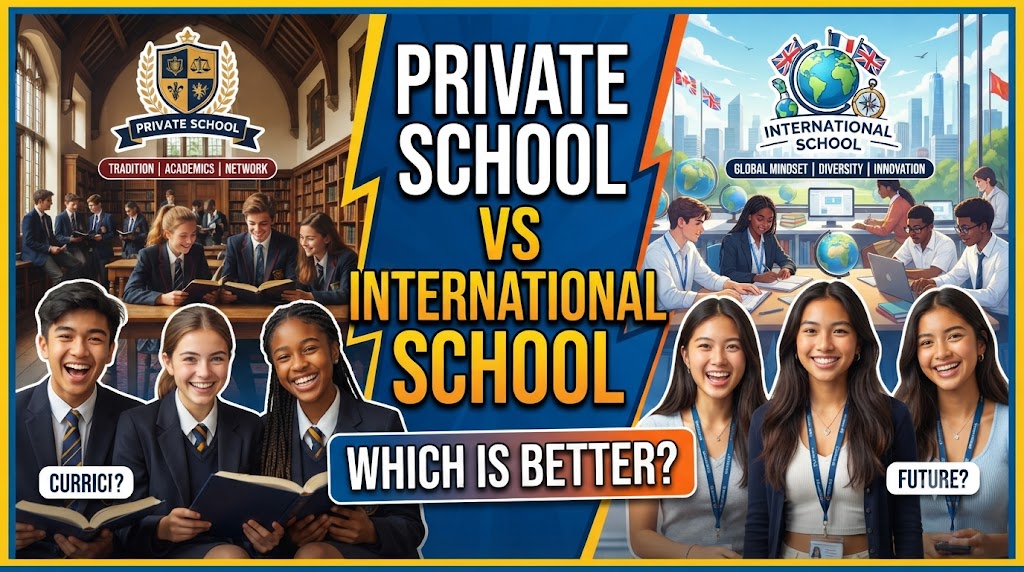
Private schools and international schools can both provide structured education, but they are not necessarily the same type of institution. A private school is generally independently managed and may follow a national or regional curriculum, while an international school usually offers an international curriculum or an education program designed with an international focus. The actual curriculum, teaching style, facilities, fees, and academic standards can vary considerably from one school to another. Therefore, comparing the specific school and curriculum is more useful than relying only on the school category.
For families in India, a private school may follow CBSE, ICSE, a state board, or another recognized curriculum. An international school may offer programs such as IB or Cambridge, depending on the institution. International schools can provide a more globally oriented learning environment, while private schools can offer a wider range of curriculum choices and fee levels. The right option depends on the child’s learning needs, family budget, future education plans, and the specific school’s quality and facilities.
Quick Comparison Table
| Feature | Private School | International School |
|---|---|---|
| Management | Privately managed | Usually privately managed |
| Curriculum | Can follow CBSE, ICSE, state board, or other curriculum | Often follows an international curriculum such as IB or Cambridge |
| Teaching Style | Depends on school and curriculum | Often emphasizes inquiry, projects, and international perspectives |
| International Exposure | Varies by school | Generally more internationally oriented |
| Fees | Wide range | Often higher, but varies |
| School Availability | Generally widespread | More concentrated in larger cities |
| Competitive Exams in India | Depends on curriculum; CBSE is commonly used | Depends on curriculum and additional preparation |
| Overseas Education | Possible with recognized qualifications | Can provide a direct international curriculum pathway |
| Facilities | Varies considerably | Often includes extensive facilities, but varies by school |
| Best Suited For | Families seeking curriculum and budget choices | Families seeking a particular international curriculum or global learning environment |
Curriculum
Private School
A private school does not automatically mean a particular curriculum. In India, private schools may follow CBSE, ICSE, a state board, or another recognized curriculum.
This gives families a relatively wide range of choices. Parents can select a school according to the curriculum that matches their child’s academic goals.
International School
International schools generally offer an international curriculum or an education model with an international orientation. Depending on the school, this may include IB, Cambridge, or another recognized program.
The curriculum may emphasize conceptual understanding, projects, inquiry, research, and independent learning, depending on the specific program.
Better depends: The important factor is the actual curriculum rather than the word “private” or “international.”
Teaching and Learning Style
Private schools can use traditional classroom teaching as well as activity-based, digital, project-based, or modern teaching methods.
International schools may place greater emphasis on inquiry, discussion, projects, presentations, and application of knowledge, depending on the curriculum.
However, teaching quality varies between individual schools.
Winner: Depends on the specific school and curriculum.
International Exposure
International schools are generally designed with a global outlook. Students may study internationally oriented curricula and encounter broader global perspectives through subjects, activities, and school programs.
Private schools can also provide international exposure through foreign-language programs, exchange activities, international competitions, and overseas university guidance, but this varies considerably.
Winner: International School for a curriculum specifically designed with an international orientation.
Academic Structure
Private schools following Indian boards generally provide a familiar academic structure within the Indian education system.
International schools may have different subject structures, assessment methods, and academic requirements depending on their curriculum.
Students who may move between countries should consider curriculum compatibility before choosing a school.
Winner: Depends on the family’s education plans.
Indian Competitive Exams
Students in private schools following CBSE or other Indian curricula can prepare for Indian competitive examinations alongside their school studies.
Students in international schools can also prepare for Indian competitive examinations, but depending on their curriculum, they may need additional preparation to cover examination-specific content.
Winner: Depends on the curriculum.
For a student specifically following a CBSE-based pathway, a private CBSE school may provide a more familiar academic structure.
Overseas University Education
International schools can offer curricula that are familiar to universities in different countries, depending on the qualification.
Students from private schools can also apply to overseas universities. Admission depends on the university, country, qualification, academic performance, entrance requirements, and other factors.
Winner: Depends on the university and curriculum.
An international school is not automatically required for studying abroad.
Fees
Private school fees vary significantly. Some private schools can be relatively affordable, while premium private schools may have high fees.
International schools often have higher fees, particularly when they offer extensive facilities, international curricula, specialized programs, transportation, activities, and other services.
However, there are substantial differences between individual schools.
Winner: Depends on the specific school’s fee structure and the family’s budget.
School Availability
Private schools are widely available across Indian cities and towns.
International schools are also present in many major Indian cities, but the number of schools offering particular international curricula can be more limited.
Winner: Private School for wider availability.
Facilities and Activities
Some international schools offer extensive sports facilities, laboratories, libraries, technology resources, arts programs, and extracurricular activities.
Private schools can also offer excellent facilities, but the standard varies considerably.
Therefore, parents should visit the actual school and compare its facilities rather than assuming that one category always has better infrastructure.
Winner: Depends on the individual school.
Which Is Better for Your Child?
A private school may suit your family if you want:
- A choice of Indian curricula such as CBSE or ICSE
- More options across different fee levels
- A school close to home
- A familiar Indian education pathway
- Preparation aligned with Indian academic goals
An international school may suit your family if you want:
- A specific international curriculum
- A globally oriented learning environment
- Greater exposure to international education approaches
- A possible pathway that aligns with overseas education plans
- More emphasis on inquiry or project-based learning, depending on the curriculum
The individual school’s teachers, curriculum implementation, facilities, student support, fees, location, and academic environment should be evaluated before admission.
Conclusion
Private schools and international schools can provide very different educational experiences, but neither category automatically guarantees a particular level of academic quality. Private schools offer a broad range of curricula and fee structures, while international schools generally provide a more internationally oriented curriculum and learning environment.
The better choice depends on the curriculum, child’s learning needs, family budget, location, teaching quality, and future education plans. Comparing specific schools on these factors will provide a more meaningful decision than comparing school categories alone.
Disclaimer
School curricula, fees, admission requirements, facilities, and educational policies can vary between institutions and may change over time. Always verify the latest information directly with the specific school and relevant education board before making an admission decision.