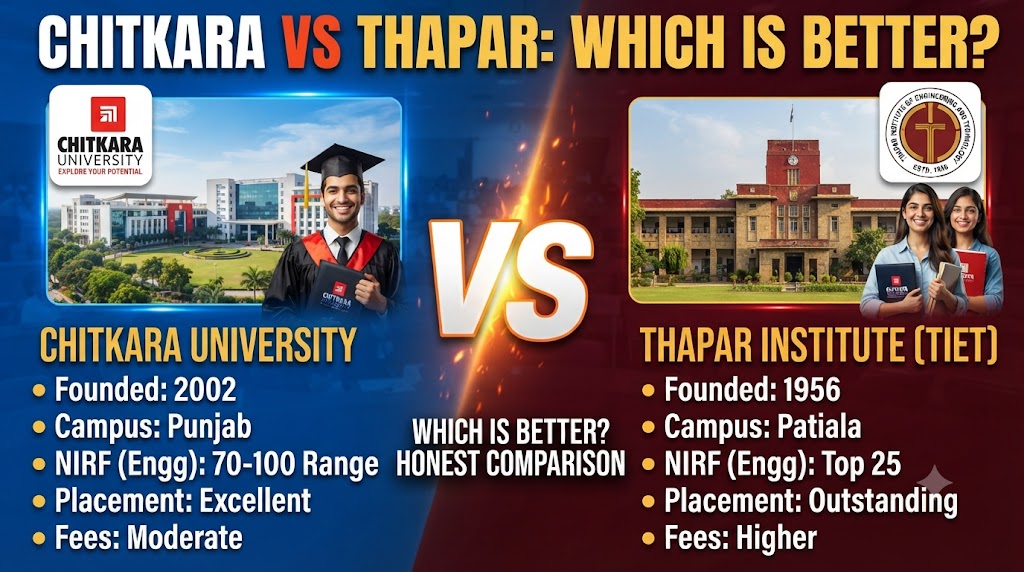
Chitkara University vs Thapar Institute of Engineering and Technology
Introduction
Chitkara University and Thapar Institute of Engineering and Technology are two prominent private higher-education institutions in Punjab. Chitkara University is located near Rajpura, while Thapar Institute is located in Patiala. Both offer engineering and technology programmes along with courses in other disciplines, but their academic structures, admission processes, fees, campus environments and programme choices are different. For students comparing the two, looking at the exact course is important because the experience and cost can vary considerably between programmes.
Chitkara University offers four-year B.E. programmes in areas including Computer Science and Engineering, Artificial Intelligence and Machine Learning, Artificial Intelligence and Future Technologies, Electronics and Communication, Mechanical, Electrical, Civil and other engineering disciplines. Thapar Institute offers undergraduate engineering programmes along with postgraduate and doctoral programmes. Its 2026–27 admissions are open for B.Tech and other undergraduate and postgraduate programmes. (Chitkara University)
Quick Comparison Table
| Feature | Chitkara University | Thapar Institute of Engineering and Technology |
|---|---|---|
| Location | Rajpura, Punjab | Patiala, Punjab |
| Type | Private University | Deemed-to-be University |
| Main strength areas | Engineering, Technology, Management, Healthcare, Design and more | Engineering, Technology, Sciences, Management and research |
| B.E./B.Tech duration | Generally 4 years | Generally 4 years |
| Engineering specialisations | Wide range including CSE, AI/ML, ECE, Mechanical, Civil and more | Multiple engineering and technology programmes |
| 2026 admission | Programme-specific requirements | 2026–27 admissions open |
| Campus size | University campus near Rajpura | 250-acre campus |
| NIRF 2025 University ranking | 78 | 26 |
| NIRF 2025 Engineering ranking | — | 29 |
| Best comparison approach | Compare exact programme, specialisation and fees | Compare exact programme, admission route and total cost |
Fees, eligibility requirements and programmes may change by academic year.
Chitkara University vs Thapar Institute: Academic Programmes
Both institutions provide engineering and technology education, but their programme structures are not identical.
Chitkara University’s 2026 engineering list includes B.E. programmes in Computer Science and Engineering, CSE with AI and Machine Learning with Microsoft, CSE with AI and Future Technologies, Electronics and Communication, Electrical, Mechanical, Automobile, Mechatronics, Civil and other specialised areas. It also offers BCA and other programmes outside engineering. (Chitkara University)
Thapar Institute has a broader academic and research structure, with undergraduate, postgraduate and PhD programmes. Its current admissions portal lists B.Tech, MBA, ME/M.Tech, MCA, M.Sc., MA and PhD programmes among its offerings. (Thapar Institute)
Winner: Depends on the course
Students should compare the exact branch, curriculum, electives, laboratories and specialisations instead of comparing only the number of programmes.
Chitkara University vs Thapar Institute: Engineering and Computer Science
For engineering students, the specific branch can make a significant difference.
Chitkara’s 2026 B.E. offerings include several technology-focused CSE options, including AI/ML and AI & Future Technologies. The university also provides specialisation options within its CSE programme, including Full Stack Development, Cloud Computing, Data Science & Analytics and Cyber Security. (Chitkara University)
Thapar Institute has a long-established engineering focus and offers multiple undergraduate engineering disciplines. Its official website describes the institute as an engineering-focused institution with programmes spanning engineering and technology. (Thapar Institute)
For a student specifically interested in CSE, AI or another technology field, the best comparison should therefore include the exact branch, curriculum, available specialisation, admission route and total fee.
Winner: Depends on the specialisation
Chitkara University vs Thapar Institute: Fees
Fees are an important difference to examine before applying.
Chitkara’s official 2026 fee structure provides semester-wise fees for individual engineering programmes. For example, its four-year B.E. CSE programme lists ₹1.82 lakh for each of the first two semesters, followed by ₹2.10 lakh per semester in semesters three and four and ₹2.31 lakh per semester from semester five onward. Additional Educational Technology Services and Career Advancement Services charges also apply during the specified semesters. (Chitkara University)
The fee structure is different for specialised programmes. For example, the 2026 CSE AI/ML with Microsoft programme has higher semester fees than the standard CSE programme. (Chitkara University)
Thapar publishes its current fee structures through its academic and admissions resources, and the applicable amount depends on the specific programme and academic session. Its 2026–27 admissions information is currently available through the official admissions portal. (Thapar Institute)
Winner: Depends on the programme
A student should calculate the complete four-year academic cost, including hostel, examination, student and other applicable charges, before comparing the two.
Chitkara University vs Thapar Institute: Admission Requirements
The admission process is another important difference.
For Chitkara’s 2026 B.E. CSE programme, the published eligibility information requires Class XII with a minimum aggregate of 60% or 60% in Physics, Chemistry and Mathematics, and JEE Main 2026 is mandatory for the listed programme. (Chitkara University)
Thapar Institute’s 2026–27 admission portal provides admission routes for its undergraduate programmes, including B.Tech. Requirements can vary according to the programme and admission category, so students should check the current prospectus before applying. (Thapar Institute)
Winner: Depends
The relevant admission route depends on the student’s Class XII subjects, marks, entrance examination performance and chosen programme.
Chitkara University vs Thapar Institute: NIRF Ranking
NIRF provides a national reference point for comparing universities and institutions.
In the NIRF 2025 University ranking, Thapar Institute of Engineering and Technology was ranked 26th, while Chitkara University was ranked 78th. (NIRF)
Thapar Institute was also ranked 29th in Engineering in NIRF 2025. (Thapar Institute)
These rankings describe the institutions according to NIRF’s methodology and should not be treated as a direct measurement of every individual course or department.
Comparison: Thapar has the higher NIRF 2025 University and Engineering positions.
Chitkara University vs Thapar Institute: Campus
Campus environment can be important for students spending four years at the institution.
Chitkara University describes its Punjab campus as being located near Rajpura and within convenient reach of Chandigarh, Mohali, Panchkula, Ambala and Patiala. Its programmes span several disciplines, creating a multidisciplinary university environment. (Chitkara University)
Thapar Institute’s official information describes a 250-acre campus in Patiala. The institute also lists campus facilities, research centres, hostels and other student resources through its website. (Thapar Institute)
Winner: Depends on location and campus preference
Students should consider travel distance, hostel requirements, campus facilities and the environment associated with their chosen department.
Chitkara University vs Thapar Institute: Placements
Placement information should be compared carefully because headline placement figures may represent different programmes, batches or definitions.
Chitkara’s official engineering material highlights campus recruitment and industry interaction, while its current university material describes industry partnerships and career-oriented programmes. (Chitkara University)
Thapar maintains a dedicated campus placement system and publishes information about recruiting organisations. Its recruiter list includes companies such as Amazon, Apple, Adobe, AMD, American Express, Bank of America and several others. (Thapar Institute)
Thapar also maintains historical placement data showing the number of companies visiting and students placed for earlier academic years. (Thapar Institute)
Because placement results vary by branch and graduating year, students should examine course-specific placement data, rather than relying only on the highest package.
Comparison: Check the latest branch-wise placement data
Chitkara University vs Thapar Institute: Industry Exposure
Both universities provide opportunities for students to interact with industry, but their approaches can differ.
Chitkara highlights industry-oriented programmes and collaborations with companies and organisations. Its engineering material also describes internships and industry interaction as part of the student experience. (Chitkara University)
Thapar has a dedicated placement and career system and maintains a large list of organisations that participate in campus recruitment. (Thapar Institute)
Students interested in industry exposure should compare internship opportunities, industry projects, technical clubs, placement preparation and recruiter participation for their particular branch.
Winner: Depends on the student’s programme and career goals
Chitkara University vs Thapar Institute: Research Opportunities
Research can become important for students considering postgraduate education, specialised technical careers or academic research.
Thapar Institute offers undergraduate, postgraduate and PhD programmes and highlights research and innovation as part of its academic structure. Its current website also features research collaborations and specialised initiatives such as the Thapar School of Advanced AI and Data Science. (Thapar Institute)
Chitkara University also offers postgraduate and doctoral programmes and has research, innovation and incubation initiatives. (Chitkara University)
Winner: Depends on the research area
Students interested in research should compare faculty, laboratories, funded projects, publications and PhD opportunities in their particular subject.
Chitkara University vs Thapar Institute: Which One Should You Choose?
The choice can be approached according to the student’s priorities rather than using one overall answer.
Choose Chitkara University if:
- Your preferred engineering specialisation is available there.
- You are interested in specialised CSE programmes such as AI/ML or AI and Future Technologies.
- Chitkara’s published fee structure fits your budget.
- The location near Rajpura and the Chandigarh region is convenient for you.
- You prefer a multidisciplinary university with programmes across several professional fields.
Choose Thapar Institute if:
- You are specifically interested in an established engineering-focused institution.
- Thapar offers the particular branch or programme you want.
- NIRF rankings are an important factor in your comparison.
- You want access to a large campus and a broad engineering and research ecosystem.
- Thapar’s admission route and total cost fit your circumstances.
Final Verdict
Chitkara University and Thapar Institute of Engineering and Technology have different academic structures, admission processes, programme choices and fee arrangements.
The NIRF 2025 University ranking places Thapar Institute at 26th and Chitkara University at 78th, while Thapar is also ranked 29th in Engineering. (NIRF)
At the same time, Chitkara offers a wide selection of specialised engineering programmes, including several CSE and AI-focused options, with a published 2026 fee structure that varies by specialisation. (Chitkara University)
Therefore, instead of choosing only on the university name, compare the same branch at both institutions, including admission eligibility, total four-year cost, curriculum, hostel expenses, placement data, internships and career opportunities.
Disclaimer
University fees, admission rules, programmes, scholarships, placement information and other policies can change by academic session. Always verify the latest information on the official university websites and current admission prospectuses before applying or paying any fees.