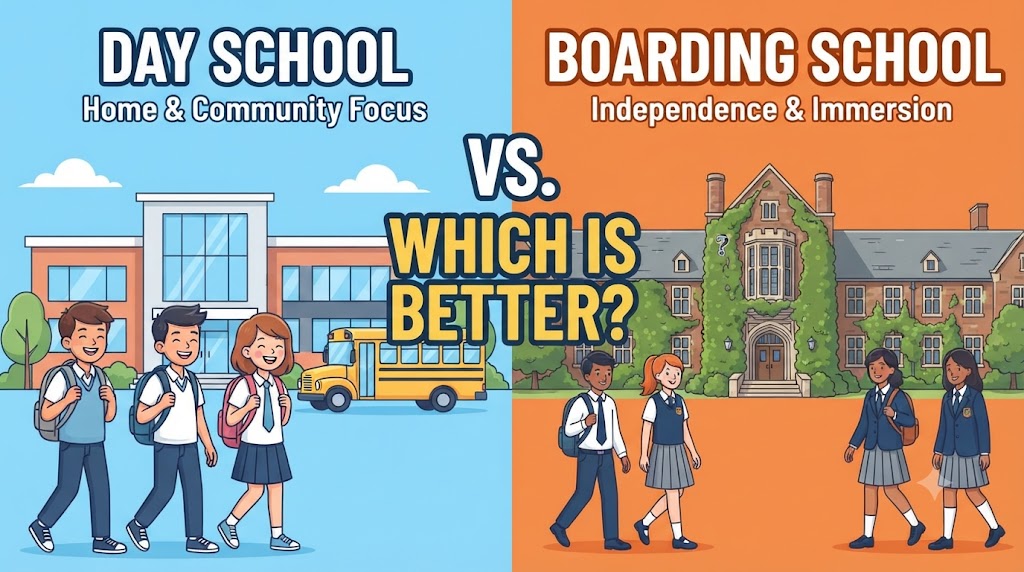
Day School vs Boarding School
Introduction
Choosing between a day school and a boarding school depends on more than academic education. A day school allows students to attend classes and return home after school, while a boarding school provides accommodation where students live and study during the school term. These two environments can create very different daily routines. Parents should consider the student’s age, independence, academic needs, family situation, distance from school, extracurricular interests, and ability to adapt to living away from home before making a decision.
A day school allows children to remain closely connected with their family and familiar home environment. A boarding school, on the other hand, can provide a more structured routine with academic activities, sports, and other activities within the school environment. Neither option is automatically better for every student. The right choice depends on the individual child’s personality, maturity, educational goals, and the quality of the particular school.
Quick Comparison Table
| Feature | Day School | Boarding School |
|---|---|---|
| Living Arrangement | Student lives at home | Student lives at school |
| Family Time | More frequent | More limited during term |
| Daily Routine | School + home routine | School and residential routine |
| Independence | Develops gradually | Often develops more through residential life |
| Parental Involvement | Usually easier | More limited during school terms |
| Extracurricular Activities | Depends on school schedule | Can be integrated into residential routine |
| Travel | Daily commute | Usually no daily commute |
| Cost | Generally lower | Generally higher |
| Best For | Students who benefit from family support | Students comfortable with residential education |
Day School vs Boarding School: Daily Routine
A day-school student generally follows a routine that includes travelling to school, attending classes and returning home. After school, the student can complete homework, relax and spend time with family.
Boarding-school students usually have a more structured routine covering classes, meals, study periods, activities and residential life. This can help students develop time-management skills, but it also means following the school’s routine for much of the day.
Winner: Depends — students who prefer family-based routines may suit day schools, while students who enjoy structured residential routines may prefer boarding schools.
Day School vs Boarding School: Family Time
Day schools provide more regular opportunities for students to interact with parents and siblings because they return home after school.
Boarding-school students spend much of the academic term away from their families. They may have scheduled holidays, weekends or visiting arrangements depending on the school.
Winner: Day School for regular family interaction.
Day School vs Boarding School: Independence
Day schools allow students to gradually develop independence while continuing to receive daily support from their families.
Boarding schools require students to manage more aspects of everyday life within the school environment. They may need to organise their belongings, follow schedules, manage study time and adapt to living with other students.
Winner: Boarding School for opportunities to develop independence, although the student’s maturity is important.
Day School vs Boarding School: Academic Environment
Both types of schools can provide strong academic education. The quality depends more on the school’s curriculum, teachers, resources, academic support and management than on whether it is a day or boarding school.
Boarding schools may offer supervised study periods or extended academic routines. Day-school students can also receive strong academic support and have the benefit of studying at home after school.
Winner: Depends on the individual school and student.
Day School vs Boarding School: Extracurricular Activities
Day schools may offer sports, clubs, cultural activities and competitions, but students generally return home after school.
Boarding schools can integrate extracurricular activities into the residential schedule, potentially giving students more opportunities to participate in sports, clubs, hobbies and other activities.
However, the actual opportunities depend on the school’s facilities and programme.
Winner: Depends on the school.
Day School vs Boarding School: Cost
Day schools generally cost less because families do not usually pay for residential accommodation, boarding meals and related residential services.
Boarding schools generally have additional expenses because students live on campus. Fees can cover accommodation, meals, supervision and other residential facilities.
The exact cost varies significantly between schools.
Winner: Day School for affordability.
Day School vs Boarding School: Social Development
Day-school students interact with classmates during school hours and continue developing relationships within their family and local community.
Boarding-school students spend more time with classmates and residential peers. This can provide frequent opportunities to develop friendships, teamwork and social independence.
However, the experience can also be challenging for students who are not comfortable being away from their families.
Winner: Depends on the student’s personality and the school environment.
Day School vs Boarding School: Parental Involvement
Parents of day-school students can usually monitor daily routines, homework and activities more directly because the child returns home each day.
In a boarding school, parents have less direct involvement in the student’s everyday routine during the school term. Communication takes place through the school’s systems and scheduled interactions.
Winner: Day School for direct daily parental involvement.
Day School vs Boarding School: Which Is Better for Students?
Day School May Be Better When:
- The student benefits from daily family support.
- Parents want greater involvement in everyday education.
- The school is conveniently located.
- The family prefers a home-based routine.
- The student is not ready to live away from home.
- Keeping education costs lower is important.
Boarding School May Be Better When:
- The student is comfortable living away from home.
- A particular boarding school offers a strong educational programme.
- Structured routines suit the student.
- Residential sports or extracurricular opportunities are important.
- The family lives far from suitable schools.
- The student is ready to develop greater independence.
Final Verdict
Day School vs Boarding School: Which is better for students?
Day school is generally better for students who benefit from regular family support and a home-based routine, while boarding school can be better for students who are mature, independent and comfortable with residential education.
There is no universal winner. Parents should consider the child’s age, personality, emotional readiness, academic requirements, family circumstances, school quality and total cost before choosing between a day school and a boarding school.
Disclaimer
School fees, boarding arrangements, admission requirements, schedules, facilities and school policies can vary between institutions and may change over time. Parents should verify the latest information directly with the school before making an admission decision.