Government School vs Private School
Introduction
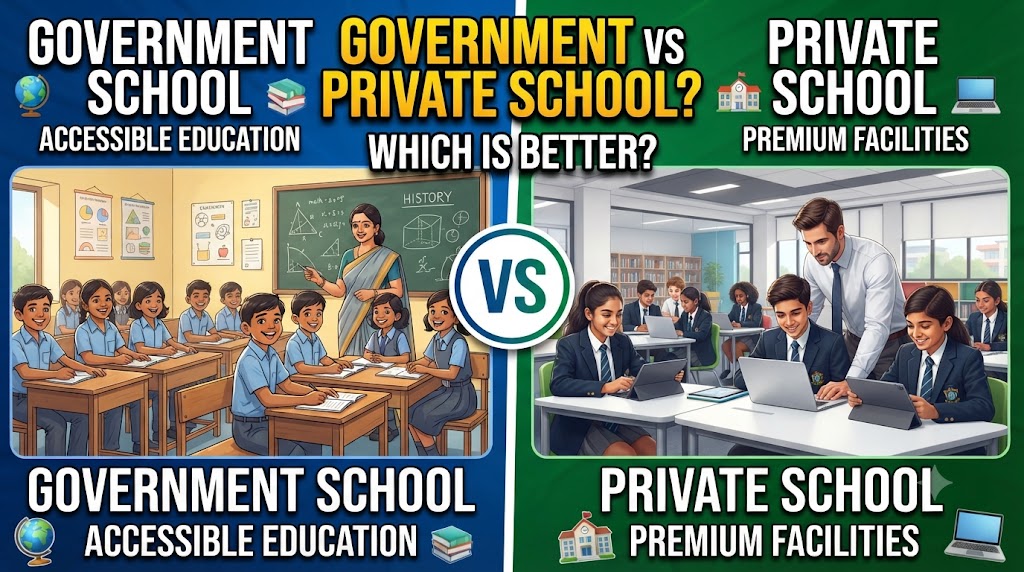
Choosing between a government school and a private school is an important decision for parents because the school environment can influence a child’s academic experience, daily routine, activities, and overall development. Government schools are generally funded and managed by government authorities, while private schools are independently managed and mainly supported through fees and other sources of funding. However, the actual quality of education can vary significantly from one school to another, so the school itself matters as much as its category.
Private schools may offer different facilities, teaching approaches, extracurricular activities, and fee structures compared with government schools. Government schools may provide more affordable education and, depending on the school and location, access to experienced teachers and government-supported facilities. Parents should therefore compare teaching quality, fees, infrastructure, class size, activities, accessibility, and the child’s individual needs before making a decision.
Quick Comparison Table
| Feature | Government School | Private School |
|---|---|---|
| Management | Government authorities | Private management |
| Fees | Usually lower | Usually higher |
| Admission | Depends on rules and availability | Depends on school policy |
| Class Size | Varies by school | Varies by school |
| Infrastructure | Varies considerably | Varies considerably |
| Teaching Quality | Varies by school and teachers | Varies by school and teachers |
| Extracurricular Activities | Depends on the school | Often varies by school |
| Affordability | Generally better | Generally more expensive |
| Best For | Families prioritising affordability | Families seeking specific facilities or school environments |
Government School vs Private School: Fees
One of the biggest differences is the cost of education.
Government schools generally have lower tuition costs because they are supported by government funding. This can make them a practical option for families who want to control their education expenses.
Private schools generally charge tuition and may have additional costs for activities, transportation, uniforms, books, or other services. However, fees differ considerably between private schools.
Winner: Government School for affordability.
Government School vs Private School: Teaching Quality
Teaching quality should not be judged solely by whether a school is government or private.
Government schools can have experienced and qualified teachers, while private schools can also have strong teaching teams. At the same time, the quality of teaching can differ from one school to another within both categories.
Parents should check teacher availability, classroom interaction, academic results where relevant, and how the school supports students who need additional help.
Winner: Depends on the individual school and teachers.
Government School vs Private School: Class Size
Class size can affect how much individual attention students receive.
Some government schools may have larger classes, while some private schools may maintain smaller classes. However, this is not true for every school.
A smaller class can make it easier for teachers to give individual attention, but teaching quality and classroom management also matter.
Winner: Depends on the school.
Government School vs Private School: Infrastructure
Infrastructure can include classrooms, laboratories, libraries, computer facilities, sports areas, sanitation facilities, and other resources.
Many private schools invest significantly in infrastructure and additional facilities, but the quality varies widely. Government schools also differ considerably depending on their location, funding, and available facilities.
Therefore, parents should visit the actual school rather than assuming that one category will always have better infrastructure.
Winner: Depends on the individual school.
Government School vs Private School: Extracurricular Activities
Extracurricular activities can help students develop interests and skills outside regular academic subjects.
Private schools may offer activities such as sports, competitions, clubs, arts, music, or technology programmes, depending on their resources and educational approach.
Government schools can also provide sports, cultural activities, competitions and other opportunities, although availability varies by school.
Winner: Depends on the school and the activities available.
Government School vs Private School: Discipline
Discipline depends heavily on school policies, teachers, administration, and the overall school environment.
Private schools may have clearly defined rules and structured routines. Government schools can also maintain disciplined and organised environments.
Parents should look at how the school handles attendance, behaviour, homework, communication and student responsibilities.
Winner: Depends on the school.
Government School vs Private School: Medium of Instruction
The medium of instruction is an important consideration, particularly for parents who have a specific preference for English, Hindi, a regional language, or another language.
Government and private schools can use different mediums depending on the state, board, and individual school. Some private schools may provide English-medium education, while government schools can also offer English-medium sections or schools in some areas.
Winner: Depends on the school and the parent’s preference.
Government School vs Private School: Personal Attention
Personal attention depends on class size, teacher availability, classroom management, and the school’s approach to supporting individual students.
A private school may provide additional academic support or communication with parents, but this is not guaranteed. Government schools can also provide effective individual support when teachers have the time and resources to do so.
Winner: Depends on the individual school.
Government School vs Private School: Which Is Better for Students?
There is no universal winner.
Government school may be better for students when:
- Affordable education is a priority
- The nearby government school has good teachers
- The school provides suitable facilities
- The family wants to minimise education expenses
- The school environment meets the child’s needs
Private school may be better when:
- The family can comfortably manage the fees
- A particular school’s facilities are useful for the child
- The school’s teaching approach suits the student
- Specific extracurricular activities are important
- The school offers the preferred medium and curriculum
Final Verdict
Government School vs Private School: Which is better?
Government schools are generally better for affordability, while private schools may be preferable when a particular school offers facilities, teaching methods, activities, or an environment that better matches the student’s needs.
The best choice should be based on the actual school, not simply its government or private status. Parents should compare teachers, fees, facilities, class size, academic support, safety, distance, curriculum, and the child’s learning needs before making the final decision.
Disclaimer
School fees, admission rules, facilities, curriculum, government policies, and school-specific requirements can change over time and may vary by state, city, board, and individual institution. Parents should verify the latest information directly with the school before making an admission decision.