IB vs IGCSE
Introduction
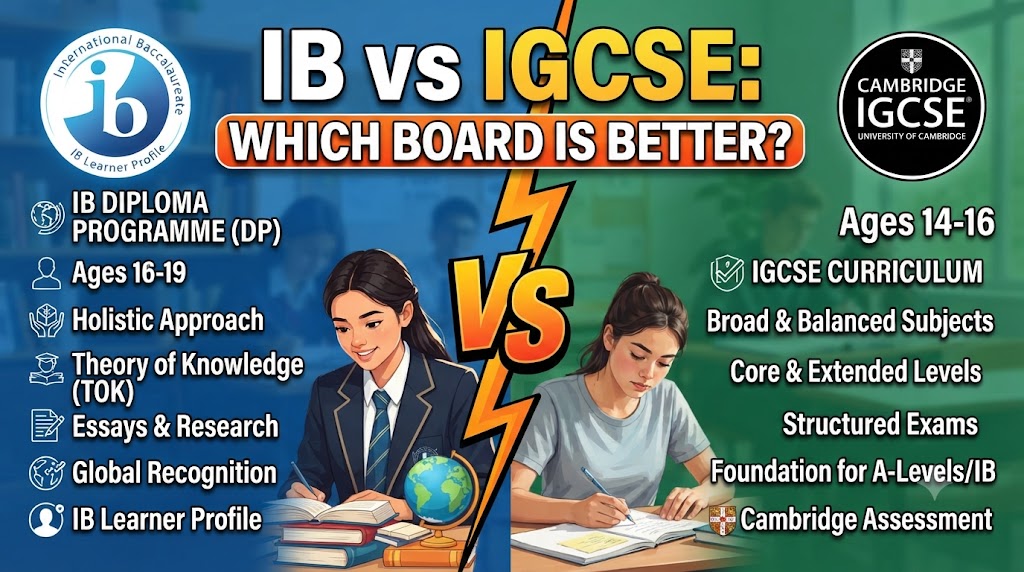
Choosing between the International Baccalaureate (IB) and Cambridge IGCSE can be difficult because both are internationally recognised education pathways, but they follow different approaches to learning and assessment. IB programmes generally place strong emphasis on inquiry, conceptual understanding, independent learning, and applying knowledge across subjects. IGCSE, offered by Cambridge, provides subject-based courses with structured syllabuses and examinations. The better choice depends on the student’s learning style, academic goals, preferred subjects, and plans for further education.
IB and IGCSE can both provide strong preparation for higher education, but they are not identical in structure or teaching approach. IB offers different programmes for different age groups, while IGCSE is primarily a qualification for students in the secondary-school years. Parents and students should therefore compare curriculum structure, assessment, flexibility, workload, recognition, and future study plans before deciding which option fits them better.
Quick Comparison Table
| Feature | IB | IGCSE |
|---|---|---|
| Full Name | International Baccalaureate | International General Certificate of Secondary Education |
| Main Approach | Inquiry and concept-based learning | Subject-based structured learning |
| Curriculum | Broad and interconnected | Individual subject syllabuses |
| Assessment | Depends on IB programme; can include coursework and examinations | Primarily subject-based assessment, depending on the course |
| Learning Style | Encourages research, inquiry and independent thinking | Strong focus on subject knowledge and application |
| Subject Choice | Programme-dependent | Generally flexible subject selection |
| International Recognition | Widely recognised | Widely recognised |
| Best For | Students who enjoy inquiry and interdisciplinary learning | Students who prefer structured subject-based study |
IB vs IGCSE: Curriculum Structure
IB Curriculum
The IB is not a single school examination. It provides different programmes for different age groups, including the Primary Years Programme, Middle Years Programme and Diploma Programme.
IB programmes generally encourage students to connect ideas, investigate questions and develop skills alongside subject knowledge. The IB Diploma Programme, for example, combines subject study with additional core components.
This approach can suit students who enjoy exploring concepts rather than simply memorising information.
IGCSE Curriculum
IGCSE is a secondary-school qualification offered by Cambridge. Schools can provide a range of subjects, allowing students to build a programme according to their interests and academic plans.
Each subject has its own syllabus and assessment structure. This makes IGCSE comparatively straightforward for students who prefer studying clearly defined subjects.
Winner: Depends — IB offers a more integrated learning approach, while IGCSE provides a structured subject-based framework.
IB vs IGCSE: Learning Style
IB generally places considerable emphasis on inquiry, critical thinking, reflection and independent learning. Students may be expected to investigate questions, discuss ideas and apply knowledge in different contexts.
IGCSE also develops analytical and problem-solving skills, but the learning experience is more closely organised around individual subjects and their respective syllabuses.
Winner: Depends — students who enjoy inquiry and independent exploration may prefer IB, while students who like structured subject learning may find IGCSE more comfortable.
IB vs IGCSE: Assessment
Assessment is another important difference.
IB assessment varies according to the specific programme. Depending on the programme and subject, students may encounter examinations, coursework, projects, investigations or other forms of assessment.
IGCSE assessment is generally organised around individual subjects. The exact assessment method can vary between subjects, with examinations and, in some cases, coursework or practical components.
Therefore, neither board can simply be called “easier” based on its assessment system.
Winner: Depends — the better system depends on whether a student performs better with structured examinations, coursework, projects, or a combination of assessment methods.
IB vs IGCSE: Subject Choice
IGCSE allows schools to offer a wide range of individual subjects. Students can usually choose subjects according to their interests and future plans, although the exact options depend on the school.
IB subject flexibility depends on the particular IB programme. The Diploma Programme, for example, has a defined structure requiring students to study subjects across different groups along with its core components.
Winner: IGCSE for students who primarily want to select individual secondary-level subjects, although the actual flexibility depends on the school and programme.
IB vs IGCSE: Workload
Both can be demanding, but the nature of the workload can differ.
IB students may have to manage research, projects, assignments, reflection and other programme requirements alongside regular studies. The workload can therefore involve considerable independent organisation.
IGCSE students also need consistent preparation across their chosen subjects, particularly as examinations approach. The workload may feel more predictable for students who prefer a clearly structured syllabus.
Winner: Depends — neither should automatically be considered easier.
IB vs IGCSE: International Recognition
Both IB and IGCSE are internationally recognised education pathways. However, recognition does not mean that every university or country treats every qualification in exactly the same way.
Students planning to study abroad should check the specific admission requirements of their target universities and countries before choosing a board.
Winner: Tie — both have strong international recognition, but individual university requirements should always be checked.
IB vs IGCSE: Which Is Better for Higher Education?
IB can be attractive to students who want an education pathway that develops independent learning, research and broader academic skills. The IB Diploma Programme is particularly designed as a pre-university programme.
IGCSE can provide a strong secondary-level foundation and can also lead into different senior-secondary pathways, including Cambridge International AS & A Levels or other qualifications, depending on the school.
The better option depends heavily on what the student plans to study after secondary school.
Winner: Depends — the student’s intended university pathway and country are more important than choosing a board simply because it is international.
IB vs IGCSE: Which Is Better for Students?
There is no universal winner between IB and IGCSE.
IB may be better for students who:
- Enjoy inquiry and independent learning
- Like connecting ideas between subjects
- Are comfortable with projects and research
- Prefer a broader educational approach
IGCSE may be better for students who:
- Prefer clearly defined subjects
- Like structured syllabuses
- Want flexibility in choosing individual subjects
- Prefer a more traditional subject-based examination pathway
Final Verdict
IB vs IGCSE: Which board is better?
IB is better for students who prefer inquiry-based, broader and more interconnected learning, while IGCSE can be better for students who prefer structured subject-based education and flexible subject selection.
Neither board is universally better. The right choice depends on the student’s learning style, academic strengths, future education plans, available subjects, school quality and the requirements of the universities they may later apply to.
Disclaimer
Curriculum structures, assessment methods, subject availability and admission requirements can vary by programme, school, country and academic year. Parents and students should check the latest official information from the relevant IB or Cambridge authorities and their chosen school before making an education decision.