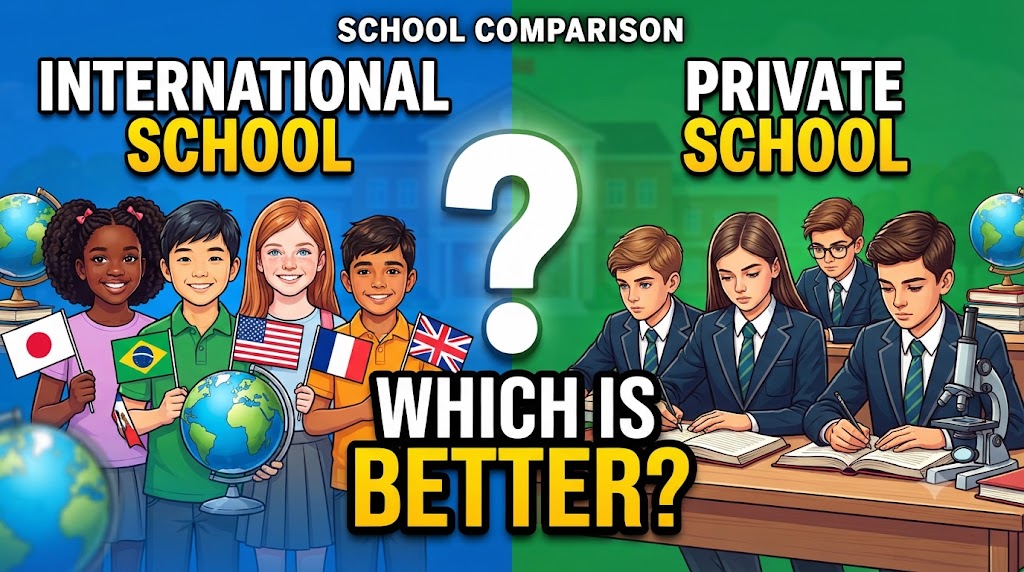
International School vs Private School
Introduction
Choosing the right school can affect a student’s learning experience, academic development, activities, and overall environment. International schools and private schools can both offer structured education, but they may differ in curriculum, teaching approach, facilities, language of instruction, fees, and admission requirements. The right choice depends on what parents expect from the school and what suits the student’s educational needs.
An international school generally follows an international curriculum or incorporates an international approach to education, while a private school may follow a national or state curriculum but is independently managed. However, the term “international school” does not automatically mean that every school offers the same curriculum or standards. Therefore, parents should compare the actual curriculum, teaching quality, fees, facilities, and academic requirements before making a decision.
Quick Comparison Table
| Feature | International School | Private School |
|---|---|---|
| Curriculum | Usually international or globally oriented | May follow CBSE, ICSE, state board, or another curriculum |
| Teaching Approach | Often emphasizes global exposure and broader learning | Varies by school and curriculum |
| Language | English is commonly used | Depends on the school |
| Fees | Often higher, but varies widely | Varies from affordable to expensive |
| Facilities | Often offers extensive facilities, but varies | Depends on the school |
| Extracurricular Activities | Often broad, but school-specific | Depends on the school |
| Class Environment | Can be more internationally oriented | Depends on the school |
| Admission | May have specific requirements | Varies by school |
| Best For | Students seeking international curriculum or global exposure | Families wanting a particular national/state curriculum or school environment |
Curriculum
Curriculum is one of the biggest differences between international and private schools.
International schools may offer curricula such as the International Baccalaureate (IB), Cambridge International, or other internationally recognized programmes. These curricula can place emphasis on inquiry, independent learning, broader perspectives, and skills alongside academic knowledge.
Private schools do not necessarily follow an international curriculum. A private school can follow CBSE, ICSE, a state board, or another recognized curriculum. Therefore, being a private school does not by itself indicate a particular type of academic programme.
Winner: Depends
The better option depends on which curriculum matches the student’s future education plans and learning needs.
Teaching Approach
International schools often use teaching approaches designed to encourage participation, inquiry, communication, projects, and independent thinking. However, the actual teaching style can differ significantly between schools.
Private schools can also use modern and student-focused teaching methods. Some may have traditional classroom methods, while others may provide project-based learning, technology-supported education, and activity-based teaching.
Winner: Depends
The quality of teaching depends more on the individual school and teachers than simply on whether the school is international or private.
Language of Instruction
English is commonly used as a primary language of instruction in many international schools. Students may also have opportunities to study additional languages depending on the curriculum.
Private schools may also use English as the main teaching language, particularly in urban areas. However, the language policy varies from one school to another.
Winner: International School
International schools generally provide a stronger international-language environment, but parents should check the actual language policy of the school.
Fees
School fees can vary considerably in both categories.
International schools can have higher fees because of their curriculum, facilities, staffing, activities, and other services. However, not every international school is necessarily more expensive than every private school.
Private schools cover a much wider range of fee levels. Some are relatively affordable, while others can be expensive depending on their facilities, location, curriculum, and reputation.
Winner: Depends
Parents should compare the complete annual cost rather than looking only at tuition fees. Transportation, books, uniforms, activities, meals, and other charges can also affect the total cost.
Facilities
International schools may offer facilities such as laboratories, libraries, sports areas, technology-enabled classrooms, arts spaces, and activity rooms. However, facilities vary considerably between schools.
Private schools can also provide excellent infrastructure. Some established private schools have extensive sports, laboratory, library, technology, and extracurricular facilities.
Winner: Depends
The actual facilities should be inspected rather than judged from the school’s category or name.
Extracurricular Activities
International schools often provide students with opportunities in sports, arts, music, cultural activities, clubs, and other programmes. Their international orientation may also provide opportunities for broader cultural exposure.
Private schools can provide many of the same activities. The range depends on the school’s resources, teachers, timetable, and priorities.
Winner: Depends
Parents should check which activities are actually available and how frequently students can participate in them.
Academic Flexibility
International curricula can provide different approaches to assessment, projects, subjects, and learning compared with traditional national curricula. This may suit students who prefer broader or more inquiry-based learning.
Private schools following CBSE, ICSE, or state boards can also provide structured academic programmes. The flexibility depends mainly on the curriculum and the individual school’s implementation.
Winner: Depends
The best choice depends on the student’s learning style and future academic plans.
Global Exposure
International schools generally have a stronger focus on global perspectives. Students may encounter international curricula, multicultural learning materials, additional languages, and activities connected with different cultures.
Private schools can also provide international exposure through language programmes, exchange activities, competitions, technology, and other initiatives, but this varies significantly.
Winner: International School
For families specifically looking for an internationally oriented learning environment, an international school may have an advantage.
Admission Requirements
Admission procedures differ from school to school.
International schools may have specific age requirements, entrance assessments, previous academic records, interviews, or other admission procedures depending on the programme.
Private schools may also conduct entrance tests, interviews, or document checks. Requirements depend on the school, board, grade, and available seats.
Winner: Depends
Parents should check the admission rules of the specific schools rather than assuming one category is easier.
Which Is Better for Higher Education?
Neither option is automatically better for higher education.
A student’s future opportunities depend on the curriculum they study, academic performance, subject choices, skills, and the admission requirements of the university or college they later apply to.
An international curriculum can be suitable for students planning to study in different countries, particularly when the curriculum is recognized by their intended universities. A private school following a national curriculum can also provide a strong foundation for higher education in India and elsewhere.
Winner: Depends
The student’s long-term education plan should be considered before choosing the school.
International School vs Private School: Which Is Better?
An international school may be better for families who specifically want an international curriculum, global exposure, a multilingual environment, or an internationally oriented learning approach.
A private school may be better for families who want a particular national or state curriculum, a specific fee range, a convenient location, or a school whose teaching and facilities match their expectations.
It is also important to remember that an international school can itself be privately managed. Therefore, “international” and “private” are not always directly opposite categories. The more useful comparison is the curriculum, teaching quality, fees, facilities, location, student support, and future education plans of the specific schools being considered.
Final Verdict
International School vs Private School: Which Is Better?
There is no universal winner. An international school can be a strong choice for students seeking an internationally oriented curriculum and global exposure. A private school can be the better choice when its curriculum, teaching quality, facilities, fees, and location fit the student’s needs.
Before making a final decision, parents should compare the actual schools rather than choosing only by the label international or private.
Disclaimer
School curricula, fees, admission requirements, facilities, and policies can vary between institutions and may change over time. Parents and students should verify the latest information directly with the respective schools before making an admission or financial decision.