Public School vs Private School
Introduction
Choosing between a public school and a private school is an important decision for parents and students. Both types of schools can provide formal education, qualified teachers, academic programmes, and extracurricular activities, but their management, funding, fees, admission processes, and available facilities can differ. The right choice depends on the family’s budget, the student’s educational needs, location, and the specific school being considered.
Public schools are generally funded and managed by government authorities, while private schools are independently managed and mainly supported through fees and other permitted sources. However, the quality and experience of education can vary significantly within both categories. Therefore, parents should compare individual schools rather than assuming that one type is automatically better than the other.
Quick Comparison Table
| Feature | Public School | Private School |
|---|---|---|
| Management | Generally managed by government authorities | Independently managed |
| Funding | Primarily supported through government funding | Primarily supported through fees and other sources |
| Tuition Fees | Generally lower | Usually higher, but varies |
| Curriculum | Depends on the board and government system | Can follow CBSE, ICSE, state board, or other recognized curriculum |
| Admission | Usually follows government or school-specific rules | Varies by school and available seats |
| Class Size | Varies by school | Varies by school |
| Facilities | Vary by school and location | Vary by school and investment |
| Teaching | Depends on teachers and school administration | Depends on teachers and school administration |
| Activities | Varies by school | Varies by school |
| Best For | Families seeking affordable education within the public system | Families seeking a particular school environment or curriculum |
Management and Ownership
The basic difference between public and private schools is their management.
Public schools are generally operated by government authorities such as central, state, or local government bodies. Their administration and policies are connected to the relevant education system.
Private schools are independently managed by private organizations, trusts, societies, or other non-government entities, depending on the applicable rules.
Winner: Depends
Management structure alone does not determine the quality of education. Parents should examine the individual school’s performance, teachers, facilities, and academic environment.
School Fees
Fees are one of the most important differences for many families.
Public schools generally have lower tuition costs because they receive government support. The exact fees and other charges depend on the particular school and education system.
Private schools generally charge higher fees, although the amount can vary considerably. Some private schools are relatively affordable, while others charge substantially more for their programmes and facilities.
Winner: Public School
For families where education costs are a major consideration, public schools generally offer a more affordable option.
Curriculum
Public schools follow the curriculum prescribed by their relevant education board or government education system. Depending on the school, this may include a state board, CBSE, or another recognized curriculum.
Private schools also follow recognized curricula. Many follow CBSE, ICSE, state boards, or other approved educational programmes.
Winner: Tie
The better curriculum depends on the student’s academic goals and the quality of implementation at the individual school.
Admission Process
Public school admissions generally follow government rules, local regulations, age requirements, and available seats. Some schools may also give preference based on location or other applicable criteria.
Private schools can have their own admission procedures within the applicable regulations. These may include application forms, document verification, assessments, interviews, or other requirements.
Winner: Depends
The admission process varies by location, school, grade, and available seats.
Class Size
Class size can influence how much individual attention students receive.
Some public schools may have larger classes, while others may maintain smaller class sizes. The situation can differ significantly between schools and locations.
Private schools may also have smaller classes, but this is not guaranteed. Some popular private schools can have large class sizes because of high demand.
Winner: Depends
Parents should ask the school about the actual student-to-teacher ratio instead of relying on the school’s category.
Quality of Teaching
The quality of teaching depends heavily on the teachers, school leadership, training, classroom practices, and academic support.
Public schools can have experienced and qualified teachers and may provide strong academic foundations. Private schools can also have qualified teachers and may use different teaching methods or technology-supported learning.
Winner: Depends
A good teacher and effective school environment matter more than whether the school is public or private.
Facilities and Infrastructure
School facilities can include classrooms, laboratories, libraries, computer rooms, sports areas, activity rooms, and other resources.
Private schools may invest significantly in infrastructure and technology, but the quality varies from one school to another.
Public schools also provide educational facilities, but resources can vary based on government funding, location, school size, and other factors.
Winner: Depends
Parents should visit the school and evaluate the actual facilities available to students.
Extracurricular Activities
Extracurricular activities can contribute to students’ development outside regular academic subjects.
Private schools may offer sports, music, arts, clubs, competitions, educational trips, and other activities. Public schools can also offer many of these activities, depending on their resources, staff, and programmes.
Winner: Depends
The number and quality of activities should be compared at the individual school level.
Technology in Education
Technology can support classroom teaching through computers, smart boards, digital learning resources, educational applications, and online platforms.
Some private schools make significant investments in technology and digital infrastructure. Public schools are also increasingly using digital educational resources, although availability can differ between schools and locations.
Winner: Depends
The actual technology available and how effectively teachers use it are more important than the school’s ownership.
Student Support
Student support may include academic assistance, counselling, special educational support, career guidance, and communication with parents.
Private schools may offer dedicated support services, but this varies considerably. Public schools can also provide support through teachers, counsellors, government programmes, and other educational services.
Winner: Depends
Parents should ask what support services are actually available and how students can access them.
School Environment
The school environment includes discipline, teacher-student relationships, peer interaction, communication with parents, and the overall learning atmosphere.
Private schools may offer a structured environment with specific school policies and activities. Public schools can also provide a strong and supportive environment, depending on the school leadership and community.
Winner: Depends
A school visit can give parents a better understanding of the actual environment.
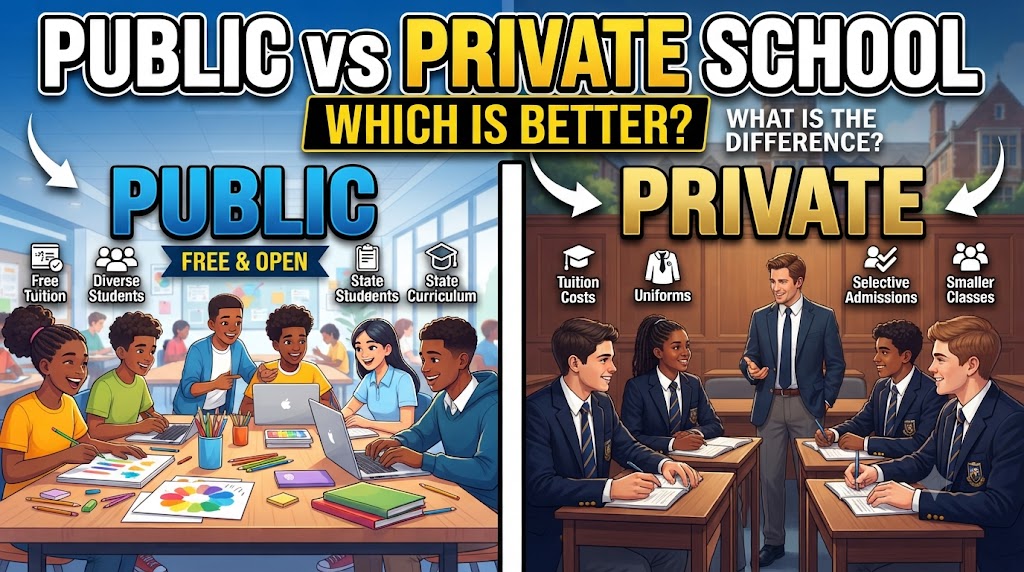
Public School vs Private School: Which Is Better?
A public school may be better for families who prioritize affordability, access to the public education system, and a recognized curriculum without high private-school fees.
A private school may be better for families who are comfortable with higher fees and want a particular school, curriculum, facilities, teaching approach, or extracurricular programme.
However, these are general differences rather than fixed rules. A well-managed public school can provide an excellent education, while an expensive private school is not automatically better.
Final Verdict
Public School vs Private School: What Is the Difference?
The biggest differences are usually related to management, funding, fees, and admission systems. Public schools generally have a cost advantage, while private schools may offer more choice in terms of school environment, facilities, or programmes depending on the institution.
There is no universal winner. Parents should compare fees, curriculum, teachers, class size, facilities, distance, activities, student support, and the school’s actual academic environment before making a decision.
Disclaimer
School fees, admission rules, curricula, facilities, government policies, and school policies can change over time and may vary by location and institution. Parents should verify the latest information directly with the respective school or education authority before making an admission decision.