BLDC Fan vs Normal Ceiling Fan
Introduction
Choosing between a BLDC fan and a normal ceiling fan can affect your home’s electricity consumption, operating cost, and everyday comfort. Both types circulate air to help keep a room comfortable, but they differ in motor technology, energy efficiency, controls, and purchase price. A BLDC fan generally uses a brushless direct-current motor and electronic controls, while a normal ceiling fan commonly uses an AC induction motor. Understanding these differences can help you select a fan that suits your room, usage pattern, budget, and electricity-saving goals.
The better option depends on how many hours you run your fan and how much you want to spend initially. A BLDC fan can be particularly useful in rooms where fans operate for long periods because its lower power consumption may reduce electricity bills over time. A normal ceiling fan can still be a practical choice when the purchase budget is limited or the existing fan works well. Before deciding, compare energy use, speed control, maintenance considerations, and overall value rather than choosing based on the motor type alone.
Quick Comparison Table
| Feature | BLDC Fan | Normal Ceiling Fan |
|---|---|---|
| Motor technology | Brushless DC motor with electronic control | Commonly AC induction motor |
| Electricity consumption | Generally lower | Generally higher |
| Initial price | Usually higher | Usually lower |
| Energy savings | Greater potential with frequent use | Usually lower |
| Remote control | Common on many models | Depends on the model |
| Speed control | Often electronic and precise | Depends on the regulator and model |
| Noise | Often quiet, depending on design | Varies by motor and construction |
| Maintenance | Generally low; electronics may require specialist repair | Generally low; simpler models may be easier to service |
| Best suited for | Frequent or long daily use | Budget-conscious buyers and occasional use |
1. Electricity Consumption
BLDC Fan
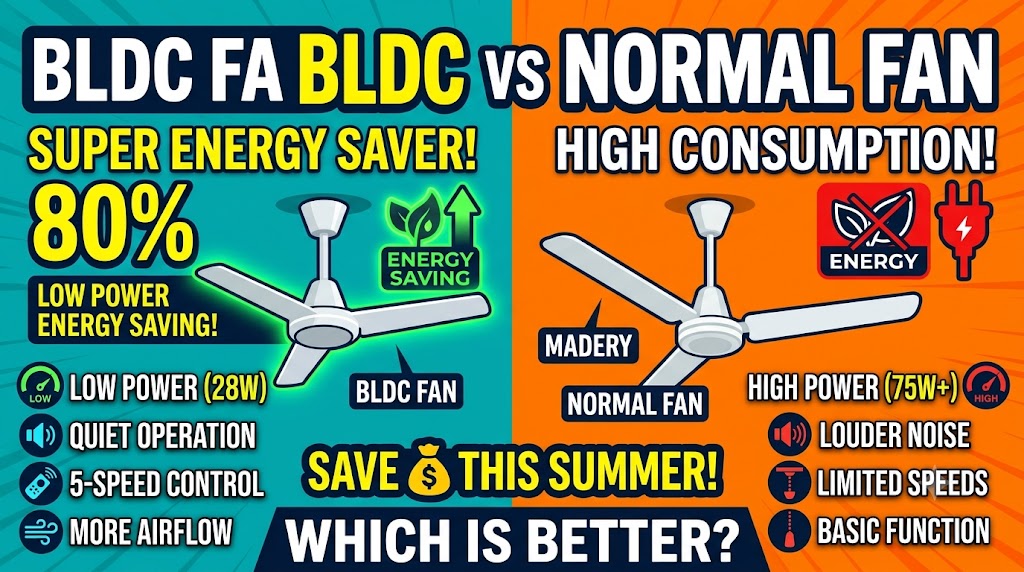
A BLDC fan is designed to operate efficiently using electronic motor control. Many domestic models consume approximately 25–35 watts at typical operating speeds, although actual consumption varies by model and speed setting. Lower power consumption can make a meaningful difference when the fan runs for many hours every day.
Normal Ceiling Fan
A conventional ceiling fan often consumes around 60–75 watts, although some efficient models use less and older models may consume more. Its actual consumption depends on the motor design, blade size, and operating speed.
Verdict: A BLDC fan generally wins on electricity consumption, but compare the rated wattage of the specific models before buying.
2. Initial Purchase Price
BLDC Fan
BLDC fans often cost more upfront because they use electronic controls and a different motor design. Prices vary with brand, design, airflow, remote-control features, and warranty.
Normal Ceiling Fan
Normal ceiling fans are available in many budget-friendly options. They may be more suitable when several fans need to be purchased at once and the initial budget is limited.
Verdict: A normal ceiling fan generally wins on initial purchase price.
3. Long-Term Electricity Cost
BLDC Fan
The lower electricity consumption of a BLDC fan can help recover its higher purchase price over time. The savings are usually more significant when the fan operates for many hours each day.
Normal Ceiling Fan
A normal fan may have a lower initial cost, but its higher power consumption can increase running expenses. For a fan used only occasionally, the difference in electricity cost may be relatively small.
Verdict: A BLDC fan is generally better for long-term savings when daily usage is high.
4. Speed Control and Convenience
BLDC Fan
Many BLDC fans include a remote control for adjusting speed and accessing additional functions. Some models also offer sleep timers and other convenience features. However, the available functions differ by model.
Normal Ceiling Fan
A normal ceiling fan may use a wall-mounted regulator or a compatible electronic controller. Remote control is available on some models but should not be assumed to be included.
Verdict: BLDC fans often offer more convenient controls, especially when the selected model includes a remote.
5. Noise and Comfort
BLDC Fan
Many BLDC fans operate quietly, particularly at lower speeds. However, noise also depends on blade balance, bearings, installation quality, and the fan’s construction.
Normal Ceiling Fan
Normal ceiling fans can also operate quietly when well designed and properly installed. Worn bearings, loose fittings, or an unsuitable regulator can cause noise or vibration.
Verdict: There is no universal winner. Compare actual noise performance and installation quality rather than relying on motor type alone.
6. Maintenance and Repair
BLDC Fan
BLDC fans generally require little routine maintenance beyond keeping the blades clean and checking the mounting. If the electronic control board or remote receiver fails, repairs may require model-specific parts or a qualified technician.
Normal Ceiling Fan
Normal ceiling fans also need occasional cleaning and inspection. Depending on the design, replacement parts and repairs may be simpler or more widely available, although this varies by manufacturer.
Verdict: A normal fan may be easier to repair in some cases, but service availability and spare-part costs matter more than the category alone.
7. Which Fan Is Better for Different Homes?
- Bedroom: A BLDC fan is a strong option if you value lower power consumption and convenient speed control.
- Living room: Either type can work well; consider room size, airflow, noise, and daily operating hours.
- Rental property: A normal ceiling fan may be sensible when keeping initial costs low is the priority.
- Homes with frequent power cuts: Some BLDC fans are designed to operate on compatible inverter supplies and may provide longer backup because of lower power consumption. Check the fan’s voltage requirements and inverter compatibility.
- Rooms where fans run all day: A BLDC fan is generally the more energy-efficient choice.
8. How Much Electricity Can a BLDC Fan Save?
Consider an illustrative comparison between a 30-watt BLDC fan and a 70-watt normal ceiling fan. If each operates for 10 hours daily:
| Calculation | BLDC Fan | Normal Fan |
|---|---|---|
| Rated power | 30 W | 70 W |
| Daily electricity use | 0.30 kWh | 0.70 kWh |
| Monthly use (30 days) | 9 kWh | 21 kWh |
| Annual use (365 days) | 109.5 kWh | 255.5 kWh |
In this example, the BLDC fan uses 12 kWh less electricity per month, or 146 kWh less per year.
Your actual savings will depend on the fans’ real power consumption, speed settings, hours of use, and electricity tariff. To estimate the monetary savings, multiply the electricity saved in kWh by your applicable per-unit rate.
Final Verdict: BLDC Fan vs Normal Ceiling Fan
A BLDC fan is generally better for energy efficiency and long-term running costs, particularly in rooms where fans operate for many hours every day. Its higher initial price may be offset by electricity savings over time.
A normal ceiling fan is a reasonable choice for buyers who want a lower purchase price or use the fan for relatively few hours. It can provide effective airflow without requiring the additional upfront expense of a BLDC model.
Overall, choose a BLDC fan if reducing electricity consumption is your main priority. Choose a normal ceiling fan if your budget is limited and its expected running cost suits your needs.
Disclaimer
Power consumption, prices, features, warranty terms, and performance vary by manufacturer and model. The wattage figures used in the electricity comparison are illustrative examples, not specifications for every fan. Check the product label and manufacturer’s information before purchasing.