Tower Fan vs Pedestal Fan
Introduction
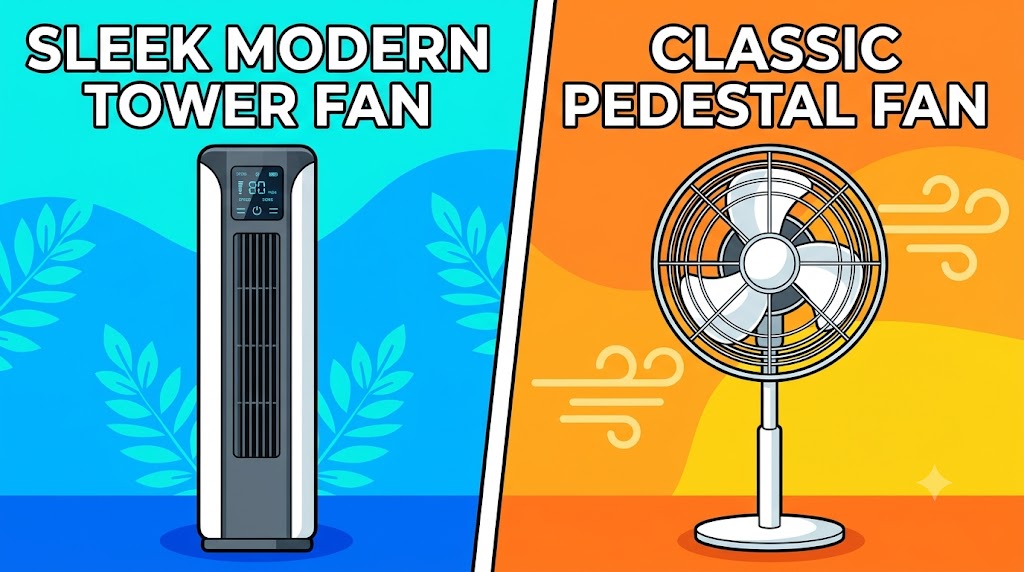
A tower fan and a pedestal fan are both designed to circulate air and improve comfort in homes, offices, and other indoor spaces. However, they differ in design, airflow, space requirements, and everyday usability. A tower fan has a tall, slim body that usually fits neatly into corners or beside furniture, while a pedestal fan has a larger exposed fan head mounted on an adjustable stand. Choosing between them depends on your room size, available space, cooling preferences, budget, and the features you need.
When comparing a tower fan vs a pedestal fan, it is important to understand that neither type produces refrigerated air like an air conditioner. Both primarily circulate room air, helping you feel cooler through increased airflow over your skin. A pedestal fan may be preferable when you want a larger, directional airflow, while a tower fan can be a practical choice when appearance, a slim design, and convenient placement are important. The better option depends on how and where you plan to use it.
Quick Comparison Table
| Feature | Tower Fan | Pedestal Fan |
|---|---|---|
| Design | Tall and slim | Fan head on a stand |
| Space required | Usually less floor space | Requires space around the fan head |
| Airflow | Often spread through a vertical outlet | Direct airflow from a rotating fan head |
| Oscillation | Available on many models | Available on many models |
| Height adjustment | Limited or unavailable on many models | Commonly available |
| Airflow direction | Depends on outlet design and oscillation | Often easy to direct vertically and horizontally |
| Cleaning | Narrow openings can be harder to clean | Exposed blades and grille are often easier to access |
| Safety | Internal blades, but openings still need care | Exposed fan blades behind a protective grille |
| Portability | Often relatively easy to position | Depends on stand, weight, and base |
| Price | Varies by features and brand | Available across a wide range of budgets |
| Best suited for | Compact spaces and a slim appearance | Directional airflow and adjustable positioning |
1. Airflow and Cooling Performance
Winner: Pedestal fan for stronger, directed airflow.
A pedestal fan generally moves a larger volume of air because many models use larger blades. Its airflow can be directed towards a person sitting on a sofa, working at a desk, or lying on a bed. This makes it a useful choice when you want to feel a strong breeze, particularly in a larger room.
A tower fan distributes air through a tall, narrow outlet. Depending on its design and oscillation feature, it can provide a more spread-out breeze without occupying much floor space. However, airflow performance varies by model, so checking the air-delivery specifications is more useful than relying on the fan type alone.
CHOICE
+1
2. Space and Design
Winner: Tower fan.
A tower fan has a slim, upright body that can fit beside furniture or in a narrow corner. It is suitable for bedrooms, small apartments, and home offices where floor space is limited.
A pedestal fan has a wider base and a circular fan head. It generally needs more open space, particularly when its head oscillates. However, its adjustable stand makes it easier to position the airflow at different heights.
If your room is small and you prefer a neat appearance, a tower fan is usually the more practical choice.
CHOICE
+1
3. Noise Level
Winner: Depends on the model, with many tower fans favouring quiet operation.
Noise matters when you use a fan while sleeping, studying, or working. Some tower fans offer sleep modes and low-speed settings designed for quieter operation.
Pedestal fans can produce noticeable motor and airflow noise, especially at high speeds. However, a well-designed pedestal fan can also operate quietly at lower settings. Neither type is automatically silent, so look for a published noise rating in decibels (dB) if quiet operation is important to you.
TechRadar
+1
4. Electricity Consumption
Winner: Depends on the fan’s rated wattage.
Neither tower fans nor pedestal fans always consume less electricity. Consumption depends on the motor, speed setting, operating time, and specific model. A tower fan with additional functions may use more power than a basic pedestal fan, while an efficient pedestal fan may consume relatively little electricity.
You can estimate the electricity used with this formula:
\[ \text{Units consumed}=\frac{\text{Watts}\times\text{Hours}}{1000} \]
For example, a 50-watt fan running for 10 hours uses 0.5 kWh, or half a unit of electricity. Compare the wattage on the product label to estimate running costs rather than assuming one design saves more power.
CHOICE
+1
5. Cleaning and Maintenance
Winner: Pedestal fan for easier access to the blades.
A pedestal fan usually has a protective grille that can be removed according to the manufacturer’s instructions, allowing you to clean dust from the blades and inner grille.
A tower fan has narrow air outlets and internal components that can be more difficult to reach. Dust may collect inside the housing, so cleaning can require a soft brush, vacuum attachment, or the method specified in the manual.
Before cleaning either fan, switch it off, unplug it, and follow the manufacturer’s maintenance instructions. Never operate a fan with its protective parts removed.
6. Safety for Children and Pets
Winner: Tower fan for reduced access to moving blades.
Many tower fans have internal blades enclosed within their housing. This reduces direct access to the moving parts and can be helpful in homes with curious children or pets.
Pedestal fans generally have rotating blades behind a protective grille. The grille helps prevent contact, but it must remain secure and undamaged. Both types should be placed on a stable surface, away from water, and positioned so that their cords do not create a tripping hazard.
A tower fan is not automatically childproof, so check the outlet openings, base stability, and product safety instructions before buying.
7. Price and Value for Money
Winner: Pedestal fan for budget-conscious buyers, in many cases.
Basic pedestal fans are widely available in budget-friendly models, making them a practical choice if your main priority is airflow at a reasonable initial cost.
Tower fans can cost more, particularly models with remote controls, timers, digital displays, or smart features. However, prices vary by brand and specifications, and some tower fans are affordable.
Compare the purchase price, warranty, rated power, airflow performance, and replacement-part availability. A lower purchase price is not necessarily better value if the fan does not meet your needs.
8. Which Fan Is Better for Different Rooms?
| Your requirement | Better choice | Reason |
|---|---|---|
| Small bedroom | Tower fan | Slim design saves floor space |
| Large living room | Pedestal fan | Many models provide stronger airflow |
| Studying or working | Either | Choose based on noise and airflow needs |
| Sleeping at night | Either, often tower | Prioritise low noise and timer options |
| Strong airflow on a hot day | Pedestal fan | Often offers greater air delivery |
| Home with small children | Tower fan | Moving blades are generally less accessible |
| Tight budget | Pedestal fan | Basic models often offer good value |
| Easy blade cleaning | Pedestal fan | Blades are usually more accessible |
These are general recommendations, not guarantees for every model. Actual performance depends on the fan’s design and specifications.
CHOICE
+1
Final Verdict: Tower Fan vs Pedestal Fan
A pedestal fan is the better choice for stronger airflow and budget-friendly cooling, while a tower fan is better for saving space and keeping moving blades enclosed.
Choose a pedestal fan if you want a powerful breeze, adjustable height, and easy cleaning. Choose a tower fan if you prefer a slim design, a compact footprint, and features suited to a bedroom or office.
Neither fan lowers the room temperature like an air conditioner. Your best choice depends on the room, airflow requirements, noise level, and the specific model’s power consumption.
Disclaimer
Fan performance, noise levels, electricity consumption, prices, and available features vary by model and brand. Check the latest manufacturer specifications and safety instructions before purchasing.