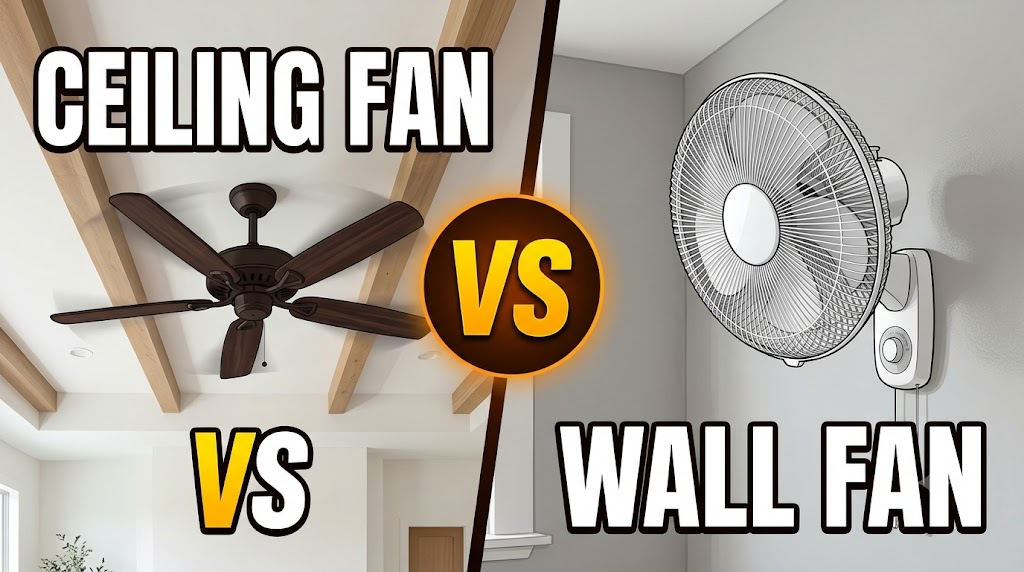
Ceiling Fan vs Wall Fan
Introduction
Ceiling fans and wall fans are both used to improve air circulation and make indoor spaces more comfortable. However, they differ in installation, airflow direction, space requirements, and suitability for different rooms. A ceiling fan is mounted overhead and circulates air across a relatively broad area, while a wall fan is attached to a wall and directs airflow toward a particular part of the room. Choosing between them depends on room layout, ceiling height, furniture placement, ventilation needs, and how you prefer air to reach people in the space.
Both types are available in different sizes, speeds, and designs, so neither is automatically better for every home. A ceiling fan is often suitable for bedrooms and living rooms where general air circulation is important. A wall fan can be useful in compact rooms, workshops, kitchens, and spaces where a ceiling-mounted fan is impractical. Electricity consumption also varies by motor, size, and speed. Comparing installation, airflow, comfort, maintenance, and cost will help you choose the right fan for your needs.
Quick Comparison Table
| Feature | Ceiling Fan | Wall Fan |
|---|---|---|
| Installation | Mounted on the ceiling | Mounted on a wall |
| Airflow | Circulates air across the room | Directs air toward a particular area |
| Floor space | Does not occupy floor space | Does not occupy floor space |
| Ceiling clearance | Requires suitable ceiling height and mounting | Useful where ceiling mounting is unsuitable |
| Direction control | Usually fixed downward airflow | Many models oscillate horizontally |
| Electricity consumption | Depends on size, motor, and speed | Depends on size, motor, and speed |
| Noise | Varies by model and installation | Varies by model and installation |
| Maintenance | Requires safe access overhead | Requires safe access to the wall-mounted unit |
| Typical use | Bedrooms, living rooms, and general circulation | Kitchens, workshops, compact rooms, and targeted cooling |
1. Airflow and Room Coverage
Ceiling Fan
A ceiling fan circulates air from above, creating airflow across a broad area beneath it. It is generally suitable for rooms where people sit, sleep, or move around in different locations. Correct fan size and placement help distribute air more effectively.
Wall Fan
A wall fan sends air outward from its mounting position. Oscillating models can move air from side to side, making them useful for directing airflow toward different parts of a room. However, furniture or other obstacles may interrupt the airflow.
Verdict: A ceiling fan is generally better for everyday air circulation across a room, while a wall fan is useful when airflow needs to be directed toward a particular area.
2. Installation and Space Requirements
Ceiling Fan
A ceiling fan needs a suitable ceiling mounting point with secure structural support and appropriate electrical wiring. In rooms with low ceilings, the fan’s blade clearance must be checked carefully for safety.
Wall Fan
A wall fan can be installed at a suitable height on a structurally sound wall. It can be particularly useful when the ceiling is unsuitable for mounting a fan or when overhead clearance is limited.
Verdict: A wall fan offers more flexibility when ceiling installation is impractical. The wall must still support the fan securely.
3. Electricity Consumption
Ceiling Fan
Ceiling fan power consumption depends on motor technology, blade size, and speed setting. Conventional models may consume more electricity than efficient BLDC models, so the fan type alone does not determine running costs.
Wall Fan
Wall fans also vary in wattage. A smaller wall fan may use less electricity than a larger ceiling fan, but a powerful wall fan can consume a similar amount or more.
Verdict: Neither type is always more energy-efficient. Compare the rated wattage of the specific models you are considering.
4. Purchase Price and Installation Cost
Ceiling Fan
The overall cost includes the fan, any required regulator, installation, and mounting hardware. Installation may be more complicated if suitable ceiling wiring or structural support is unavailable.
Wall Fan
A wall fan may be affordable and can be practical when a suitable mounting point already exists. Installation costs depend on wall strength, wiring, mounting height, and the model’s weight.
Verdict: There is no universal price winner. Compare the total cost of the fan and installation rather than the purchase price alone.
5. Comfort and Speed Control
Ceiling Fan
Ceiling fans are useful for maintaining continuous airflow while people sleep, work, or relax. Many models offer several speed settings, and some include remote controls or smart features.
Wall Fan
Wall fans can provide more direct airflow toward a person or work area. Oscillation and adjustable tilt, where available, allow users to change the direction of the airflow.
Verdict: A ceiling fan is generally convenient for whole-room comfort, while a wall fan is useful when targeted airflow is preferred.
6. Noise and Maintenance
Ceiling Fan
A properly installed ceiling fan can operate quietly. Dust accumulation, loose fittings, worn bearings, or unbalanced blades can cause noise and vibration. Cleaning and periodic inspection help maintain performance.
Wall Fan
Wall fans also need regular cleaning and inspection. Their exposed blades and guards can collect dust, while loose wall mounts or worn motor components can create noise.
Verdict: Neither type is automatically quieter or easier to maintain. Build quality, installation, and access for cleaning are the main factors.
7. Safety Considerations
Ceiling Fan
A ceiling fan must be installed with secure mounting and adequate clearance above people and furniture. Installation should follow the manufacturer’s requirements, especially in rooms with low ceilings.
Wall Fan
A wall fan must be securely attached to a suitable wall at a safe height. Its power cable, mounting bracket, guard, and oscillation mechanism should remain in good condition.
Verdict: Both can be safe when correctly installed and maintained. Choose the location that provides secure mounting and appropriate clearance.
8. Which Fan Is Better for Different Rooms?
- Bedroom: A ceiling fan is generally suitable for broad airflow throughout the sleeping area.
- Living room: A ceiling fan is usually a practical choice for general comfort.
- Kitchen: A wall fan can direct airflow toward a work area, provided it is installed away from heat, grease, and other hazards.
- Small shop or workshop: A wall fan can deliver airflow toward a counter or workstation without occupying ceiling space.
- Low-ceiling room: A wall fan may be preferable if safe clearance for a ceiling fan cannot be maintained.
- Room with awkward furniture placement: A wall fan can be positioned to direct air around obstacles, depending on the layout.
Final Verdict: Ceiling Fan vs Wall Fan
A ceiling fan is generally better for everyday air circulation in bedrooms, living rooms, and other spaces where people need comfortable airflow across a broad area. It is a practical choice when the ceiling provides adequate height and secure mounting.
A wall fan is generally better when you need directed airflow, flexible placement, or an alternative to ceiling mounting. It can be especially useful in compact rooms, kitchens, workshops, and work areas.
Overall, choose a ceiling fan for general room comfort and a wall fan for targeted airflow or installation flexibility. If energy savings are important, compare the actual wattage and airflow performance of individual models before making your decision.
Disclaimer
Fan prices, power consumption, features, noise levels, and performance vary by manufacturer and model. Installation requirements also depend on the building and mounting location. Check the manufacturer’s specifications and safety instructions before purchasing or installing a fan.