Induction Cooktop vs Gas Stove
Introduction
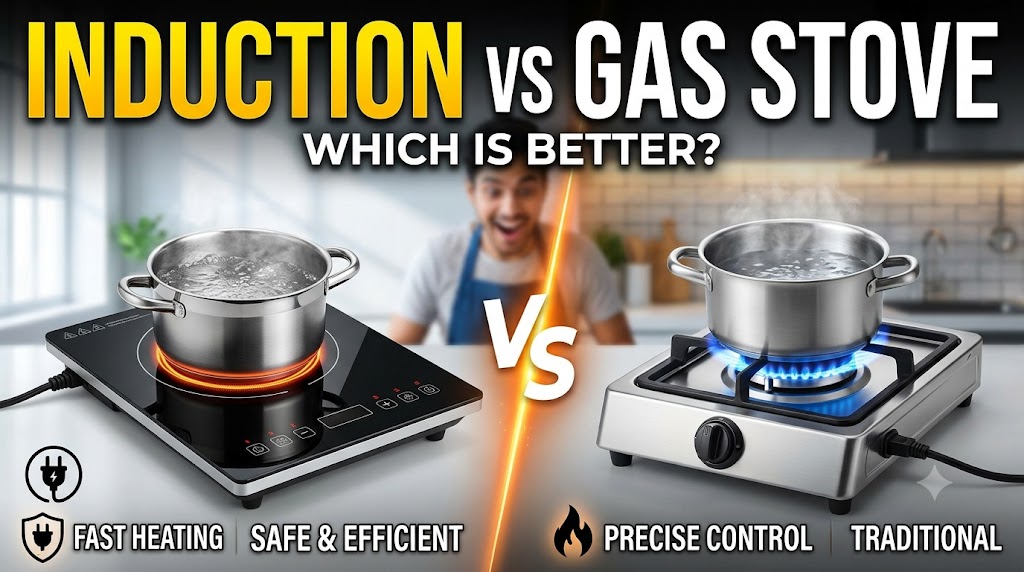
An induction cooktop and a gas stove are two popular options for cooking at home, but they use different methods to produce heat. An induction cooktop uses electromagnetic energy to heat compatible cookware directly, while a gas stove burns fuel to produce a flame that heats the cooking vessel. These differences affect cooking speed, energy efficiency, safety, cleaning, and installation requirements. Choosing between them depends on your cooking habits, electricity and gas costs, cookware, budget, and the reliability of your household’s power supply.
An induction cooktop is often attractive to households looking for efficient heating, precise temperature control, and a cooking surface that is easy to clean. A gas stove remains a familiar choice because it works with compatible cookware without requiring electricity to generate the cooking flame. However, gas cooking produces combustion pollutants indoors, so proper ventilation is important. Before making a decision, compare the overall operating cost, practical convenience, safety features, and suitability for your kitchen rather than assuming one option is best for everyone.
Quick Comparison Table
| Feature | Induction Cooktop | Gas Stove |
|---|---|---|
| Heating method | Electromagnetic heating of compatible cookware | Flame heats the cookware |
| Cooking speed | Generally fast | Depends on burner power and cookware |
| Energy efficiency | Usually higher at transferring energy to cookware | More heat escapes around the cookware |
| Temperature control | Often precise, depending on the model | Flame intensity can be adjusted directly |
| Cookware | Requires induction-compatible cookware | Works with most heat-resistant cookware |
| Indoor emissions | No combustion at the cooktop | Produces combustion pollutants |
| Cleaning | Usually easy, with a flat surface | Burners and pan supports require more cleaning |
| Power requirement | Needs electricity | Usually uses LPG or piped gas; some models need electricity for ignition |
| Initial cost | Varies by model and installation | Varies by stove type and installation |
| Best suited for | Efficient cooking with compatible cookware and reliable electricity | Households that prefer gas and broad cookware compatibility |
1. Cooking Speed
Induction Cooktop
An induction cooktop generates heat directly in compatible cookware, reducing the heat lost between the heating source and the pan. This allows many induction models to boil water and heat food quickly. Actual performance depends on the cooktop’s power rating, cookware, and selected setting.
Gas Stove
A gas stove heats cookware with a flame. Cooking speed depends on the burner’s heat output, flame adjustment, pan size, and how efficiently the cookware captures the heat. Powerful gas burners can also cook quickly.
Verdict: An induction cooktop often heats cookware faster, particularly when boiling water, but the result depends on the models being compared.
2. Energy Efficiency and Electricity or Gas Costs
Induction Cooktop
Induction cooking transfers a relatively high proportion of its energy into the cookware. This can reduce wasted heat and may be particularly useful for frequent cooking. However, the actual running cost depends on your electricity tariff and the cooktop’s power consumption.
Gas Stove
A gas stove loses some heat around the sides of the cooking vessel. Its operating cost depends on LPG cylinder prices or piped-gas tariffs, burner efficiency, and cooking duration.
Verdict: Induction generally has an efficiency advantage at the cooking surface. Which option costs less to operate depends on local electricity and gas prices.
3. Temperature Control
Induction Cooktop
Many induction cooktops offer numbered power levels, preset cooking modes, timers, and automatic power adjustment. These controls can help with tasks that require steady, low heat, although performance varies by model.
Gas Stove
A gas stove allows the user to change the flame by turning a knob. This direct adjustment is familiar to many cooks, but maintaining a very low flame depends on the burner design and stove quality.
Verdict: Induction often offers convenient electronic controls, while gas provides direct visual adjustment of the flame. The better choice depends on the cooking task and personal preference.
4. Cookware Compatibility
Induction Cooktop
An induction cooktop requires cookware with a magnetic base. Cast iron and many magnetic stainless-steel pans work, while aluminium, copper, and glass cookware generally will not work unless designed with an induction-compatible base.
You can check a pan by seeing whether a magnet sticks firmly to its bottom, although the manufacturer’s compatibility information is more reliable.
Gas Stove
A gas stove works with most cookware designed for stovetop cooking, including many aluminium, stainless-steel, cast-iron, and copper pans. The cookware must still be suitable for the heat and burner arrangement.
Verdict: Gas wins for broad cookware compatibility. Induction is suitable if your existing cookware is compatible or you are willing to replace selected pans.
5. Safety
Induction Cooktop
An induction cooktop has no open flame and does not burn fuel at the cooking surface. Many models include pan detection, automatic shutoff, and residual-heat indicators. The surface can still become hot from the cookware, and electrical safety remains important.
Gas Stove
A gas stove uses an open flame and requires careful handling of gas connections. Leaks, unattended flames, and nearby combustible materials can create serious hazards. Proper installation, ventilation, and maintenance are essential.
Verdict: Induction generally has an advantage because it avoids an open flame and on-site fuel combustion. It is not entirely risk-free, and safe use is important for both options.
6. Indoor Air Quality
Induction Cooktop
Induction cooking produces no combustion gases at the cooktop because it does not burn fuel. Nevertheless, cooking food can still generate smoke, grease particles, and other airborne pollutants, so kitchen ventilation remains useful.
Gas Stove
Gas combustion can release nitrogen dioxide, carbon monoxide under faulty or incomplete combustion conditions, and other combustion products. Appropriate ventilation and a properly maintained stove are important for indoor air quality.
Verdict: Induction has a clear advantage for avoiding pollutants produced by gas combustion inside the kitchen.
7. Cleaning and Maintenance
Induction Cooktop
The flat glass-ceramic surface is generally easy to wipe after it has cooled. Spills are less likely to burn onto the surface because the cooktop heats the pan directly, although heat from the pan can still make spills stick.
Gas Stove
A gas stove has burners, pan supports, and other parts that may need to be removed and cleaned. Food spills can collect around the burners, making cleaning more time-consuming.
Verdict: Induction generally wins for routine cleaning. Follow the manufacturer’s instructions to avoid scratching or damaging the surface.
8. Installation and Power Supply
Induction Cooktop
An induction cooktop needs a suitable electrical connection. Higher-powered built-in models may require a dedicated circuit and professional installation. During a power cut, an ordinary electric induction cooktop cannot cook unless a suitable backup power system supports it.
Gas Stove
A gas stove requires a safe LPG cylinder connection or piped-gas installation. Many models can continue cooking during a power cut if they have a manual ignition method, although models relying on electric ignition may need an alternative ignition method.
Verdict: Gas is often more practical during power cuts, while induction may be more convenient in homes with reliable electricity and an appropriate electrical connection.
9. Purchase Price and Long-Term Value
Induction Cooktop
Portable induction cooktops can be relatively affordable, while built-in models and high-powered units may cost considerably more. You may also need to purchase compatible cookware or upgrade the electrical connection.
Gas Stove
Gas stoves are available in a wide range of prices. Your total cost may include the stove, regulator, hose, gas connection, and ongoing fuel expenses, depending on your existing setup.
Verdict: Neither option is always cheaper overall. Compare the complete installation cost, cookware requirements, and expected fuel or electricity expenses.
10. Which Option Is Better for Different Homes?
- Frequent everyday cooking: Induction is attractive when electricity is reliable and the running cost is reasonable.
- Traditional cooking methods: Gas may be preferable if you frequently use cookware or techniques that are not compatible with induction.
- Homes with frequent power cuts: Gas can offer more continuity if it has a safe non-electric ignition method.
- Small kitchens: Induction may be easier to clean and can reduce heat released by the cooking appliance into the room.
- Households prioritising indoor air quality: Induction avoids gas-combustion emissions at the cooktop, although ventilation is still needed for cooking fumes.
- Budget-conscious households: Compare local fuel and electricity prices, existing cookware, and installation costs before deciding.
Final Verdict: Induction Cooktop vs Gas Stove
An induction cooktop is generally better for energy efficiency, easy cleaning, fast heating, and avoiding combustion emissions indoors. It is a strong choice for households with reliable electricity and compatible cookware.
A gas stove is generally better for broad cookware compatibility and cooking during power cuts, provided the model can be safely ignited without electricity. It may also suit households that already have a convenient gas connection.
Overall, choose induction if efficiency, cleaning convenience, and avoiding an open flame are your priorities. Choose gas if fuel availability, cookware flexibility, and power-cut practicality matter more. Compare local energy costs before making the final decision.
Disclaimer
Cooking performance, energy consumption, appliance prices, and operating costs vary by model and location. Electricity tariffs, LPG prices, and piped-gas charges may change. Follow the manufacturer’s installation and safety instructions, and ensure adequate kitchen ventilation.