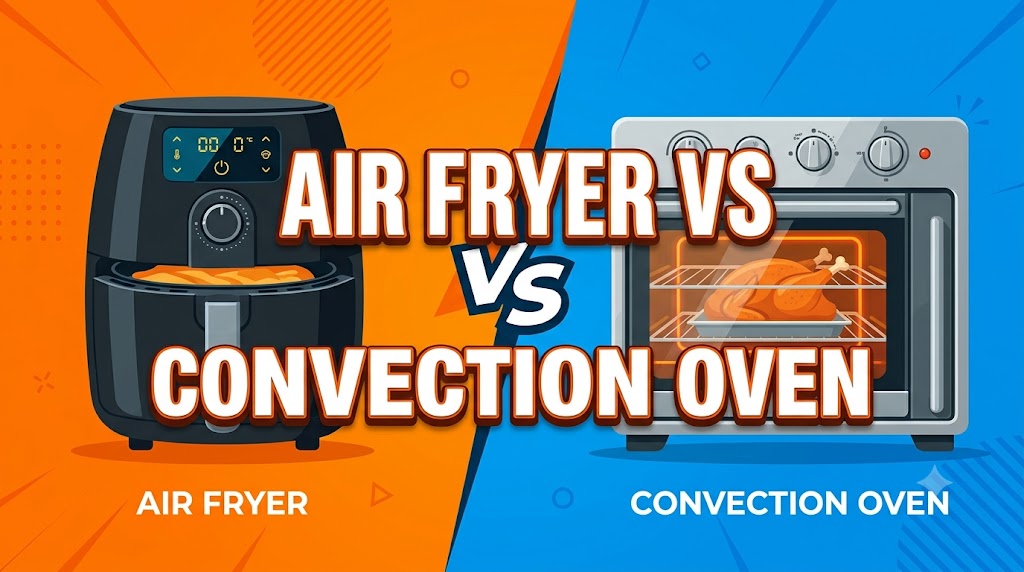
29. Air Fryer vs Convection Oven
Introduction
An air fryer and a convection oven are popular kitchen appliances that use circulating hot air to cook food, but they differ in size, design, and everyday convenience. An air fryer typically has a compact cooking chamber and a fan that circulates hot air around the food. A convection oven uses a fan to distribute heat inside a larger oven cavity. Both appliances can cook foods such as vegetables, potatoes, and roasted dishes, depending on their features and capacity. The better choice depends on your household size, preferred recipes, cooking habits, and available kitchen space.
Before choosing between an air fryer and a convection oven, consider cooking capacity, preheating time, food texture, energy use, cleaning, and purchase price. An air fryer can be convenient for preparing smaller portions of crispy food without immersing it in oil. A convection oven is useful for larger batches, baking, roasting, and preparing multiple items when its size and rack arrangement allow. Some air fryers also have baking and roasting functions, while certain convection ovens include dedicated air-fry settings. Comparing the specific models is important because their capabilities and results can overlap.
Quick Comparison Table
| Feature | Air Fryer | Convection Oven |
|---|---|---|
| Cooking method | Rapid circulating hot air | Circulating hot air |
| Best suited for | Smaller batches and crispy foods | Baking, roasting, and larger batches |
| Cooking capacity | Usually smaller | Usually larger |
| Preheating | Often short, model-dependent | May require longer preheating |
| Crisping | Often effective for small portions | Depends on airflow, temperature, and food placement |
| Baking | Available on some models | Generally well suited |
| Cooking multiple dishes | Limited by basket or chamber size | More room in many models |
| Counter space | Often compact | Often requires more space |
| Cleaning | Basket and tray may be removable | Racks and oven cavity require cleaning |
| Ideal user | People cooking smaller portions | Families and people preparing larger meals |
1. Cooking Technology
Air Fryer
An air fryer uses a heating element and fan to circulate hot air around food. Its compact chamber can promote rapid heating and browning, particularly when food is arranged in a single layer with enough room for airflow.
Convection Oven
A convection oven uses a fan to circulate heated air throughout the cooking chamber. Its larger interior can accommodate trays, baking dishes, and larger portions, depending on the model.
Winner: Tie. Both use circulating hot air, but their designs and airflow patterns differ.
2. Cooking Capacity
An air fryer is generally suitable for small or medium portions, such as fries, vegetables, snacks, and a limited quantity of other foods. Larger air fryers and dual-basket models offer more capacity, but the usable cooking area still matters.
A convection oven generally provides more room for large dishes, baking trays, and family-sized meals. Its racks can also help when preparing different items, provided the food placement allows adequate airflow.
Winner: Convection oven for larger meals and batches.
3. Crispiness and Food Texture
Air fryers can produce crisp surfaces on foods such as potatoes, breaded snacks, and vegetables. Results depend on the recipe, moisture content, food quantity, temperature, and whether the basket is overcrowded.
A convection oven can also brown and crisp food. However, results vary with its fan performance, tray design, temperature, and distance between the food and heating elements.
Neither appliance guarantees the same results for every recipe.
Winner: Air fryer for convenient crisping of smaller portions; a convection oven can achieve similar results with suitable settings.
4. Cooking Speed
An air fryer often heats up quickly because of its relatively small cooking chamber. It may also cook small portions efficiently without requiring a large oven to heat up.
A convection oven may take longer to preheat, particularly when it has a larger cavity. However, it can prepare larger quantities in one batch, which may reduce the total time needed for family meals.
Winner: Air fryer for many small-batch meals; convection oven may be more practical for larger quantities.
5. Baking Performance
Some air fryers support baking cakes, muffins, and other small recipes when suitable accessories and temperature settings are available. Their compact dimensions can limit the size and shape of baking dishes.
A convection oven is generally more versatile for baking larger cakes, cookies, bread, and multiple items, depending on its capacity and temperature control.
Winner: Convection oven for regular and larger-scale baking.
6. Oil Usage and Health Considerations
Both appliances can cook many foods using little oil compared with traditional deep frying. An air fryer may require only a small amount of oil for certain recipes, while a convection oven can roast or crisp food with minimal added oil as well.
The healthfulness of the final meal depends on the ingredients, cooking method, portion size, and amount of added fat. An air fryer does not automatically make every food healthy.
Winner: Tie. Either can support lower-oil cooking.
7. Energy Consumption
Energy use depends on the appliance’s power rating, cooking duration, temperature, and the quantity of food prepared. An air fryer may use less total energy for a small portion because it has a compact chamber and often needs less preheating.
A convection oven may be more practical when preparing several portions at once. Its larger size does not automatically mean it consumes more energy for every cooking task.
Winner: Air fryer may be more efficient for small batches, while the result for larger meals depends on the models and cooking conditions.
8. Cleaning and Maintenance
Many air fryers have removable baskets and trays that are relatively easy to clean. Non-stick surfaces should be handled according to the manufacturer’s instructions to avoid damage.
A convection oven may require cleaning its racks, trays, and larger interior. Cleaning effort depends on the design, accessories, and how much food spills or splatters during cooking.
Winner: Air fryer for many routine small-batch cooking tasks, although cleaning convenience varies by model.
9. Price and Kitchen Space
Air fryers are available in compact sizes and can be convenient for kitchens with limited counter space. Their prices vary according to capacity, controls, and additional functions.
Convection ovens range from countertop models to larger built-in appliances. They may cost more and need more room, but they can provide greater cooking capacity and baking flexibility.
Winner: Air fryer for compact convenience; convection oven for greater cooking space and versatility.
10. Which One Should You Choose?
| Your requirement | Better choice |
|---|---|
| Crispy snacks in small portions | Air fryer |
| Baking cakes and cookies regularly | Convection oven |
| Preparing large family meals | Convection oven |
| Cooking small portions with less added oil | Air fryer |
| Roasting vegetables | Either |
| Limited kitchen counter space | Compact air fryer |
| Baking larger dishes | Convection oven |
| Cooking multiple items on trays | Convection oven |
Conclusion
An air fryer is generally the more convenient choice for small portions, quick cooking, and crisping foods with little added oil. A convection oven is usually better for larger meals, regular baking, and recipes that need more interior space. Both appliances can roast vegetables and cook a wide variety of dishes, so the final decision should depend on your most frequent cooking tasks. Before buying, compare usable capacity, power consumption, available modes, cleaning requirements, and the manufacturer’s instructions rather than choosing based on the appliance name alone.
Frequently Asked Questions
1. Is an air fryer better than a convection oven?
An air fryer is often more convenient for small portions and crispy snacks, while a convection oven is generally better for larger meals and baking. The best choice depends on your cooking needs.
2. Can a convection oven make food as crispy as an air fryer?
Yes. A convection oven can crisp food when its airflow, temperature, and cooking settings are suitable. Results depend on the appliance and recipe.
3. Is an air fryer healthier than a convection oven?
Neither appliance is automatically healthier. Both can prepare many foods with little added oil, and the overall nutritional value depends on ingredients and portion sizes.
4. Which appliance uses less electricity?
An air fryer may use less electricity for small portions because it often heats up quickly. A convection oven may be practical for larger batches. Actual consumption depends on the models and cooking time.
5. Can an air fryer replace a convection oven?
An air fryer can replace some convection-oven tasks, especially small-batch roasting and crisping. It may not provide the same capacity or convenience for large cakes, bread, and family-sized dishes.
6. Which is better for a family of four?
A convection oven may be more convenient for larger meals and multiple dishes. A sufficiently large air fryer can also suit a family of four, depending on portion sizes and cooking habits.
Disclaimer
Cooking performance, capacity, power consumption, and prices vary by model and may change over time. Check the manufacturer’s specifications, safety instructions, and recommended cookware before purchasing.