Convection Microwave vs Solo Microwave
Introduction
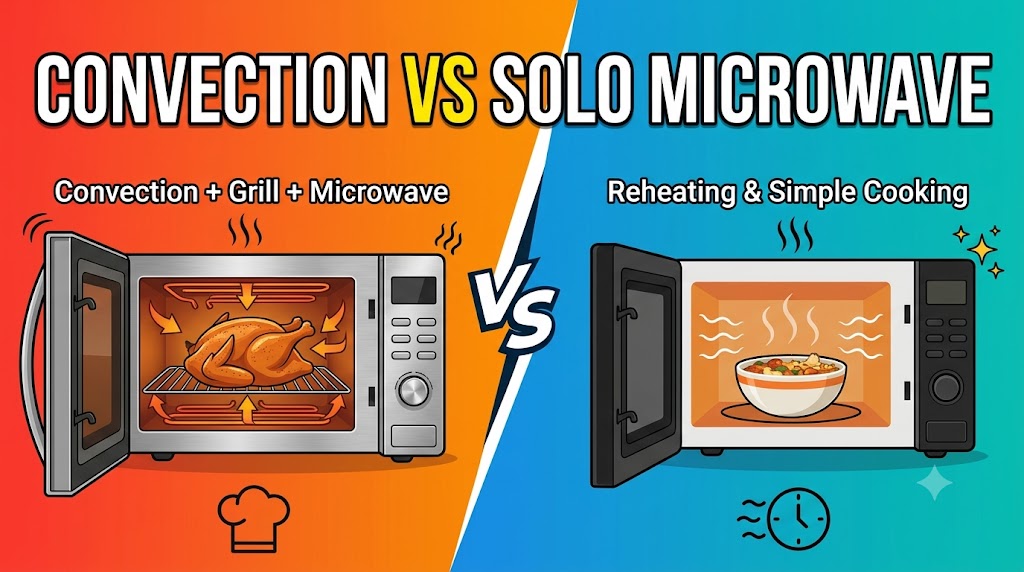
A convection microwave and a solo microwave are both useful kitchen appliances, but they offer different cooking capabilities. A solo microwave uses microwave energy to heat, reheat, defrost, and cook suitable foods quickly. A convection microwave combines microwave heating with a convection heating system, allowing it to perform additional tasks such as baking and roasting. The main difference is that a convection model offers greater cooking flexibility, while a solo model focuses on basic microwave functions. Your choice depends on your cooking habits, budget, kitchen space, and whether you regularly prepare baked or roasted dishes.
Before choosing between these appliances, consider their cooking modes, capacity, controls, energy consumption, and price. A solo microwave may be sufficient if you mainly reheat leftovers, warm beverages, defrost frozen ingredients, and prepare simple meals. A convection microwave is more suitable if you want one appliance for everyday heating as well as occasional baking and roasting. However, additional features do not automatically make it the better purchase for every household. Comparing their practical uses will help you select a microwave that meets your needs without paying for functions you rarely use.
Quick Comparison Table
| Feature | Convection Microwave | Solo Microwave |
|---|---|---|
| Main function | Heating, cooking, baking, and roasting | Heating, cooking, and defrosting |
| Cooking technology | Microwave and convection heating | Microwave heating |
| Reheating food | Yes | Yes |
| Defrosting | Yes | Yes |
| Baking cakes and cookies | Yes, using convection mode | Not suitable for conventional oven-style baking |
| Roasting | Supported in convection mode | Limited compared with convection models |
| Grilling | Depends on the model and available modes | Generally unavailable |
| Cooking flexibility | Higher | Basic |
| Price | Generally higher | Generally lower |
| Ideal user | People needing multiple cooking functions | People needing everyday microwave functions |
1. Cooking Technology
Convection Microwave
A convection microwave combines microwave energy with a heating element and fan that circulates hot air. This allows it to heat food quickly while also providing oven-style cooking in convection mode.
Solo Microwave
A solo microwave uses microwave energy to heat food. It is designed for routine tasks such as reheating meals, defrosting frozen ingredients, warming beverages, and cooking many microwave-compatible dishes.
Winner: Convection microwave for versatility; solo microwave for basic heating needs.
2. Baking Performance
A convection microwave can bake cakes, cookies, muffins, and other suitable recipes using its convection function. Correct temperature settings, suitable cookware, and preheating instructions are important for good results.
A solo microwave does not provide conventional convection baking. Although some recipes can be prepared using microwave energy alone, the texture and browning may differ from oven-baked results.
Winner: Convection microwave.
3. Reheating and Defrosting
Both appliances can reheat leftovers and defrost frozen foods. A solo microwave handles these common tasks effectively without requiring you to pay for additional baking features.
A convection microwave can perform the same basic functions, but its extra capabilities may not be necessary if reheating is your primary requirement.
Winner: Tie for basic reheating and defrosting.
4. Cooking Speed
Both appliances can cook or reheat many foods quickly using microwave energy. Actual cooking time depends on food quantity, moisture content, power rating, and the selected settings.
Convection cooking may require additional time for preheating and oven-style baking. Therefore, a convection microwave is not necessarily faster for every dish.
Winner: Solo microwave for straightforward everyday heating when extra cooking functions are unnecessary; otherwise, it depends on the recipe.
5. Grilling and Roasting
A convection microwave can roast foods using hot air, but grilling capability depends on whether the particular model includes a dedicated grill function.
A solo microwave generally cannot provide traditional grilling or the same surface browning as an oven. It is better suited to cooking tasks that do not require a browned exterior.
Winner: Convection microwave, particularly when the required grilling function is available.
6. Energy Consumption
Energy consumption depends on rated power, cooking time, selected mode, food quantity, and appliance efficiency. Microwave heating is often convenient for short heating tasks because it does not require warming an entire oven cavity.
Convection baking may use more energy when preheating and longer cooking periods are needed. However, the exact difference depends on the models and how frequently each function is used.
Winner: Neither appliance wins in every situation. A solo microwave may be more practical for frequent short heating tasks.
7. Price and Value for Money
Solo microwaves are generally more affordable because they provide fewer cooking functions. They can offer good value for households that mainly need reheating, defrosting, and basic cooking.
Convection microwaves usually cost more, but the additional expense may be worthwhile if you regularly bake or roast food and want to avoid buying a separate oven.
Winner: Solo microwave for a lower initial cost; convection microwave for households that will use its extra functions.
8. Ease of Use and Maintenance
A solo microwave usually has simpler controls because it offers fewer cooking modes. This can make it easier for users who mainly want to heat food without adjusting multiple settings.
A convection microwave has more functions and may require learning different temperature and cooking modes. Both appliances need regular cleaning, and the manufacturer’s instructions should be followed for maintenance.
Winner: Solo microwave for simplicity.
9. Which One Should You Choose?
| Your requirement | Better choice |
|---|---|
| Reheating daily meals | Solo microwave |
| Defrosting frozen food | Either |
| Baking cakes and cookies | Convection microwave |
| Roasting food | Convection microwave |
| Basic cooking on a limited budget | Solo microwave |
| Multiple cooking functions in one appliance | Convection microwave |
| Simple controls and everyday heating | Solo microwave |
Frequently Asked Questions
1. What is the main difference between a convection microwave and a solo microwave?
A convection microwave supports microwave heating and hot-air convection cooking, while a solo microwave is designed for basic microwave heating, cooking, and defrosting.
2. Can a solo microwave bake a cake?
A solo microwave can prepare some microwave cake recipes, but it does not provide conventional oven-style baking. A convection microwave is better suited to traditional cake baking.
3. Is a convection microwave worth buying?
It can be worth buying if you regularly bake or roast food and want multiple cooking functions in one appliance. If you only reheat meals, a solo microwave may be sufficient.
4. Which microwave is cheaper?
Solo microwaves are generally cheaper than convection microwaves, although actual prices depend on brand, capacity, features, and model.
5. Can a convection microwave replace an OTG?
A convection microwave can handle many baking and roasting tasks, but its capacity, controls, and cooking results may differ from those of an OTG. The right choice depends on your recipes and cooking needs.
6. Which microwave is better for a small family?
Either can suit a small family. A solo microwave is practical for basic heating and defrosting, while a convection microwave is more useful if the family also needs baking and roasting functions.
Conclusion
A convection microwave is the better choice if you want an appliance that can reheat food, defrost ingredients, bake, and roast. A solo microwave is a practical option if your main requirements are everyday heating, defrosting, and basic cooking at a generally lower purchase price. Before buying, check the available modes, internal capacity, power rating, warranty, and manufacturer’s cookware instructions. The best appliance is the one that matches your actual cooking habits rather than simply offering the greatest number of features.
Disclaimer: Features, power ratings, capacities, and prices vary by model and may change over time. Check the manufacturer’s specifications and operating instructions before purchasing.