OTG vs Microwave Oven
Introduction
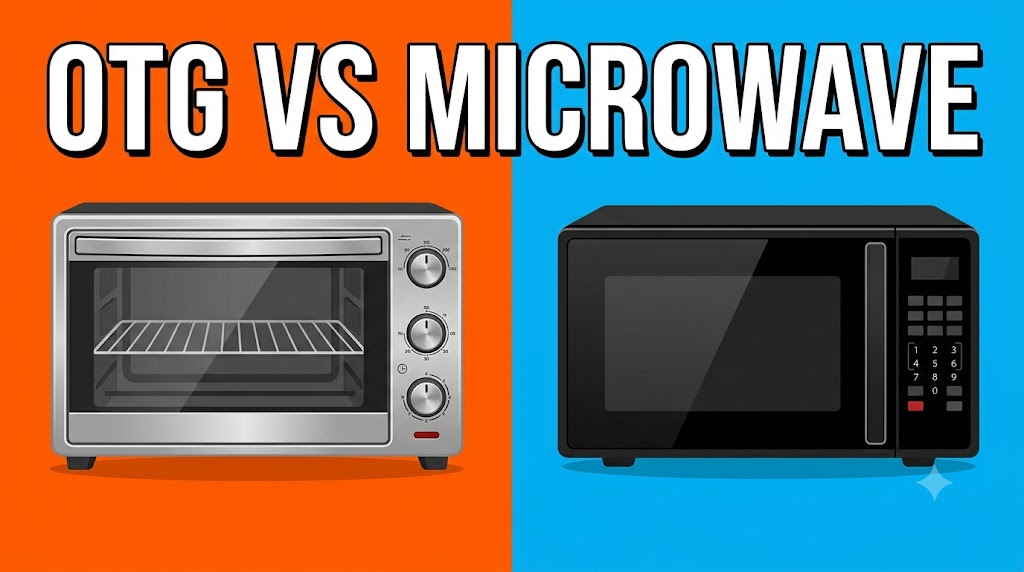
An OTG (Oven, Toaster, and Griller) and a microwave oven are both useful kitchen appliances, but they work differently and serve different cooking needs. An OTG uses heating elements to cook food through radiant heat, making it suitable for baking cakes, cookies, bread, and grilling certain foods. A microwave oven primarily uses electromagnetic waves to heat food quickly, making it convenient for reheating meals, defrosting frozen ingredients, and everyday cooking. Choosing between them depends on the dishes you prepare most often, the cooking results you expect, and the time you can spend in the kitchen.
Before buying either appliance, consider its cooking functions, capacity, temperature controls, energy use, and available kitchen space. An OTG is generally a better choice for people who regularly bake and want traditional oven-style browning. A basic microwave is more practical for households that frequently reheat leftovers or defrost food. However, cooking capabilities vary by model, and some microwave ovens also include grilling and convection functions. Understanding these differences will help you choose an appliance that suits your routine instead of paying for features you rarely use.
Quick Comparison Table
| Feature | OTG | Microwave Oven |
|---|---|---|
| Main cooking method | Electric heating elements | Microwave energy |
| Best suited for | Baking, toasting, and grilling | Reheating, defrosting, and quick cooking |
| Reheating food | Possible, but often slower | Generally faster |
| Baking cakes and cookies | Well suited | Depends on the model; convection models are better suited |
| Grilling and browning | Suitable for many foods | Depends on whether grill or convection functions are available |
| Defrosting frozen food | Usually slower and less convenient | Convenient on models with a defrost function |
| Cooking speed | Often slower for everyday heating | Usually faster for reheating |
| Preheating | Usually required for baking | Not generally required for basic microwave heating |
| Cookware | Oven-safe metal and other suitable materials | Microwave-safe cookware; metal is generally unsuitable in microwave mode |
| Ideal user | Frequent home bakers | Households needing quick everyday heating |
1. Cooking Technology
OTG
An OTG heats food using electric heating elements. Heat transfers to the food through radiation and hot air inside the chamber. This method is useful for baking, toasting, and grilling, especially when a recipe requires controlled oven temperatures.
Microwave Oven
A microwave oven uses electromagnetic waves to heat food by interacting with polar molecules, particularly water. It is effective for reheating meals and cooking many foods quickly. Basic solo models do not provide the same baking and browning capabilities as a conventional oven.
Winner: Depends on the cooking task. An OTG suits traditional baking, while a basic microwave suits quick heating.
2. Baking Performance
An OTG is designed for oven-style baking. It can bake cakes, cookies, muffins, bread, and other recipes that need sustained heat. Temperature settings and suitable trays help achieve the desired texture and browning.
A solo microwave is not designed for conventional baking because it does not operate like a traditional oven. A convection microwave, however, includes a heating system that supports oven-style baking.
Winner: OTG for regular baking; a convection microwave can also be suitable.
3. Reheating and Defrosting
Microwave ovens are particularly convenient for reheating rice, vegetables, curries, and other leftovers. Many models also have defrost settings for frozen meat and other ingredients.
An OTG can reheat food, but it generally takes longer and may dry out some dishes. It is less convenient when you only need to warm a plate of food.
Winner: Microwave oven.
4. Grilling and Browning
An OTG can grill vegetables, paneer, sandwiches, and suitable meat preparations using its heating elements. It can also brown the surface of many baked dishes.
A basic solo microwave does not provide conventional grilling or surface browning. A microwave with a dedicated grill function can handle some grilling tasks, while convection models offer additional cooking options.
Winner: OTG for traditional oven-style grilling and browning, although the result depends on the appliance and recipe.
5. Cooking Speed and Convenience
Microwave ovens are generally faster for reheating and many routine cooking tasks. They are convenient when you need to warm food between work, school, or other daily activities.
An OTG usually requires preheating for baking and may take longer to cook certain dishes. However, this is not a disadvantage if you are preparing recipes that benefit from controlled oven heat.
Winner: Microwave oven for everyday convenience; OTG for recipes requiring oven-style cooking.
6. Energy Consumption
Energy consumption depends on the appliance’s rated power, cooking duration, temperature, capacity, and how efficiently it performs the task. A microwave may use less energy for a short reheating task because it heats food directly without warming a large oven cavity in the same way.
An OTG may consume more energy during lengthy baking sessions, particularly when preheating is required. However, actual consumption varies by model and usage, so rated wattage alone does not establish which appliance will cost less to operate.
Winner: A microwave often has an advantage for short reheating tasks, but overall energy costs depend on how you use each appliance.
7. Capacity and Kitchen Space
Both appliances are available in different capacities. A compact microwave can fit conveniently into many kitchens, while larger OTGs may require additional counter space and clearance for ventilation.
Before purchasing, check the internal dimensions as well as the advertised capacity. A large capacity does not necessarily mean that your preferred baking tray or dish will fit comfortably.
Winner: Depends on the model and available kitchen space.
8. Which Is Better for Your Needs?
| Your requirement | Better choice |
|---|---|
| Baking cakes, cookies, and bread regularly | OTG |
| Reheating daily meals quickly | Microwave oven |
| Defrosting frozen ingredients | Microwave oven |
| Grilling and browning food | OTG |
| Preparing food with multiple cooking functions | Convection microwave or a suitable OTG |
| Basic household reheating | Solo microwave |
| Frequent home baking | OTG |
Frequently Asked Questions
1. Is an OTG better than a microwave oven?
An OTG is generally better for baking and traditional grilling, while a microwave oven is better for quick reheating and defrosting.
2. Can a microwave oven bake cakes?
A solo microwave is not designed for conventional oven baking. A convection microwave can bake cakes using its convection function.
3. Is an OTG good for reheating food?
Yes, but reheating generally takes longer than in a microwave and may dry out some foods.
4. Which is better for grilling, OTG or microwave?
An OTG is suitable for traditional grilling and browning. Microwave grilling depends on whether the appliance has a dedicated grill function.
5. Which appliance is better for everyday home use?
A microwave is usually more convenient for reheating meals and defrosting ingredients. An OTG is better for households that bake regularly.
6. Can I use metal utensils in both appliances?
Oven-safe metal utensils can generally be used in an OTG. Metal should not be used in a microwave’s m
Conclusion
An OTG and a microwave oven are designed for different purposes. An OTG is generally the better choice for regular baking, toasting, and traditional grilling. A microwave oven is more convenient for reheating leftovers, defrosting ingredients, and saving time during everyday meal preparation. If your budget allows only one appliance, choose according to the tasks you perform most frequently. If you bake often, select an OTG; if you mainly need quick heating, a microwave is the more practical option.
Disclaimer: Features, capacities, power ratings, and prices vary by model and may change over time. Check the manufacturer’s specifications and operating instructions before purchasing.