Wet and Dry Vacuum vs Dry Vacuum Cleaner
Introduction
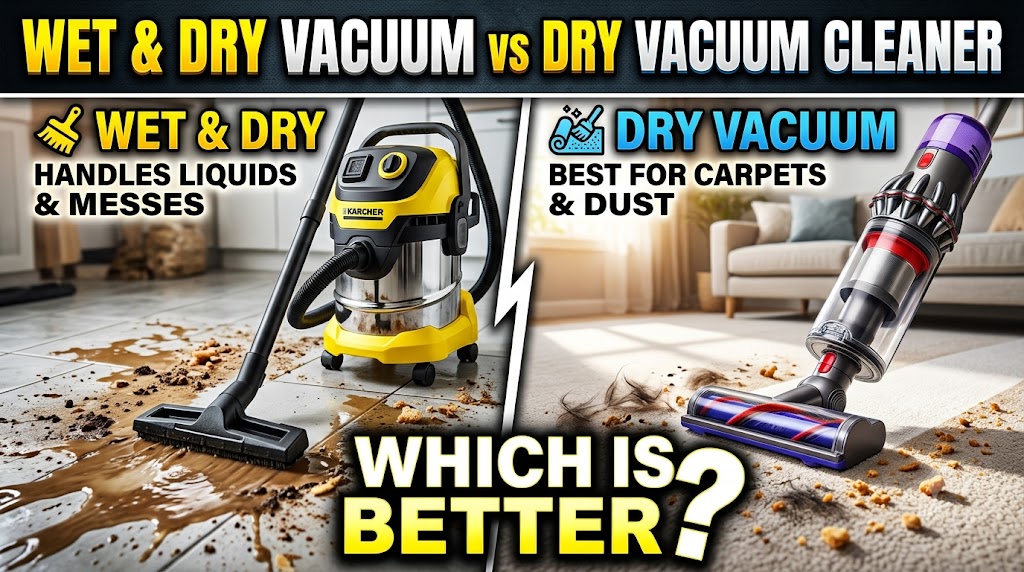
Choosing between a wet and dry vacuum cleaner and a dry vacuum cleaner depends on your cleaning requirements. Both appliances remove dust, dirt, and debris, but they serve different purposes. A wet and dry vacuum cleaner can collect dry debris and suitable liquids, while a dry vacuum cleaner is designed primarily for dust and dry messes. Understanding these differences helps you select an appliance that suits your home, workplace, and everyday cleaning needs.
Before buying, consider the surfaces you clean, how frequently liquid spills occur, available storage space, maintenance, and your budget. A wet and dry vacuum cleaner offers greater versatility, but those additional capabilities may not be necessary for every household. A dry vacuum cleaner can be a practical choice if you mainly need to remove dust, crumbs, hair, and other dry debris. The better option depends on your cleaning habits and the features of the model.
Quick Comparison Table
| Feature | Wet and Dry Vacuum Cleaner | Dry Vacuum Cleaner |
|---|---|---|
| Primary purpose | Dry debris and suitable liquids | Dust and dry debris |
| Liquid pickup | Yes, if permitted by manufacturer | Generally not suitable |
| Dust removal | Yes | Yes |
| Versatility | Wet and dry cleaning | Dry cleaning |
| Maintenance | Requires additional care after wet use | Generally simpler |
| Storage | Some models are bulky | Compact options available |
| Best for | Homes, garages and workshops | Everyday household cleaning |
1. Cleaning Capabilities
Wet and Dry Vacuum Cleaner
A wet and dry vacuum cleaner is designed to collect dry debris and suitable liquids. It can help clean dust, crumbs, dirt, and accidental liquid spills when the model supports the intended use.
Some models are useful in garages, workshops, and utility areas where different types of messes occur.
Dry Vacuum Cleaner
A dry vacuum cleaner is designed primarily for dust, dirt, hair, crumbs, and other dry debris. It is suitable for routine cleaning of compatible floors, carpets, and upholstery.
It should not be used to collect liquids unless the manufacturer explicitly permits it.
Winner: Wet and Dry Vacuum Cleaner. It offers broader cleaning capabilities because it handles dry debris and suitable liquids.
2. Everyday Household Cleaning
Wet and Dry Vacuum Cleaner
This appliance can manage routine dust removal as well as occasional wet messes. It may be useful in busy homes, kitchens, utility rooms, and other areas where spills occur.
Its convenience depends on the model’s size, attachments, weight, and suitability for your flooring.
Dry Vacuum Cleaner
A dry vacuum cleaner is suitable for regular household cleaning. It can remove everyday dust, hair, crumbs, and dry dirt without requiring wet-cleaning capabilities.
For households that rarely need to clean liquid spills with a vacuum, a dry model may be sufficient.
Winner: Depends. A dry model is suitable for everyday dry cleaning, while a wet and dry model is more versatile when spills are also a concern.
3. Liquid Spill Cleaning
Wet and Dry Vacuum Cleaner
A wet and dry vacuum cleaner is designed to collect suitable liquids. Depending on the model, it may help clean accidental water spills and other permitted liquid messes.
Always follow the manufacturer’s instructions regarding liquid capacity, tank handling, and prohibited substances.
Dry Vacuum Cleaner
A standard dry vacuum cleaner should not be used to collect liquids unless its manufacturer explicitly allows it. Liquids can damage components and create electrical hazards.
Winner: Wet and Dry Vacuum Cleaner. It is specifically designed for permitted liquid collection.
4. Maintenance and Cleaning
Wet and Dry Vacuum Cleaner
After collecting liquids, the tank and designated wet-use components may need to be emptied, cleaned, and dried according to the manufacturer’s instructions.
This additional maintenance helps reduce residue buildup and unpleasant odors.
Dry Vacuum Cleaner
Maintenance usually involves emptying the dust container or replacing the bag, maintaining filters, and removing hair or debris from compatible attachments.
For dry-only cleaning, the maintenance routine is generally straightforward.
Winner: Dry Vacuum Cleaner. Its maintenance routine is generally simpler when used exclusively for dry debris.
5. Space and Convenience
Wet and Dry Vacuum Cleaner
Wet and dry vacuum cleaners come in different sizes. Some larger models may be less convenient to move or store in small homes, although compact options are available.
Check the appliance’s dimensions, weight, and storage requirements before buying.
Dry Vacuum Cleaner
Dry vacuum cleaners are available in handheld, stick, canister, and upright designs. This variety makes it easier to find an appliance that suits your storage space and cleaning routine.
Winner: Depends. Compare the actual size, weight, and design of the models you are considering.
6. Cost and Value for Money
Wet and Dry Vacuum Cleaner
Its additional functionality can provide good value if you regularly clean both dry debris and suitable liquid spills.
However, value depends on the purchase price, maintenance requirements, accessories, and how frequently you use its wet-cleaning capability.
Dry Vacuum Cleaner
A dry vacuum cleaner may be a cost-effective option when you only need to remove dust and dry debris. You can prioritize features such as filtration, attachments, maneuverability, and flooring compatibility.
Prices vary by model, so neither category is always cheaper.
Winner: Depends. Choose according to your cleaning requirements and overall cost rather than the appliance category alone.
7. Which One Is Better for Different Users?
| User or Situation | Recommended Option | Reason |
|---|---|---|
| Home with frequent suitable liquid spills | Wet and Dry Vacuum Cleaner | Designed for dry debris and permitted liquids |
| Home mainly needing dust removal | Dry Vacuum Cleaner | Focuses on everyday dry cleaning |
| Garage or workshop | Wet and Dry Vacuum Cleaner | Handles different messes within its rated capabilities |
| Small apartment | Depends | Compact models exist in both categories |
| Household needing straightforward dry cleaning | Dry Vacuum Cleaner | Wet-cleaning capability may be unnecessary |
| One appliance for wet and dry messes | Wet and Dry Vacuum Cleaner | Offers greater versatility |
Final Verdict: Wet and Dry Vacuum vs Dry Vacuum Cleaner
A wet and dry vacuum cleaner is the better choice if you regularly deal with dry dirt and suitable liquid spills. Its broader capabilities make it useful for homes, garages, and work areas where different types of messes occur.
A dry vacuum cleaner is a sensible choice if your cleaning needs mainly involve dust, hair, crumbs, and dry debris. It may be more practical for everyday household cleaning, particularly when you choose a model that matches your flooring and storage space.
Overall winner: Wet and Dry Vacuum Cleaner for versatility. However, if you only need dry cleaning, a dry vacuum cleaner may be the more practical purchase. Compare filtration, attachments, capacity, maintenance requirements, and manufacturer-approved uses before buying.
Frequently Asked Questions (FAQs)
1. What is the main difference between a wet and dry vacuum cleaner and a dry vacuum cleaner?
A wet and dry vacuum cleaner is designed to collect dry debris and suitable liquids, whereas a standard dry vacuum cleaner is designed primarily for dust and dry debris.
2. Can a dry vacuum cleaner clean water?
A standard dry vacuum cleaner should not be used to collect water unless the manufacturer explicitly states that it is suitable for that purpose.
3. Is a wet and dry vacuum cleaner good for home use?
Yes. It can be useful in homes where both dry dirt and occasional liquid spills need to be cleaned.
4. Is a wet and dry vacuum cleaner better than a dry vacuum cleaner?
It is more versatile because it can handle suitable liquids as well as dry debris. However, a dry model may be a better fit for households that only need routine dry cleaning.
5. Which vacuum cleaner is easier to maintain?
A dry vacuum cleaner generally has a simpler maintenance routine for dry debris. A wet and dry model may require additional tank cleaning and drying after liquid pickup.
6. Can a wet and dry vacuum cleaner replace a regular vacuum cleaner?
It can handle many dry-cleaning tasks, but performance depends on the model, attachments, filtration, and flooring compatibility.
Disclaimer
Product capabilities, prices, features, and maintenance requirements vary by model and manufacturer. Always read the user manual before use, especially when collecting liquids or cleaning delicate surfaces. Never use a vacuum cleaner for liquids or materials prohibited by its manufacturer.