Solar Microinverter vs Power Optimizer
Introduction
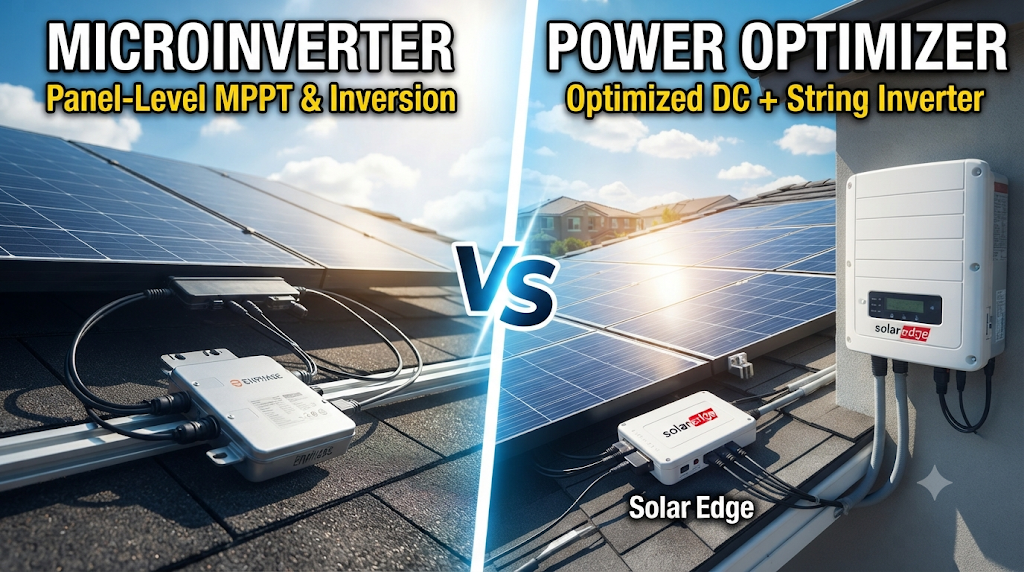
Solar microinverters and power optimizers are two technologies designed to improve the performance of solar panel systems. Both work at the individual solar panel level, helping reduce the impact of partial shading, different panel orientations and variations in panel performance. However, they use different methods to manage electricity. A microinverter converts DC electricity into AC electricity directly at the solar panel, while a power optimizer adjusts the panel’s DC output before sending it to a central solar inverter.
Choosing between a solar microinverter and a power optimizer depends on your roof design, shading conditions, installation budget and maintenance preferences. Both technologies can improve solar energy production compared with a conventional string inverter in certain situations. However, their equipment requirements, electrical configurations and overall costs are different. Understanding these differences can help homeowners select a suitable solar system for their electricity needs.
Quick Comparison Table
| Feature | Solar Microinverter | Power Optimizer |
|---|---|---|
| Main function | Converts DC to AC at panel level | Optimizes DC power at panel level |
| Conversion type | DC to AC | DC to DC |
| Central inverter | Not required for DC-to-AC conversion | Required |
| MPPT | Individual panel level | Individual panel level |
| Shading performance | Very good | Very good |
| Panel-level monitoring | Generally available | Generally available |
| System design | Distributed inverter system | Optimizer with central inverter |
| Installation | One microinverter per panel or supported group | One optimizer per panel or supported configuration |
| Maintenance | Individual rooftop units | Optimizers and central inverter |
| Initial cost | Generally higher | Depends on optimizer and inverter combination |
| System expansion | Often more flexible | Depends on central inverter capacity |
| Best suited for | Complex or shaded rooftops | Shaded rooftops needing centralized conversion |
1. Working Principle
Solar Microinverter
A solar microinverter is a small inverter installed underneath or near an individual solar panel. It converts the DC electricity generated by the panel into AC electricity directly at the panel level.
Each microinverter manages the output of its connected panel independently. This means a problem or shading on one panel generally does not directly reduce the output of other panels.
Microinverters also perform Maximum Power Point Tracking (MPPT) to help each connected panel produce electricity according to its operating conditions.
Power Optimizer
A power optimizer is a DC-to-DC electronic device installed with an individual solar panel. Its main job is to regulate and optimize the panel’s DC electricity before sending it to a central string inverter.
Unlike a microinverter, a power optimizer does not perform the final DC-to-AC conversion. The central inverter converts the combined DC electricity into AC electricity for household use.
Power optimizers also provide individual panel-level MPPT, helping reduce the impact of differences in sunlight and panel performance.
Winner: Depends. Both technologies provide panel-level optimization. A microinverter offers independent DC-to-AC conversion, while a power optimizer works with a central inverter.
2. Solar Energy Production
Solar Microinverter
Microinverters can improve overall energy production when solar panels receive different amounts of sunlight. Since each panel operates with its own inverter, the performance of one panel is less dependent on other panels.
This can be useful when some panels receive morning sunlight while others receive afternoon sunlight.
Power Optimizer
Power optimizers also improve energy production by managing the output of individual panels. They help reduce mismatch losses caused by shading, different panel orientations or variations in panel performance.
However, the system still depends on the central inverter for final electricity conversion.
Winner: Tie. Both technologies can improve solar energy production in systems with uneven sunlight. Actual results depend on equipment specifications and roof conditions.
3. Performance in Shaded Areas
Solar Microinverter
Microinverters are particularly useful for rooftops where trees, nearby buildings, water tanks or other objects create partial shading.
Because each panel has its own inverter, a shaded panel generally does not significantly affect the electricity conversion of other panels.
Power Optimizer
Power optimizers are also designed to reduce the effect of partial shading. They manage the DC output of individual panels and help prevent a poorly performing panel from unnecessarily reducing the output of other panels.
However, the overall system still depends on the central inverter and its operating requirements.
Winner: Tie. Both technologies are suitable for partially shaded rooftops. The actual advantage depends on the system design and the type of shading.
4. Installation Requirements
Solar Microinverter
A microinverter is installed underneath or near each solar panel. The individual units convert DC electricity into AC electricity, which is connected through suitable AC wiring and protection equipment.
This design does not require a separate central string inverter for DC-to-AC conversion.
However, installing multiple electronic devices on the roof requires proper mounting, electrical connections and weather protection.
Power Optimizer
Power optimizers are also installed near individual solar panels. However, they must be connected to a compatible central inverter.
The system requires both panel-level optimization devices and a central inverter, making the electrical design different from a microinverter installation.
Winner: Depends. Microinverters eliminate the need for a central solar inverter, while power optimizers use a centralized conversion system. Installation complexity depends on the roof and equipment configuration.
5. Monitoring and Fault Detection
Solar Microinverter
Most modern microinverter systems offer panel-level monitoring through a monitoring platform or mobile application.
Homeowners can check the electricity production of individual panels and identify underperforming units more easily.
This can help installers locate problems without relying only on total system production.
Power Optimizer
Power optimizer systems can also provide panel-level monitoring when supported by the optimizer and central inverter platform.
Homeowners can monitor individual panel performance and identify possible problems with the solar installation.
Winner: Tie. Both technologies can offer detailed panel-level monitoring. Available features depend on the manufacturer and monitoring system.
6. Maintenance and Repair
Solar Microinverter
A microinverter system contains multiple small electronic units installed near the solar panels. If one microinverter develops a fault, the affected panel may stop producing electricity while the other functioning units can continue operating.
However, accessing a faulty microinverter generally requires rooftop inspection and repair.
Power Optimizer
A power optimizer system contains individual optimization devices along with a central inverter.
If one optimizer develops a problem, the affected panel’s output may be reduced or interrupted. The central inverter is another important component that requires maintenance and may need replacement if it develops a fault.
The advantage is that the central inverter is generally installed in an accessible location.
Winner: Depends. Microinverters offer distributed conversion, while power optimizer systems keep the main inverter in one accessible location. Maintenance convenience depends on equipment placement and repair arrangements.
7. Initial Installation Cost
Solar Microinverter
Microinverters generally have a higher initial equipment cost because each panel requires its own microinverter or a supported multi-panel unit.
The installation also requires suitable AC wiring and protection equipment.
However, the absence of a separate central string inverter must be considered when comparing the complete system cost.
Power Optimizer
Power optimizer systems require individual optimizers and a compatible central inverter.
Their total installation cost depends on the number of panels, inverter capacity, equipment brand, installation work and available features.
In many system designs, power optimizers can be a more economical alternative to microinverters.
Winner: Power Optimizer in many installations. However, the actual price difference must be determined through complete system quotations rather than comparing individual device prices.
8. System Expansion
Solar Microinverter
Microinverter systems can offer flexibility when adding more solar panels because additional panels can be connected using compatible microinverters.
However, the existing AC wiring, branch circuit capacity, electrical protection and system limits must support the expansion.
Power Optimizer
Power optimizer systems depend on the capacity and compatibility of the central inverter.
Adding more panels may require checking the inverter’s maximum input power, voltage, current and available connections. An additional inverter may be required if the existing equipment cannot support expansion.
Winner: Solar Microinverter. It generally offers more flexibility for adding panels, although the electrical design and equipment limits still apply.
9. Safety and Electrical Design
Solar Microinverter
Microinverters convert DC electricity into AC electricity near the solar panels. This reduces the amount of high-voltage DC wiring running from the roof to the central electrical equipment.
However, AC wiring and suitable electrical protection are still necessary.
Power Optimizer
Power optimizers manage DC electricity at the panel level and can support reduced-voltage or rapid-shutdown safety functions when the complete system is designed for them.
However, the system still has DC connections between the optimizers and central inverter during normal operation.
Winner: Solar Microinverter for reducing rooftop high-voltage DC wiring. Actual safety depends on the equipment, protection features, installation standards and electrical design.
10. Which Is Better for Residential Solar Systems?
Solar Microinverter
A microinverter system can be suitable for homeowners who have:
- Roofs with partial shading.
- Solar panels facing different directions.
- Limited space for central inverter equipment.
- A preference for panel-level electricity conversion.
- Plans to expand the system with compatible equipment.
Power Optimizer
A power optimizer system can be suitable for homeowners who have:
- Partially shaded rooftops.
- Solar panels installed in different orientations.
- A preference for centralized DC-to-AC conversion.
- A need for individual panel monitoring.
- A budget that favours an optimizer-based system.
Winner: Depends. Both options can work well for residential solar installations. The better choice depends on roof conditions, equipment compatibility, budget and long-term maintenance requirements.
Overall Comparison: Which Is Better?
Solar microinverters and power optimizers both improve the management of individual solar panels, but their electrical designs are different.
| Comparison Factor | Better Option |
|---|---|
| Independent DC-to-AC conversion | Solar Microinverter |
| Panel-level MPPT | Tie |
| Partial shading | Tie |
| Panel-level monitoring | Tie |
| Flexible system expansion | Solar Microinverter |
| Centralized inverter maintenance | Power Optimizer |
| Reducing rooftop high-voltage DC wiring | Solar Microinverter |
| Initial installation cost | Power Optimizer in many installations |
Final Verdict
A solar microinverter is generally better for homeowners who want independent panel-level electricity conversion, flexible system expansion and reduced high-voltage DC wiring on the roof. It can be particularly useful for complex rooftops with different panel orientations and partial shading.
A power optimizer is a practical choice for homeowners who want panel-level optimization while keeping DC-to-AC conversion centralized. It can also offer a cost-effective solution when the complete optimizer and central inverter system is competitively priced.
Neither technology is universally better. Before choosing, compare complete installation quotations, equipment warranties, inverter compatibility, monitoring facilities and the expected energy production of your rooftop solar system.
Frequently Asked Questions (FAQs)
1. What is the main difference between a solar microinverter and a power optimizer?
A microinverter converts DC electricity into AC electricity at the solar panel. A power optimizer adjusts the panel’s DC electricity and sends it to a central inverter for final conversion.
2. Which is better for partially shaded solar panels?
Both technologies can perform well in partially shaded conditions because they provide individual panel-level optimization. The actual result depends on the system design and shading pattern.
3. Do power optimizers require a central inverter?
Yes. Power optimizers perform DC-to-DC conversion, so a compatible central inverter is required to convert DC electricity into AC electricity.
4. Do microinverters work without a central inverter?
Yes. Microinverters perform DC-to-AC conversion at the panel level, so a separate central string inverter is not required. However, grid-connected systems still need suitable electrical protection and grid-compliant equipment.
5. Are microinverters more expensive than power optimizers?
Microinverter systems generally have a higher initial equipment cost. However, the complete installation price depends on the number of panels, inverter capacity, wiring and other equipment.
6. Can power optimizers increase solar panel efficiency?
Power optimizers can improve the overall energy production of a solar system by reducing losses associated with shading and panel mismatch. They do not increase the physical rated efficiency of the solar cells.
7. Which technology offers better panel-level monitoring?
Both technologies can provide panel-level monitoring when supported by their respective monitoring platforms.
8. Can a solar system use microinverters and power optimizers together?
Some specialized system designs may support different module-level electronics, but compatibility must be verified. They should not be mixed without checking manufacturer specifications and system architecture.
Disclaimer
This article is intended for general educational and comparison purposes. Solar microinverter and power optimizer performance, installation costs, efficiency and compatibility may vary depending on the manufacturer, solar panel specifications, roof conditions and electrical system design. Always consult a qualified solar installer before selecting or installing solar equipment.