ICSE vs IGCSE
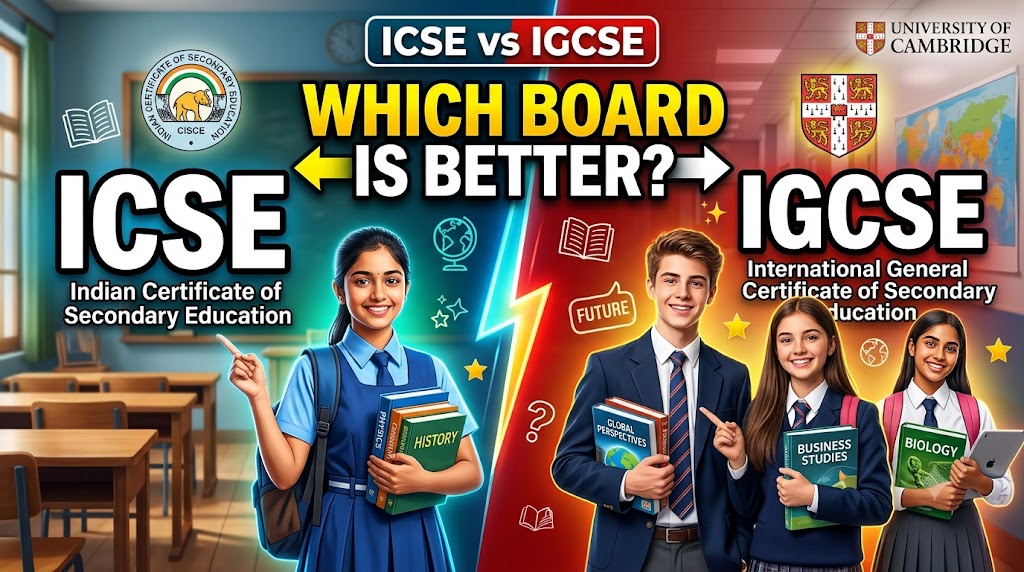
Choosing between ICSE and IGCSE can be difficult because both offer broad academic options but follow different education approaches. In this ICSE vs IGCSE comparison, we look at curriculum, subjects, learning style, assessment, recognition, school transfer and future education options.
ICSE is the Class 10 examination conducted by the Council for the Indian School Certificate Examinations (CISCE), while Cambridge IGCSE is an internationally oriented qualification generally taken by students around ages 14–16. Cambridge IGCSE offers more than 70 subjects, while ICSE provides a broad range of academic, language, application and vocational subjects. (CISCE)
Quick Comparison: ICSE vs IGCSE
| Feature | ICSE | IGCSE |
|---|---|---|
| Education system | Indian school education | International qualification |
| Main orientation | Indian | International |
| Typical stage | Class 10 | Usually ages 14–16 |
| Curriculum | Broad and structured | Flexible and subject-based |
| Subject choice | Broad range | 70+ subjects available |
| Learning approach | Knowledge, application and broader subject coverage | Enquiry, application and problem-solving |
| Assessment | Board examination with applicable internal assessment | Written, oral, coursework or practical depending on subject |
| International recognition | Recognised Indian school qualification | Widely recognised internationally |
| Indian education pathway | Strong | Accepted in India subject to requirements |
| Best suited for | Students following an Indian education pathway | Students seeking international flexibility |
ICSE vs IGCSE: Curriculum
ICSE follows the CISCE curriculum and provides a broad academic structure. The ICSE syllabus includes English, second languages, History, Civics and Geography, Mathematics, Science, Economics, Commercial Studies, Computer Applications and several other subjects. (CISCE)
Cambridge IGCSE is designed for an international student population. Cambridge describes its curriculum as flexible and says schools can build different programmes around their specific needs. It also offers more than 70 subjects, including more than 30 languages. (Cambridge International)
In simple terms: ICSE provides a broad Indian curriculum, while IGCSE gives schools greater flexibility in selecting subject combinations.
ICSE vs IGCSE: Syllabus
The ICSE syllabus covers a wide range of academic areas. Students study compulsory areas and can choose from additional subjects depending on the school’s offerings and applicable group structure. The official ICSE syllabus includes subjects such as Mathematics, Science, Economics, Computer Applications, Environmental Applications, Physical Education, Art and several others. (CISCE)
IGCSE is organised around individual subjects. Schools can combine subjects according to their programme, allowing students to build different academic combinations. (Cambridge International)
This makes IGCSE particularly flexible for schools that want to offer an international subject mix.
Learning Approach
ICSE provides a broad academic foundation with emphasis on different subject areas and application of knowledge. CISCE has also been increasing the emphasis on competencies such as application, analysis, interpretation and evaluation in its examination approach. For the ICSE Year 2026 examination, CISCE stated that the weightage for such competencies would be approximately 40% in the relevant specimen examination framework. (CISCE)
Cambridge IGCSE explicitly focuses on developing creative thinking, enquiry and problem-solving skills, as well as applying knowledge to familiar and new situations. (Cambridge International)
Therefore:
- ICSE may suit students who prefer a broad and structured academic programme.
- IGCSE may suit students who enjoy enquiry, application and flexible subject choices.
Neither should automatically be considered easier.
Subjects and Academic Choice
ICSE offers a wide range of subjects through its different groups. The official syllabus includes languages, humanities, mathematics, sciences, commerce-related subjects, computer applications, arts, performing arts, physical education and several application-oriented subjects. (CISCE)
Cambridge IGCSE offers more than 70 subjects and allows schools to provide different combinations. Its subjects include sciences, mathematics, languages, humanities, business-related subjects and many other areas. (Cambridge International)
For subject flexibility, IGCSE has an advantage.
However, the actual choice available to a student depends on what the particular school offers.
Examination and Assessment
ICSE uses a board examination at the end of Class 10, along with applicable internal assessment components depending on the subject and examination requirements.
Cambridge IGCSE assessment takes place at the end of the course. Depending on the subject, assessment can include written, oral, coursework and practical components. (Cambridge International)
Cambridge IGCSE therefore provides different assessment formats across subjects.
Better choice depends on the student:
- ICSE may feel more familiar to students following the Indian examination system.
- IGCSE may suit students who are comfortable with different assessment methods.
Global Recognition
Cambridge IGCSE has a strong international orientation and is widely recognised by higher-education institutions around the world. Cambridge maintains a recognition database containing formal policies from universities and other institutions. (Cambridge International Help)
ICSE is an established Indian school qualification and is widely used within India’s school education system.
For students who may move between countries or schools using international curricula, IGCSE can provide a more internationally oriented pathway.
Better for international education: IGCSE.
ICSE vs IGCSE for Higher Education in India
Both qualifications can lead to further education in India, but students should understand the specific requirements of their chosen course.
Cambridge states that Cambridge IGCSE is accepted as equivalent to Grade 10 in India under the applicable equivalence criteria. Cambridge also notes that universities and institutions may have their own admission and grade requirements. (Cambridge International)
This is especially important for competitive courses. Students should check the latest requirements of the relevant university, examination authority or admission process before selecting subjects.
So, choosing IGCSE does not mean that a student cannot continue education in India.
ICSE vs IGCSE for Studying Abroad
IGCSE has been created specifically for international use and is recognised by educational institutions in many countries. Cambridge describes IGCSE as an international qualification for students typically aged 14–16. (Cambridge International)
ICSE students can also apply for higher education outside India. However, universities and countries may have different requirements for school qualifications, subjects and later qualifications.
For a student who already expects to pursue an international education pathway, IGCSE may be the more natural fit.
School Transfer
ICSE can be convenient for students who move between schools following the CISCE system, particularly within India.
IGCSE can be useful when transferring to another school that offers Cambridge programmes. However, the exact subjects available can differ between schools.
Cambridge itself advises students moving from Cambridge schools to Indian exam boards to check the admission requirements of the board they wish to join. (Cambridge International)
Therefore, parents should always check the actual curriculum and subjects of the new school before transferring.
Cost of Education
There is no universal fee structure for either ICSE or IGCSE.
The total cost depends on the school, location, facilities, activities, books, transportation and other services.
IGCSE is often available through private or international-style schools, and some of these schools can have higher fees. However, this is not a rule for every school.
The best approach is to compare the actual total annual cost of the schools being considered.
Which Is Better for Your Child?
There is no single winner in the ICSE vs IGCSE comparison. The right option depends on the student’s learning style, future plans, school choices and budget.
Choose ICSE if:
- You mainly expect the student to continue within the Indian education system.
- You prefer a broad and structured academic curriculum.
- You want strong coverage across languages, sciences, humanities and other subjects.
- You are considering schools that follow the CISCE system.
- The selected ICSE school provides the subjects your child needs.
Consider IGCSE if:
- You want an internationally oriented curriculum.
- International study or relocation is a realistic possibility.
- Your child enjoys enquiry, application and problem-solving.
- You want greater flexibility in subject combinations.
- The selected school has a strong Cambridge programme.
Final Verdict: ICSE vs IGCSE
ICSE can be the better choice for students who want a broad Indian school curriculum and expect to continue mainly within the Indian education system.
IGCSE can be the better choice for students who want greater curriculum flexibility and an internationally oriented qualification.
So, ICSE vs IGCSE does not have one universal winner.
Choose ICSE when the Indian education pathway, broad subject coverage and a structured school system are your main priorities.
Choose IGCSE when international education, subject flexibility and an internationally oriented curriculum are more important.
The most important factor, however, is not just the board or qualification. Compare the actual school, teachers, subjects, fees, teaching quality and your child’s future academic requirements before making the final decision.
Related Parkhu Comparisons
- CBSE vs State Board: Which Board Is Better?
- ICSE vs State Board: Which Board Is Better?
- CBSE vs IB: Which Board Is Better?
- CBSE vs IGCSE: Which Board Is Better?
Disclaimer
Education boards, curricula, admission requirements, examination rules, subject combinations and school fees can change over time. The information in this comparison is intended for general guidance. Parents and students should verify the latest curriculum, eligibility, admission and examination requirements with CISCE, Cambridge International, the school, university or relevant official authority before making an important education decision.